
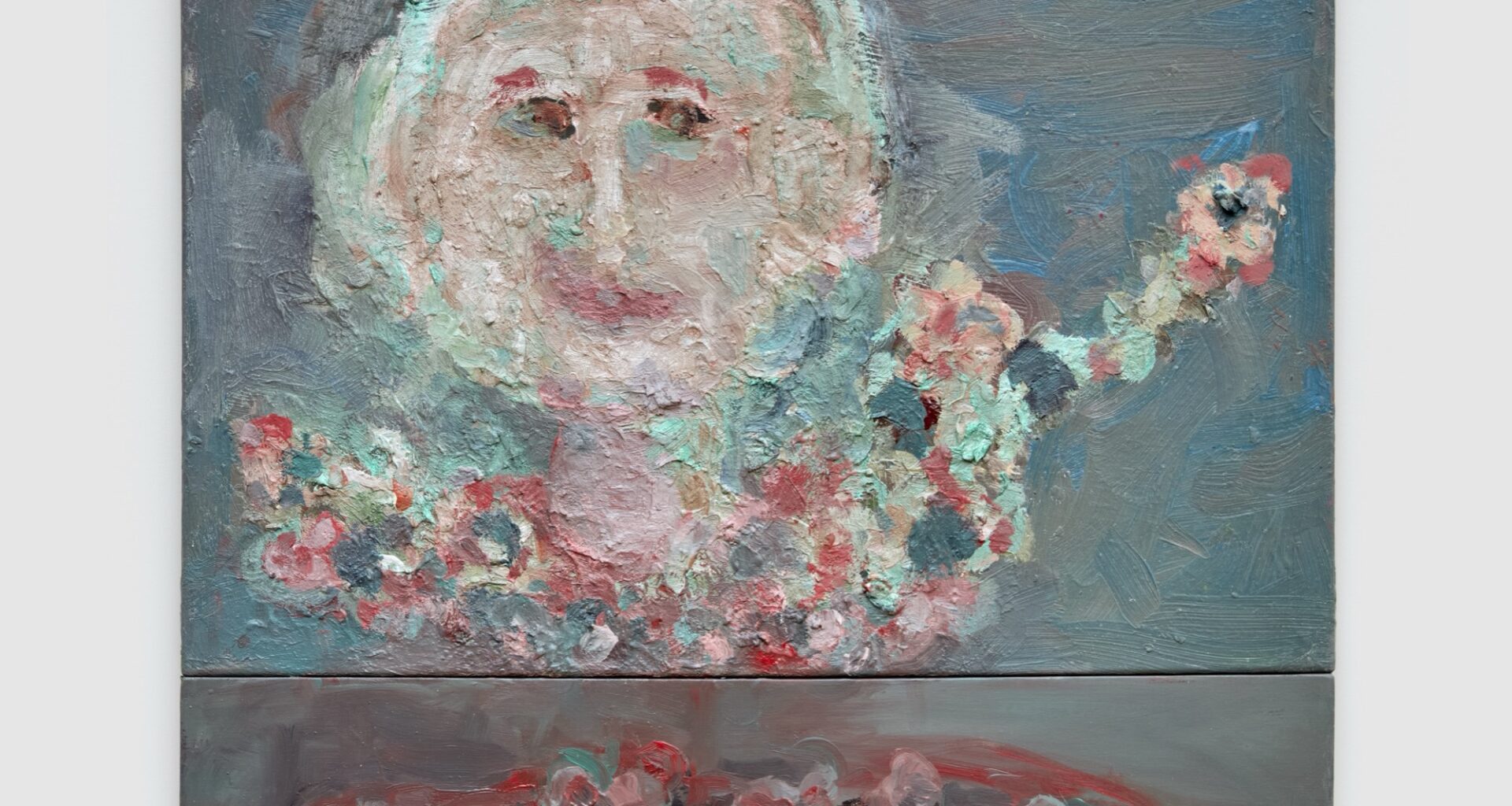
The Stationary Traveler
Galerie Sardine
May 15–July 18, 2026
New York
Touching on themes of beauty and vanity, pleasure and mortality, The Stationary Traveler is a selective survey of twenty-two paintings and two sculptures of modest scale by Farrell Brickhouse, now in the fifth decade of his career. Dating from 1997–2025, these works present moving testimony to his career-long pursuit of authenticity of expression, relatively small objects that jump scale in their absorptive power. As our attention is seized by odd situations and figures—acrobats, corpses, fallen kings—we lose ourselves completely in the time they take to fully decipher. His subjects rarely stand alone, but lean against one another in telling repetitions: seagoers afloat; disembodied legs; struggling pairs; offerings of bouquets or giant fish.
Brickhouse lays his oils on thick, his palette mostly penumbral but lit with shards of color, as if excavated. A precedent is set here in the 1997 abstraction Horizon, in which a maelstrom of Philip Guston-esque pink brushstrokes overtakes the surface, seeming to rise upward toward a shred of gray horizon as well as to flow outward at the viewer. The linen is mounted on an irregular wood panel support, giving it a wobbly effect. The surprising impression of this painting that is not terribly large (at 28 by 32 inches) is one of inundation. Brickhouse worked for a time as a deep-sea fisherman and, as in Horizon—along with other works like The Sparrows (2014) and Adrift, Ship of Fools (2020)—we feel the sea in more ways than one, beyond the depiction of figures in boats. The sense is of oceanic immersion, as we are set adrift in a medium that still feels viscous.
Brickhouse is a world builder. In Andre’s Poem (2024), an awkward figure in a cerulean ground sprinkled with glitter sits at left; at the right, angels and birds coalesce and dissolve in a pale gray sky. A whole dreamlike universe has materialized for this Andre, reminiscent of Henri Michaux’s visions. The exhibition’s title, The Stationary Traveler, is also that of one of its larger paintings (2012), predominantly red, in which a solitary figure levitates above a group of small, flower-like beings with leaves joined like hands. Glitter makes the work sparkle, as if lit by phosphorescence. The ambient paint comes to life, suggesting that fantastical beings can materialize anywhere. Sometimes the effect can be spooky, as in the nocturne Howl II (2024), in which a giant goblinlike face haunts an embracing couple.