
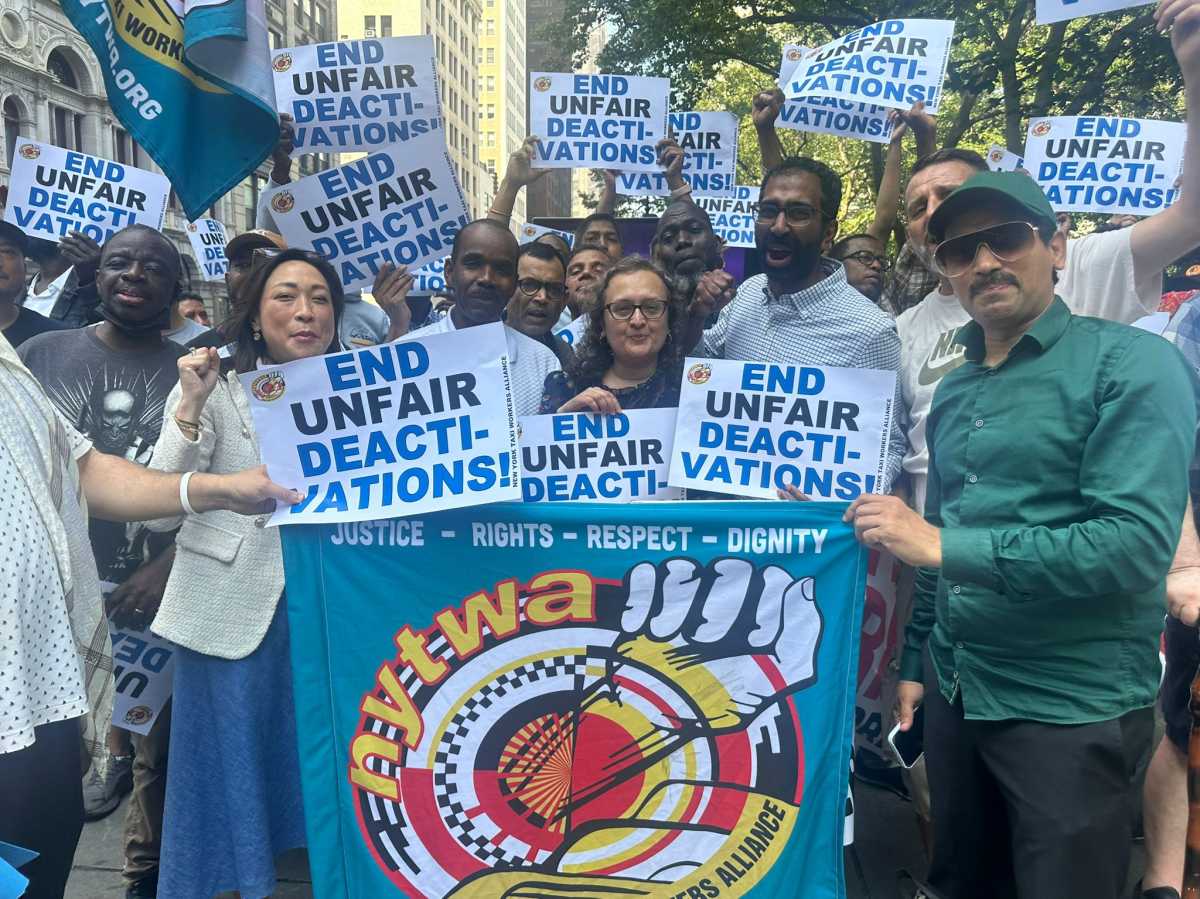
Drivers making a living off fares who argued a policy wasn’t fair for suspending their license after arrests, often downgraded or dropped, have prevailed after 20 years and obstacles along the road to judgment.
United States Second District Circuit Court of Appeals Judge Richard J. Sullivan, on June 30, approved an up to $140 million settlement for about 19,500, including cabbies, Uber, Lyft, black car, and other Taxi and Limousine Commission (TLC)-licensed drivers.
The class against New York City and the TLC includes drivers suspended based on arrests between June 28, 2003, and Feb. 18, 2020. The TLC has since modified its process. One-quarter of the settlement, or $35 million, would go to attorneys.
Judge Sullivan said the proposed settlement is believed to “be the largest due-process settlement ever reached by the City of New York” and “one of the largest due-process settlements in the nation.”
The $140 million settlement fund would pay out up to $36,000 per person, plus $15,000 for named plaintiffs.
“By any measure, this nearly 20-year lawsuit stands apart,” Judge Sullivan wrote before citing “the historic nature of the settlement.”
Daniel Ackman, a Manhattan lawyer in private practice who specializes in representing cabbies, filed the initial complaint in 2006.
“No lawsuit should be old enough to go to college. This one obviously is,” he said. “Because it took so long, the damages increased. The TLC kept doing what we said was illegal.”
Ackman said the TLC, for many years, suspended licenses “based on an arrest, not a conviction,” while denying “drivers fair post-suspension hearings.”
“We won the lawsuit a couple of years ago, had it certified as a class action, and attorneys reached a settlement with the City,” said Bhairavi Desai, executive director of Taxi Workers Alliance, a union for TLC drivers and an AFL-CIO affiliate, representing over 28,000 members. “It has been a long and slow road to victory.”
 A yellow NYC taxi van crosses the Brooklyn Bridge.Photo via Getty Images
A TLC spokesperson said the agency has long since ended the practice at the core of the suit, which alleged drivers were being deprived of their livelihood without fair hearings or appeals.
“We take the rights of our drivers and their fair treatment seriously,” the spokesperson said, adding the TLC in 2020 “amended the processes relevant to this case” in ways that “demonstrate the agency’s commitment to protecting the rights of taxi drivers.”
How lawsuit stopped an unconstitutional suspension practice
The case started when Jonathan Nnebe, a taxi driver since 1992 and Queens resident, became the initial named plaintiff. His license was suspended after two passengers who leaped out of his cab without paying filed charges.
Ackman said he knew others were in similar situations due to a process that punished drivers upon accusation, not adjudication, with no real appeal.
“We always believed it was a class action,” Ackman said. “We knew this wasn’t happening to a few people. This was a systemic thing.”
The attorneys argued that cab drivers unconstitutionally lost their license automatically upon arrest, with little to no chance of appeal.
“We had many drivers in this predicament. I remember thinking this is such a kangaroo court,” said Desai. “There was a feeling of presumed guilt.”
Attorney David Goldberg appeared in 2009 before the first appeal, and Boston-based Lichten & Liss-Riordan has been involved since 2019.
“We initially lost, and we appealed,” Desai continued. “The case was sent back down to the judge, and we eventually won.”
New York-based international law firm Fried, Frank, Harris, Shriver & Jacobson joined for the trial.
Law firms representing plaintiffs collectively would receive 25%, $35 million, less than 33% retainers 8,200 plaintiffs signed with a means of dividing to be determined.
“I didn’t think of quitting. Once you’re committed to a class action lawsuit, you have to see it through. I can’t tell you what our odds of winning were,” Ackman said. “I always thought we’d win eventually.”
Judge Sullivan wrote the case also entailed “novel legal questions that necessitated resolution by the Second Circuit on two separate occasions” and that damage trials would exceed the settlement and take roughly 1,600 business days or six years.
Based on an Aug. 13, 2025, fairness hearing, 533 who requested damages hearings would get $700 for suspensions up to 25 days, while 596 who requested hearings suspended for 391 days or longer would receive $36,000.
Another 201 suspended for 25 days or fewer who didn’t request damages hearings would get $262.50, while 178 suspended for 391 days or more who didn’t request hearings would receive $13,500.
“The amount each gets depends on how long their suspension was and whether they made a request for a hearing,” Ackman said.
New York City urged the Court to limit class counsel’s fees to 3.5 percent up to $4.9 million, although the judge said city attorneys noted proper fees should be $5 million to $7 million.
The judge cited time and labor, magnitude, complexity, risk, and quality of representation as well as the 33 percent retainer fee. “The Court finds that each factor favors the requested award,” the judge wrote.
“Prolonged litigation will only further delay recovery for plaintiffs,” the Judge continued, calling the amounts “fair, reasonable, and adequate.”
He said plaintiffs’ response “has been overwhelmingly positive” and that “percentage,” not “lodestar” or hourly method of paying attorneys, is more common.
Lodestar calculates a “presumptively reasonable fee” by multiplying the attorneys’ “reasonable hourly rate,” but he said the percentage “aligns with the overwhelming trend.”
“It’s not like winning the World Series, where it’s all of a sudden. It’s a process,” Ackman said. “No money has changed hands yet. We won’t know how much everybody gets until the claims period is over.”
The drivers’ union is happy, but waiting for funds to arrive for drivers whose meters have been running for decades.
“You can’t turn back time and make up for the losses that people suffered. We hope this will give them a semblance of a better future,” Desai said. “We will only breathe a sigh of relief once the checks are in the hands of the drivers.”