
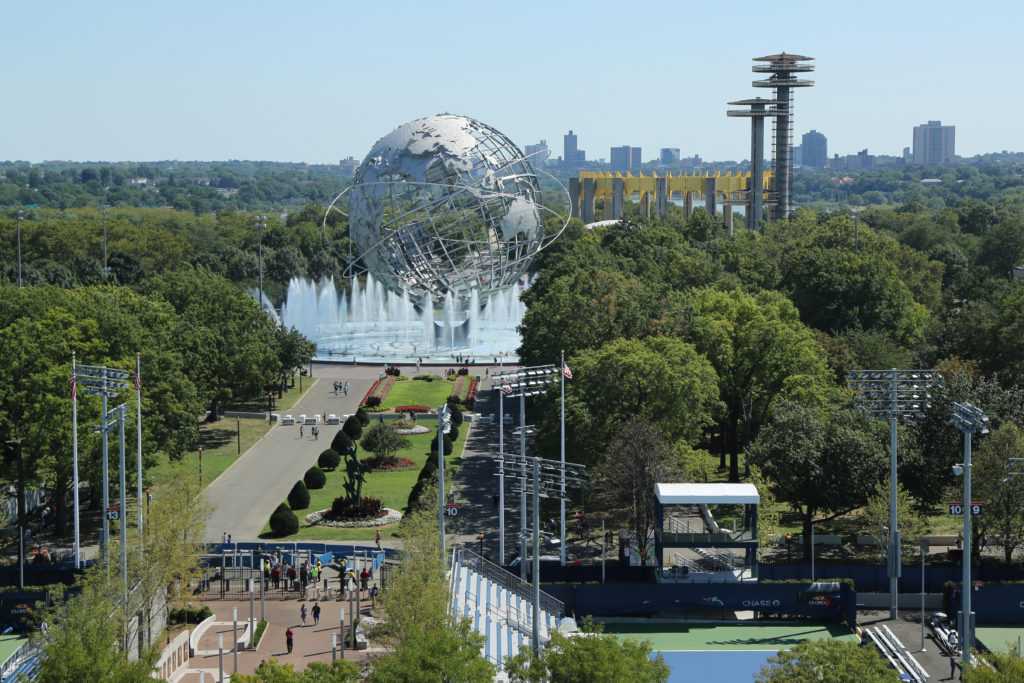
This summer, the eyes of the world are on The World’s Borough — with Flushing Meadows Corona Park specifically serving as a global center of sports and culture. Visitors from every corner of the planet have descended on Queens’ largest park, where the official FIFA World Cup Fan Zone has drawn thousands of cheering fans to the USTA Billie Jean King National Tennis Center. Next month, Flushing Meadows Corona Park will assume its annual role as the tennis capital of the world with the start of the US Open.
Throw in last month’s incredible three-day Governor’s Ball festival, drawing the music industry’s biggest acts and tens of thousands of their fans from across the world, and there is no more desirable place to be this summer than Flushing Meadows Corona Park.
We should be proud — after all, this is what the Park was built for. It stretches for almost 900 acres right in the heart of Queens and features tennis courts, ballfields, a pitch and putt golf course, playgrounds, swimming pools, gardens, ponds, trails, tracks and so much more. It was home to not one, but two World’s Fairs, with remnants like the Unisphere going on to become globally-recognized symbols of Queens and its values. And serves as the proud home of our hometown New York Mets, in addition to the US Open. Without a doubt, Flushing Meadows Corona Park has earned its nickname as “The World’s Park.”
And just as it belongs to the world during the grandest of global events, it belongs first and foremost to the people of Queens.
To the soccer players running up and down its pitches. To the runners and cyclists doing laps around Meadow Lake. To the families who come to enjoy the cherry blossoms in the spring and the foliage in the fall.
But is the World’s Park able to live up to that moniker?
Walk through it on a rainy day and you may find yourself ankle-deep in floodwater, thanks to decades of underfunded drainage upgrades. The Unisphere has struggled with mechanical issues that have recently kept its fountain dry. Nearby, the beloved Mist Garden, a lifeline on scorching summer days, is frequently out of service. Nearly everyone in the neighborhoods served by the park is all too familiar with the persistent service issues in the Aquatic Center’s HVAC system. And looming over all of it is the still-unfunded restoration of Philip Johnson’s magnificent New York State Pavilion, a landmark of postwar American architecture that slowly deteriorates while the city looks the other way.
Let’s be clear, disinvestment and disregard of this nature are policy choices. For generations, the City has turned its back on Flushing Meadows Corona Park. Despite its historic grandeur and continuing cultural impact, the park remains chronically underfunded. The deferred maintenance has piled up year after year and today it stands as a crisis hiding in plain sight.
To be sure, the park has benefited from extraordinary partners. That spirit of partnership was formalized in 2015 with the creation of the Alliance for Flushing Meadows Corona Park, which has united a range community-minded entities — ConEd, Delta, the USTA, the Queens Chamber of Commerce, and others — behind the single shared purpose of bolstering investment in the park and the communities it serves. The Alliance, which advocates and raises funds for the park, and leads programming and volunteer efforts, is a source of real hope, and we are proud of the important work it has done to help the park from sliding into an even more troubling level of disrepair.
But private partnership cannot substitute for public responsibility. By our estimation, the park requires an additional $15 million annually just to address deferred maintenance and meet its basic operational needs. Fully funding the park is not only about righting a historic wrong. It is also about recognizing what investment in this park would yield. As Queens’ population continues to grow, so does the need for its residents to have access to green space that is safe, accessible and vibrant. The park also anchors an ecosystem of major events that generate enormous economic activity for the borough and the city. Every dollar invested here returns multiples.
The most immediate step the City can take is straightforward. When it comes time to renew the Alliance for Flushing Meadows Corona Park’s maintenance and operations agreement with the Parks Department, they should iron out an agreement that ensures the park gets what it needs. That agreement — the formal instrument governing the Alliance’s relationship with the City — should include meaningful public funding commitments, a structure for sharing concessions revenue with the Alliance (as the Prospect Park Alliance and Central Park Conservancy have long enjoyed), and provisions that allow the Alliance to grow the sustainable funding streams this park so desperately needs. A modest ticket surcharge on major events, modeled on the North Brooklyn Parks Alliance’s successful “Under the K Bridge” concerts, is another mechanism that belongs in that conversation.
The agreement is, in other words, not just a bureaucratic formality. It represents an opportunity to reset the City’s relationship with one of its greatest parks and to put Flushing Meadows Corona Park on a sustainable financial footing for the first time in its history.
The world has come to Queens this summer. They are seeing our park at its most spectacular — the lights, the crowds, the electric atmosphere of elite competition. What they will not see, unless we act, is what happens the rest of the year: the flooding, the broken fountains, the shuttered amenities and the slow, painful decay of a park that has given so much and received so little in return.
Flushing Meadows Corona Park should welcome the world to New York City. Let’s make sure it remains worthy of the name.