
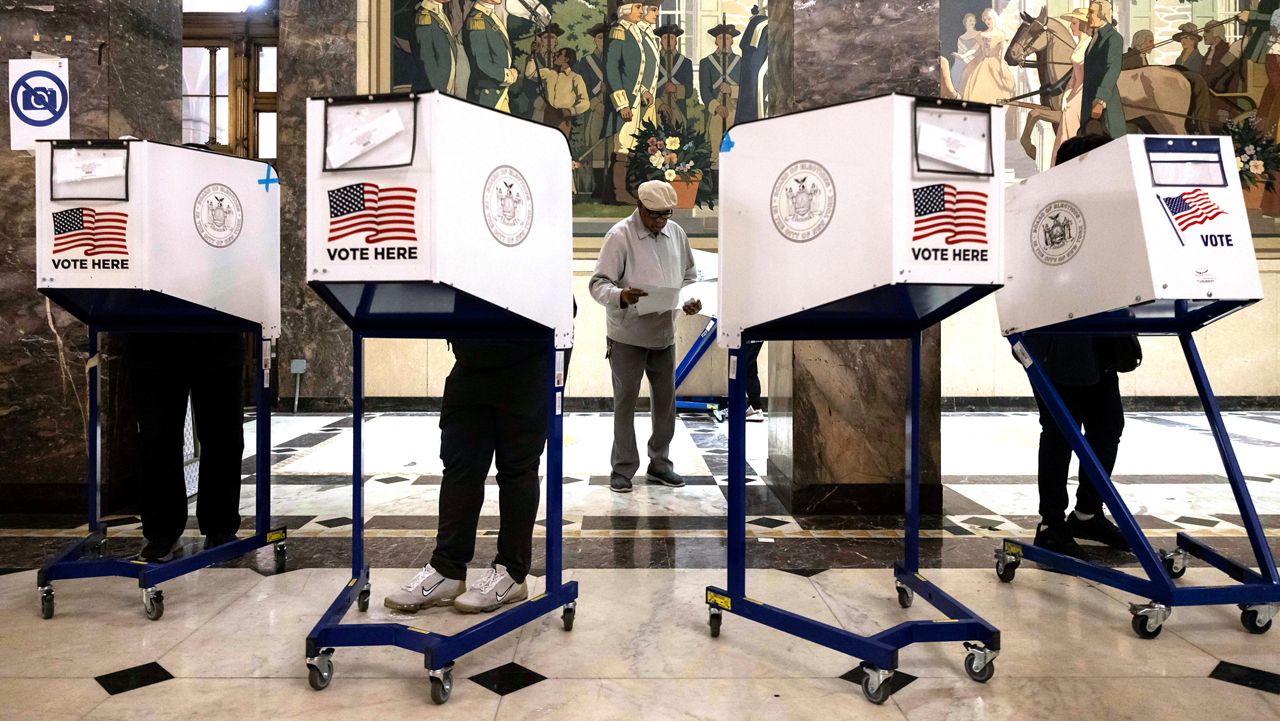
There’s a growing push in the state of New York to change the way elections are held in some cities.
Some advocates behind this movement say it will allow more people to take part in the voting process and have a greater say in who represents them.
“Our proposal is that there is one election where everyone is allowed to vote regardless of party, and voters will rank their candidates in order of preference,” said Charlotte Collett, co-chair of Ranked Choice Voting Albany. “Right now, there are about one-third of registered voters in Albany who are not allowed to vote in the Democratic primary. By the way, there’s only one primary and that’s from the Democratic Party because they’re unaffiliated.”
Ranked Choice Voting Albany wants to do away with primaries for city offices in favor of a single November election in New York’s capital city.
Ranked choice voting is a voting practice that allows voters to rank candidates in order of preference. Votes are distributed until one candidate earns more than 50%.
Members say this practice could allow more Black and brown voters to take part in the Democratic process.
“To us, this is really democracy one-on-one,” said Dorian Solot, co-chair of Ranked Choice Voting Albany. “Everybody should have the right to vote in the election that matters.”
Earlier this month, the group delivered 3,200 voter signatures to the Albany City Clerk’s office to push for a ballot initiative this November, but efforts fell short with city leaders.
The Capital District chapter of the Working Families Party expresses caution.
“We see this proposal as a way to really fundamentally and radically change the way Albany does elections,” said Secretary Andy Kaier.
Unite NY is not a part of the efforts in Albany.
However, in the city of Buffalo, the group has paired with the Western New York RCV Coalition to push for election reform proposals that include semi-open primaries, which would allow independent voters to vote in either the Republican or Democratic primary, ranked choice voting, and expanded ballot access on the November ballot.
But the Buffalo Charter Revision Commission voted Wednesday not to advance the proposals at the commission’s meeting.
“People support these reforms,” said Tim Hoefer, who is on the Board of Directors for Unite NY. “Having the opportunity to have voters learn about these and themselves is what the CRV should have done.”
According to Unite NY’s June 2026 polling that resulted from a petition that gathered nearly 500 signatures urging city leaders to put election reform on the agenda for Wednesday’s meeting:
80% of Buffalo voters support a ballot initiative to let voters decide whether to adopt election reforms
67% of Buffalo voters support open primaries
67% support reducing the number of signatures required for independent candidates to get on the ballot
50% of Buffalo voters support ranked choice voting
Prior to the meeting, the Working Families Party urged the Buffalo Charter Revision Commission to reject the open primaries proposal.
In a statement, its director Jasmine Gripper said in part:
“The NYWFP has been steadfast in its commitment to expanding participation and access to our democracy. Cycle after cycle, we are continuously focused on increasing voter turnout and engagement in our democratic elections. There is no evidence that open primaries are an electoral reform that will increase participation. Political parties provide valuable insight into candidate values and alignment to help inform voters. Political parties also allow unions, community organizations and civic groups to leverage their collective resources and shared interest to propel candidates to victory. The NYWFP strongly opposes open and semi-open primaries. We urge the City of Buffalo Charter Revision Commission to reject the proposal to allow open primaries.”
In New York City, ranked choice voting is used for primary and special elections in multiple races, including the mayor and city council races. This is after an amendment in the city charter that was approved by voters back in 2019.
Outside of the city, Newburgh moved to ranked choice voting after a lawsuit was filed alleging the town violated New York’s Voting Rights Act.
This was after the town elected all of its town board members to at-large seats which some argued could have diluted votes from the town’s 40% non-white population.