
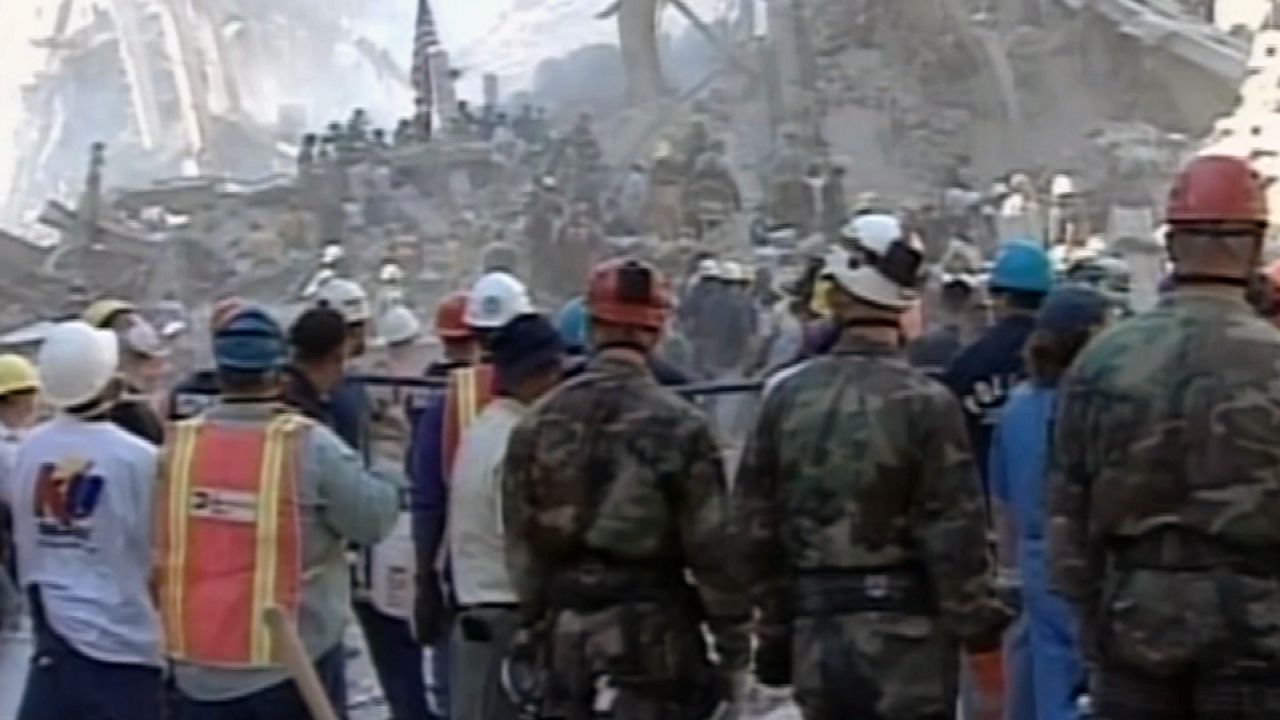
For years, a team of lawyers representing people whose loved ones died from 9/11-related illnesses has been trying to get to the bottom of this question: what exactly did the city know about the toxins in Lower Manhattan – and when?
In the nearly 25 years since Sept. 11, 2001, more people have died from 9/11-related illnesses than the 2,753 who died on the day of the attacks, according to the 9/11 Memorial and Museum.
For nearly three years, city agencies have claimed they have no relevant records about its investigation into the air quality in Lower Manhattan. That includes the Department of Environmental Protection.
The request for records included testing, the decision-making into reopening evacuated areas of Lower Manhattan and conversations about liability risk for the city, according to the initial Freedom of Information Law request.
The Department of Environmental Protection, which had a very public role in the response to the air quality concerns in Lower Manhattan, claimed it had no records for more than 18 months before that. The agency said it could find no records, despite conducting “a diligent search.”
In the end, that was not true. Sixty-eight boxes were turned over. And now, the city agency has divulged it has been withholding even more records, according to a filing from this week.
That admission is not the only development that has raised alarm to at least one lawyer NY1 showed court records to.
A city attorney admitted he claimed the Department of Environmental Protection had no 9/11 air quality records, despite not verifying if that was true, according to a transcript of a deposition taken last week.
Russell Pecunies said instead of doing his own investigation, he was told by another attorney to deny the appeal for the bevy of records requests.
In his 18 years as the person in charge of responding to denied Freedom of Information Law requests, Pecunies said it was the first time this has ever happened.
After Pecunies denied the FOIL request, the agency was sued in the state supreme court by Ben Chevat, the executive director of 9/11 Health Watch. He’s represented by Andy Carboy, who’s doing this job pro bono for a group of people who have suffered 9/11-related illnesses and people whose loved ones have passed away.
City lawyers initially called the lawsuit a “fishing expedition,” but reversed course months later.
State Supreme Court Justice James Clynes ruled the agency’s appeal denial was improper after the 68 boxes were located, calling Pecunies’ ruling “arbitrary and capricious.” He ordered two DEP officials to be deposed to get to the bottom of what happened.
On July 1, Carboy deposed Pecunies.
“Can you tell me how much time you spent, once you learned you were being asked to make a FOIL appeal determination on our request, from the moment you learned of it until the time you signed that letter, the one-page determination?” Carboy asked Pecunies.
“Including writing the letter, less than an hour,” he responded.
Pecunies said he would typically reach out to whoever conducted the document search before determining the outcome of the appeal.
Carboy’s appeal to Pecunies in February 2024 raised questions about DEP’s search.
“DEP failed to appropriately ‘certify that it does not have possession of such record or that such record cannot be found after diligent search.’ Instead, DEP offers a boilerplate response, devoid of detail concerning any search, and lacking certification,” Carboy wrote more than two years ago.
However, last week, Pecunies appeared to contradict what should happen in this kind of appeal.
“What circumstances would dictate that you email questions to the liaison or record searcher while you’re going about determining an appeal?” Carboy asked during the recorded deposition.
“Well, a circumstance would be if we had denied the appeal because we had said there were no responsive records. I would email them and generally would say, ‘They’re saying there must be responsive records, so can you do another search?’” explained Pecunies.
That did not happen in this case.
“What was the basis of your conclusion that a diligent search had been undertaken for the records that Petitioner requested?” asked Carboy.
“Advice of counsel,” said Pecunies.
The FOIL appeals officer said he never found out where the DEP searched for the records Carboy asked for, and the other DEP attorney telling him to respond there were no records was the only effort put into the denial.
The lawyer who told Pecunies to deny Carboy’s appeal was Musa Ali.
Ali was at the deposition. His current position is the head of the FOIL unit for the DEP, according to his LinkedIn page, which lists part of his job as providing “strategic legal guidance to senior management on…responding to Freedom of Information Law requests.”
NY1 asked DEP for a comment from Ali, asking specifically why he would tell Pecunies how to respond in this case. Additionally, NY1 asked if Ali knew there were documents that hadn’t been turned over.
Instead of offering any responses to its own employee’s deposition, DEP referred NY1 to the Law Department.
“It’s outrageous,” said Cory Morris, a New York lawyer who specializes in public records law.
NY1 has reached out to Morris, sending him court filings in this case for years, for his expertise.
“I’ve chalked this up to incompetency,” he said. “But after this one, I don’t know what to say.”
“There is no explanation other than either the person didn’t do their job or they’re concealing the records,” he added.
Now, city lawyers have admitted they have more records that they have not turned over.
“Following discussions between the parties regarding an appropriate method to review the records for responsiveness and produce non-exempt materials, Respondent conducted three in-office reviews on November 17, 2025, December 15, 2025 and March 27, 2026,” said Saarah Dhinsa, an associate corporation counsel for the city.
The three reviews yielded those boxes with hundreds of thousands of records inside.
In May, Justice Clynes said in his ruling ordering the deposition of Pecunies that the city contended “that relevant material has already been provided to (Carboy).”
Months ago, Carboy wondered whether the agency hadn’t turned everything over.
“If DEP withholds documents on the basis of a purported FOIL exception, will it alert Petitioner and prepare a privilege log or will it say nothing?” Carboy asked in a court filing from December 2025.
Carboy said the agency did the latter.
NY1 asked the DEP how many records are being withheld and when Carboy, if ever, was notified. An agency spokesperson said to contact the Law Department.
Out of the records that were turned over by DEP, most revolved around test results, according to Carboy. The files, some reviewed by NY1, showed the city requesting data from building owners months after Lower Manhattan had largely reopened. Some building owners responded that they had no idea they had to get testing.
Another document originated from the city Law Department during the Bloomberg administration.
“These original World Trade Center documents have been collected and scanned by the New York City Law Department. DO NOT DISPOSE OF THESE DOCUMENTS: they must be preserved to serve as evidence in the event future WTC-related legal actions are brought against the City,” the undated letter from a Law Department employee reads.
While found with records from the DEP, it’s addressed generally to “NYC Employee.” While the memo does not say which other agencies received it, Carboy said in court records it went to all of them.
Despite that memo, the city Law Department told Carboy its records are not organized in a way to review records about liability concerns in 2001, which Carboy requested.
In March, the Mayor’s Office also told Carboy it has no records about liability concerns in 2001.
But a month earlier, Carboy obtained a document from a library at the University of Texas that is from 2001, sent to Robert Harding, a then-deputy mayor under Rudy Giuliani.
The memo laid out potential liability the city could face in the wake of the attacks.
The letter, which the Mayor’s Office told Carboy it does not have, outlined that there could be as many as 35,000 claims filed against the city for a range of issues, including being allowed back into Lower Manhattan before it was safe.
The memo does not say the city knowingly did that, but the two-page document lists it as a possible reason for lawsuits.
After Carboy obtained this memo, lawyers for the Mayor’s Office said in court filings that most emails were not saved from employees who left before 2002.
“The Mayor’s Office searched all available records in the Enterprise Vault (EV) database (over 7,200 email accounts) and searched for physical records in possession of the Mayor’s Office at a storage facility on White Street,” according to a city letter from March to Carboy. “The EV database holds records dating back to 2002 with occasional records from prior years if the email account was active prior to 2002 and stayed active in 2002.”
The lack of records from the Mayor’s Office and Law Department has led to a lawsuit, similar to the one filed against DEP.
While this battle is occurring behind the scenes, publicly, Mayor Zohran Mamdani is saying all documents should be turned over on the matter of 9/11 air quality.
“New Yorkers who have become sick have had to fight for information that should have been theirs from the very beginning,” he said, announcing more than $34 million being dedicated in the budget to creating a public portal of 9/11 air quality documents from across all city agencies.
And yet that same day, lawyers representing Mamdani’s office asked a state Supreme Court justice to throw out Carboy’s lawsuit, claiming – as DEP once did as well – that diligent searches were conducted and no relevant records turned up.