
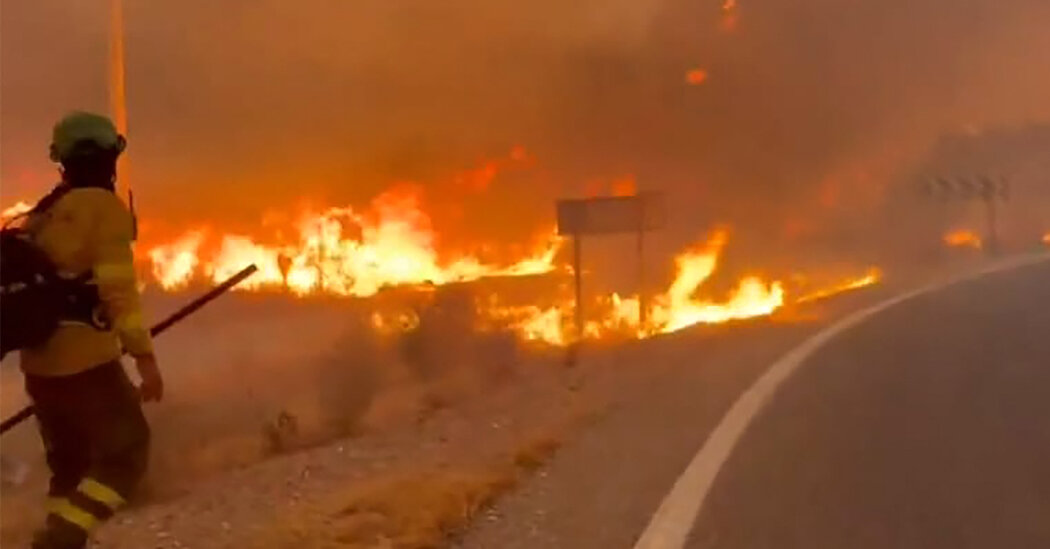
At least 12 people died and another 23 were missing on Friday after a wildfire tore through dry scrubland in southern Spain, making the blaze one of the deadliest on record in the country as Europe braces for a high-risk fire season fueled by scorching temperatures.
Nearly all of the confirmed victims were foreigners, including from Belgium and Britain, according to Juanma Moreno, the president of the region of Andalusia. Some of those who died had not followed orders to evacuate or to shelter in place once the flames got too close, he said at a news conference.
“It is an immense tragedy,” Mr. Moreno added.
Over 500 firefighters and civil protection workers battled the blaze, which broke out near the municipality of Los Gallardos, in Almería, on Thursday afternoon. The flames quickly coursed through the area, which is mountainous, rugged and popular with tourists.
“This is the first time we’ve faced a fire as devastating as this one,” Francisco Miguel Reyes, the mayor of Los Gallardos, told a Spanish radio station on Friday, adding, “It looks like a bomb went off” over the town.
Ángel Collado, the mayor of Bédar, a hamlet in the area of the fire, said at a news conference that officials had gone door to door urging residents to evacuate. One of the residents, who survived, refused to leave and advised a separate group of nine people to remain indoors as well, Mr. Collado said.
The group then fled along a route different than the evacuation path recommended by the authorities, and seven of them died, Mr. Collado added.
Mr. Moreno, the regional president, said that decision proved fatal. “Unfortunately, a number of residents did not heed these appeals,” he said. “Their failure to follow those recommendations is likely what led to the tragic loss of life.”
Four victims were found inside a right-hand drive vehicle and were believed to be British, Antonio Sanz, the health and emergencies minister in Andalusia, said on Friday. A further eight people were injured, he added.
The wildfire began when a power line broke, sparking what was initially a “low-intensity urban fire,” according to Mr. Moreno. But strong wind gusts of about 30 miles per hour drove the flames up the hillside, he said.
The fire had already burned about 740 acres, he added, noting that crews were struggling to contain the flames because of the dry weather, steep terrain and limited access for fire engines.
“This is a difficult and complex fire,” Mr. Moreno said. “Twenty-three people remain unaccounted-for. That does not mean they are dead; sometimes people have simply moved to other areas, so we need to be cautious.”
Víctor Fernández, a local priest, told a Spanish radio station, “It all happened very fast.”
He said he had gone to say Mass in a nearby town, “and you could see the smoke at 7 p.m., and when I came out at 9 p.m. you could already see the flames devouring the highway.”
“The afternoon was very dry, the wind was very strong, it was like hell,” he added.
Laurens Soenen, a spokesman for the Belgian Foreign Ministry, said in an email on Friday that a number of Belgians were still missing after the fire, but he could not specify how many.
Much of Europe has faced a series of searing heat waves this summer, and forecasters have warned that the relentless hot weather is creating an unprecedented danger of wildfires in some countries.
“We are experiencing an exceptionally intense start to the 2026 wildfire season,” Julien Marion, the head of France’s civil protection and crisis management agency, said at a news conference in Paris on Friday.
Rainfall in the winter and spring led to lush vegetation that has dried under successive heat waves and created an abundance of fuel for wildfires, Mr. Marion said. Over 8,000 fires have burned nearly 100 square miles so far this year in France, he added — roughly double the area at the same time last year.
A wildfire in the Pyrenees mountain range area of France, on the border with Spain, forced more than 10,000 people to evacuate from their homes, the authorities said on Monday.
Across southern Spain, evacuations have been ordered in several areas because of wildfires. Around 1,000 people had to leave their homes in the town of Benhavís in the Málaga region after a wildfire erupted on Thursday, the regional emergency service said.
Extensive analysis is needed to connect a single heat wave to climate change, but scientists have no doubt that these waves are becoming hotter, more frequent and longer lasting around the world. Europe is getting warmer faster than any other continent.
In Germany, a record-breaking heat wave at the end of June led to roughly 5,100 deaths, according to estimates published on Thursday by the Robert Koch Institute, the federal public health institute.
Christopher F. Schuetze contributed reporting from Berlin, Qasim Nauman from Seoul, Koba Ryckewaert from Brussels, and Aurelien Breeden from Paris.