
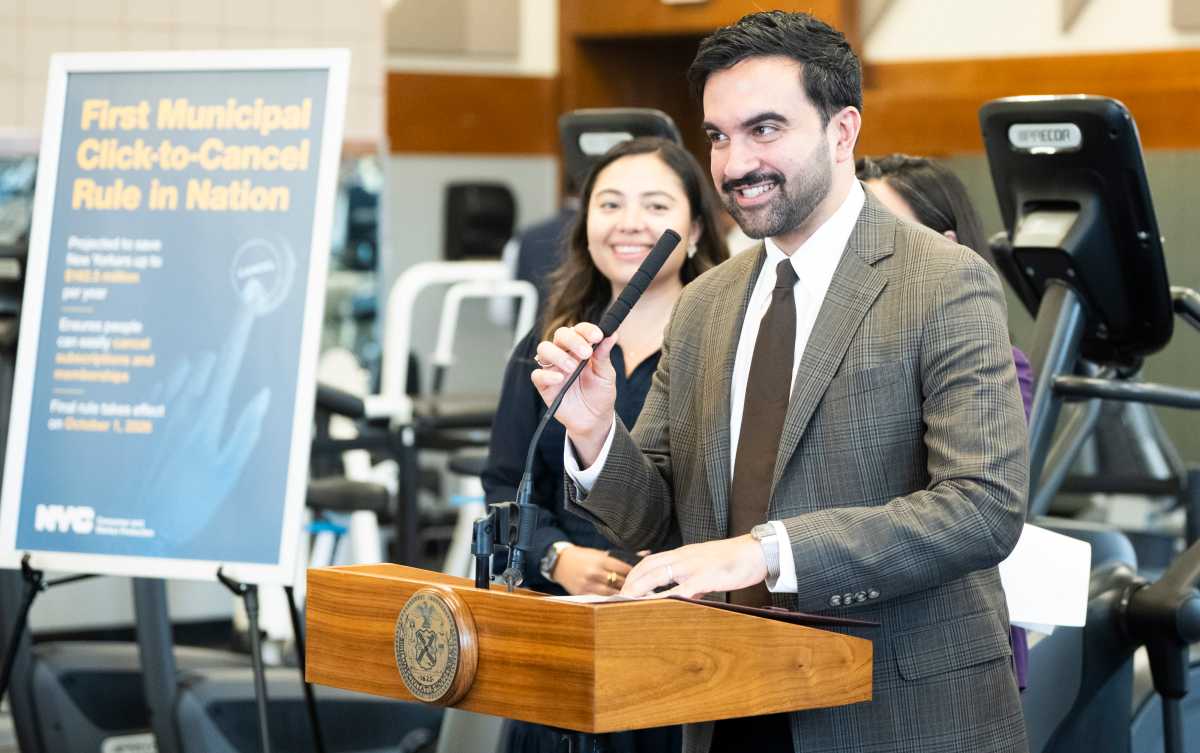
New Yorkers who sign up for gym memberships, streaming services, and other recurring subscriptions must soon be allowed by law to cancel them just as easily — and through the same method they used to enroll — under a new city rule taking effect Oct. 1.
The final “click-to-cancel” rule requires businesses to clearly disclose subscription terms and give customers a simple way to end automatic-renewal and continuous-service plans at any time, according to a notice of adoption published by the Department of Consumer and Worker Protection.
Someone who subscribes online must be able to cancel online. Businesses that accept sign-ups through multiple methods must offer cancellation through all of those methods, while companies that enroll customers in person must also provide an online option, such as a website or email.
“If a business can enroll you with one click, they can let you cancel with one click. It’s that simple,” DCWP Commissioner Sam Levine said at a Friday press conference held at a Manhattan recreation center. “No more free trials that secretly become monthly charges. No more cancellation pages buried beneath endless menus.”
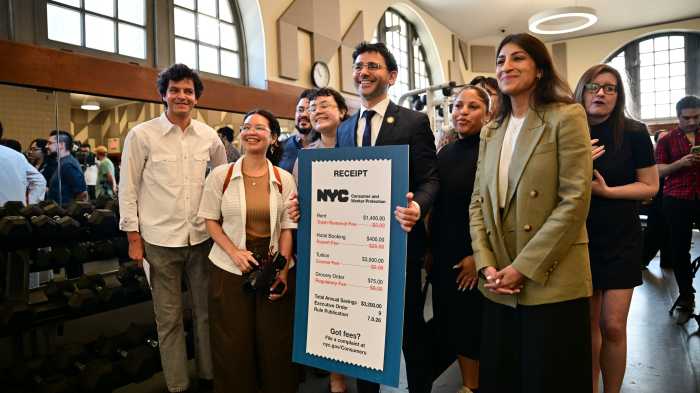 DCWP Commissioner Sam Levine and former Federal Trade Commission Chair Lina Khan attend the city’s “click-to-cancel” announcement at a recreation center on July 10Photo by Lloyd Mitchell
The rule prohibits companies from hanging up on customers who are trying to cancel, from obscuring or providing false cancellation instructions, from misrepresenting the cost or consequences of ending a subscription, or from unreasonably delaying a request.
Businesses may still offer discounts or other incentives to persuade a customer to stay, but those offers cannot obstruct or unreasonably delay the cancellation, according to the adopted rule.
Companies found to have violated the rule would be liable for amounts charged after a customer’s first attempt to cancel.
Civil penalties start at $525 for a first violation, rise to $1,050 for a second, and reach $3,500 for a third or subsequent violation, according to the City Record notice.
Mayor Zohran Mamdani framed the regulation at Friday’s press conference as part of his affordability agenda and a crackdown on businesses that profit from hidden costs and difficult cancellation processes.
“New Yorkers have enough to worry about without these kinds of hidden costs weighing on their minds,” Mamdani said. “No longer will our city be a playground for those who think they can make a quick buck on the backs of hiding this kind of information from New Yorkers.”
The city first proposed the rule in April and held a public hearing on May 8. DCWP said it received substantial comments from consumers, advocates and representatives of industries including streaming, telecommunications, broadband, health and fitness, newspapers and magazines.
Industry representatives argued that existing state law was sufficient and that adding a local rule could create confusion, according to DCWP’s summary of comments on the proposal. State law already requires businesses offering automatic-renewal subscriptions to provide a cancellation mechanism that is as easy to use as the method used for signing up.
DCWP said its rule is consistent with state law but contains expanded or amended provisions covering penalties, restitution and the methods businesses must make available for cancellation.
 DCWP Commissioner Sam Levine.Photo by Lloyd Mitchell
State Sen. Kristen Gonzalez said at Friday’s announcement that corporations had lobbied in Albany for a weaker version of click-to-cancel protections.
“While they were fighting us in Albany, this is proof that here in New York City, your mayor is fighting for you,” Gonzalez said.
How NYC’s click-to-cancel rules work
DCWP said it received more than 100 consumer complaints involving difficulty canceling subscriptions in 2025 alone. During the rulemaking process, one commenter said they had been forced to cancel a credit card to prevent a company from continuing to collect subscription payments, according to the adoption notice.
The regulation also imposes advance-notice requirements for certain renewals, free trials and price changes.
Customers with subscriptions initially lasting at least one year and automatically renewing for six months or longer must receive notice between 15 and 45 days before the cancellation deadline.
Businesses must notify customers of material changes, including price increases, between five business days and 30 days before they take effect. Free trials lasting longer than one month must come with a reminder between three and 21 days before the deadline to avoid the first charge.
Those notices must be sent through a method selected by the customer, including email, text message, an app notification or another channel offered by the business.
The rule also states that merchandise sent under an automatic-renewal or continuous-service agreement without a customer’s affirmative consent will be treated as an unconditional gift. The recipient would have no obligation to pay for or return it.
The protections include several exemptions. They do not apply to banks, credit unions, entities regulated by the state Department of Financial Services, licensed security-alarm operators and certain service-contract providers, among other categories.
Representatives of the wireless and telecommunications industries asked DCWP for an exemption, arguing that federal law and Federal Communications Commission oversight already provide extensive consumer protections. The agency rejected that request, saying the commenters did not identify a federal law or regulation imposing a click-to-cancel requirement.
Mamdani said the rule falls within DCWP’s authority because it concerns companies transacting with New York City residents.
The rule will take effect Oct. 1 to give companies time to bring their systems into compliance before DCWP begins enforcement, he said.
Levine said enforcement would begin with New Yorkers reporting businesses that fail to follow the new requirements.
Consumers can file complaints by calling 311 or visiting the city’s consumer website. DCWP would first try to mediate the complaint, recover money for the customer and ensure the subscription is canceled, Levine said.
“If we see a pattern … we will take that company to court,” he said.
Levine added that the city could seek repayment for affected consumers and a permanent injunction preventing the business from continuing the practice.
Mamdani said the administration wants to make compliance straightforward for businesses rather than issue penalties for their own sake.
“There’s no desire to be punitive for punitive sake,” he said. “There is a desire, however, to ensure that people are not being taken advantage of.”
City Hall said the Roosevelt Institute projected that the rule could save New Yorkers between $21.5 million and $162.5 million annually. DCWP’s adoption notice also cites an estimate of at least 600,000 hours in yearly time savings.
City Hall described the measure as the first municipal click-to-cancel rule in the country. At least nine states, including California, Massachusetts, Minnesota and Illinois, have enacted their own click-to-cancel requirements, according to DCWP.
Mamdani also announced a separate proposed rule on Friday that would require businesses to include unavoidable fees in advertised prices.
Under that proposal, mandatory service, processing or enrollment charges would generally have to be included in the advertised price rather than first disclosed at checkout. Taxes, government-imposed charges and postage or shipping costs reasonably and actually incurred to deliver physical goods could still be excluded from the advertised total.
The junk-fee measure is not yet final. DCWP is accepting public comments through Aug. 7 and will hold a public hearing that morning.
The rule follows an executive order that Mamdani signed four days after taking office, directing DCWP to prioritize enforcement against deceptive subscription practices and to consider new regulations targeting subscription traps. The separate junk-fee proposal stems from a companion executive order signed the same day.