
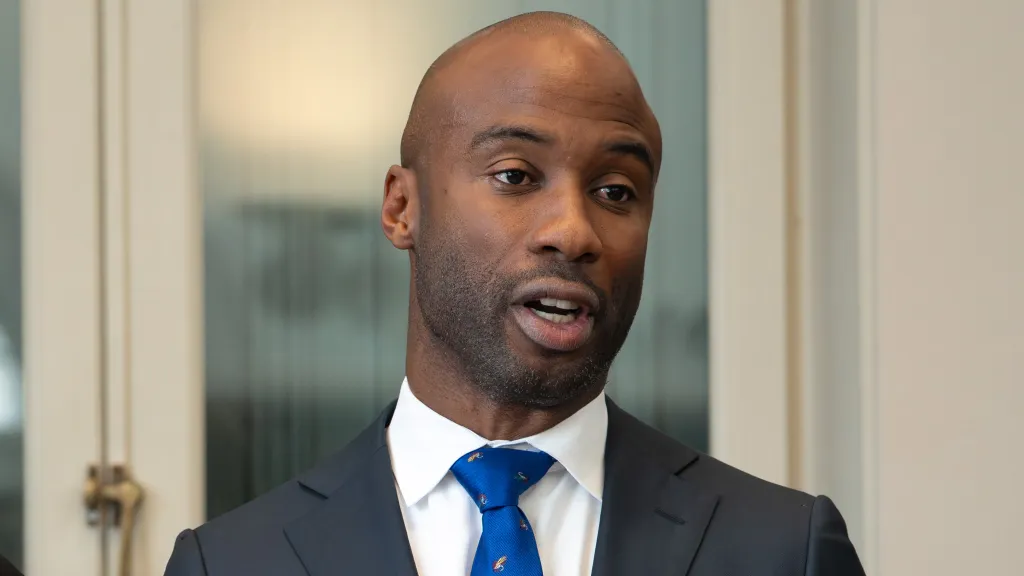
Charges of contract improprieties have put Kamar Samuels in danger of being New York City’s shortest serving schools chancellor since Cathie Black resigned after 95 days back in 2011.
For a longtime city educator who served as superintendent for two community school districts, Samuels’ public image and priorities remain murky.
He whiffed on the early issues of school mergers and artificial intelligence. Notably, these weren’t necessarily his chosen priorities but the vacuum in his agenda allowed those matters to choose him, rather than the other way around.
On the Upper West Side, a merger plan he shepherded as a district superintendent blew up when a planned middle school closure went off the rails amid parental opposition and racial disparities.
Later, a proposed AI-centric high school was abandoned when its selective admissions and core mission were questioned. Samuels himself admitted his administration “missed the mark” on initial AI guidance. His latest decision to maintain current funding levels for schools losing enrollment seems to be based more on inertia than budgetary responsibility.
Samuels’ difficulty building a public profile was further impeded by Mayor Mamdani’s sharing of the education spotlight with Gov. Hochul. Thus, this spring’s big state budget wins — expansion of pre-K opportunities, increased state school aid, and extension of the deadline on class size limits — are ascribed to others, not Samuels. The current questions over his handling of vendor contracts add to his woes.
If he survives the contract scandal, New York needs Samuels to establish a strong, positive public identity beyond the vagaries of his slick new aspirational report, purportedly the result of a monthslong listening tour. Multiple crises demand that he create a popular political base with concrete thoughtful solutions.
The schools’ most basic missions, students’ academic proficiency and meeting quality graduation standards, continue to show unacceptably low rates of achievement especially for Black and Latino students, students with disabilities, multilingual learners, and students in temporary housing. Interventions like targeted tutoring, after-school and summer programs, and school-based support services lag.
Mergers and AI remain citywide issues, requiring more than tepid attention to isolated situations. A third of students are chronically absent, calculated as missing 18 or more school days annually, with an untold number falling just short of that threshold.
Students with disabilities placed in private schools because the city lacks appropriate services costs taxpayers $1.2 billion annually but promises to fix the problem remain unfulfilled.
Those are just current needs. The class size deadline still looms with its future demands on teacher hiring and retention as well as new school construction. Major curricular and assessment reforms are needed to fulfill coming changes in state graduation requirements.
The chancellor says that school desegregation is a top priority but words alone are not enough, nor is off-loading the issue to individual districts whose very insularity discourages needed cross-district solutions. Similarly, though the mayor campaigned on ending kindergarten gifted and talented programs, Samuels has yet to take action.
Pressing issues regarding school bus performance and contracts, inequities in parent fundraising, cuts to federal funding, and paraprofessional pay must also be addressed.
Samuels still has time for a strong, passionate, clear, and workable agenda; an opportunity to craft a public identity to save his chancellorship. But the window is quickly closing.
Bloomfield is professor of leadership, law, and policy at Brooklyn College and The CUNY Graduate Center.