
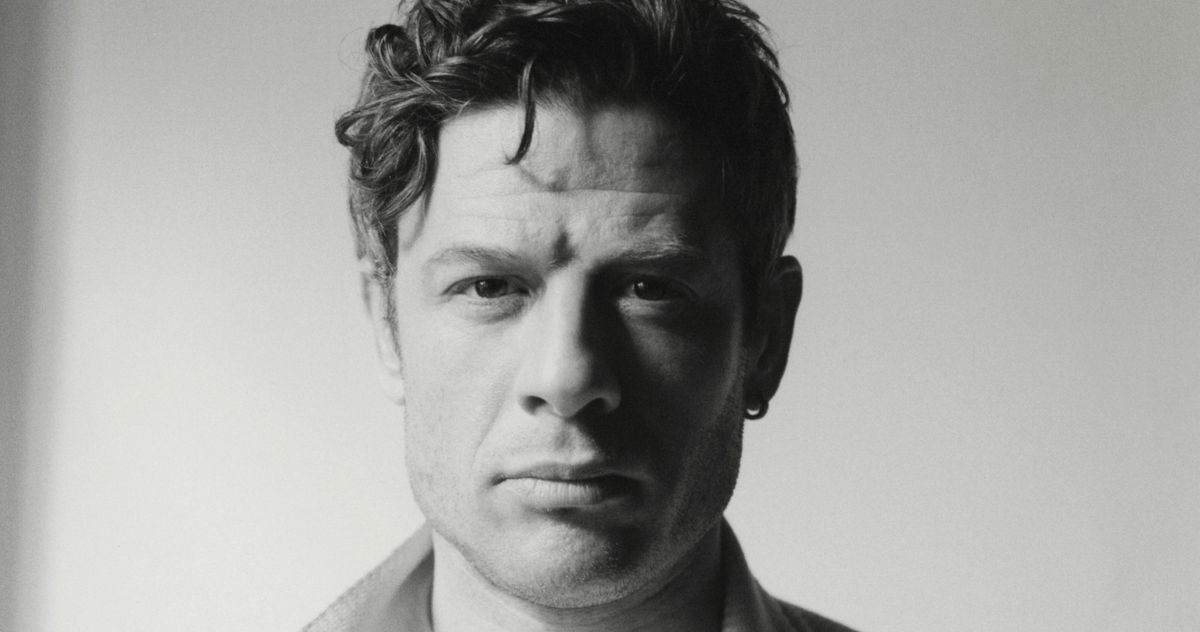
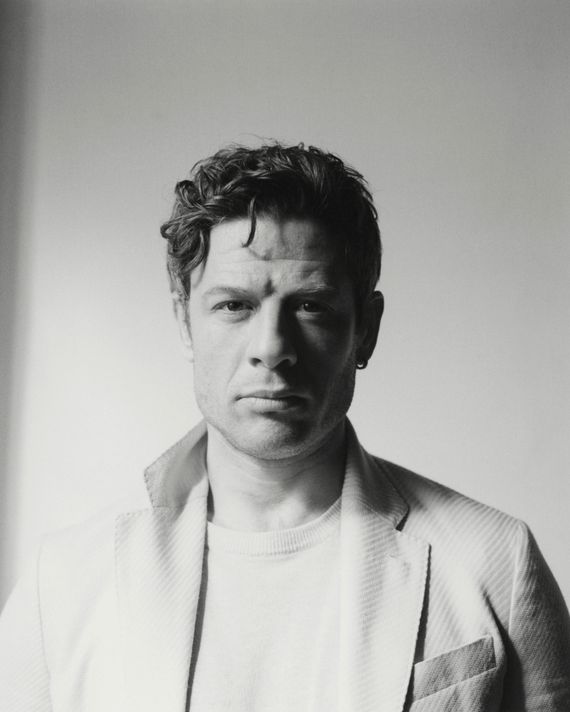
Photo: Valentin Hennequin
Manage cookie preferences
War is raging at the Warner Bros. lot in Leavesden, a suburb a short train ride from London best known as the place where families decamp for a day to see the Harry Potter film sets. But tucked away from the tourists, past a checkpoint that requires signing a pile of paperwork, you’ll find a rustic medieval village occupied by battling armies, partially set on fire, and — thanks to the intermittently spitting rain — slathered in mud. In the immense downtime between scenes during my visit this past September, the crew of HBO’s Game of Thrones prequel House of the Dragon trudges among plastic tents serving as makeshift production offices. In some, writers huddle under blankets in chairs watching playbacks of action sequences. In others, background actors adjust their chain mail and faux furs and clutch prop weapons, some of which are designed to explode and splatter blood on impact. And finally, in another tent, doing his best not to muss up his intricately engraved suit of armor, there’s James Norton, gleeful as a schoolboy about to hear the bell for recess.
If you’ve watched enough British television, Norton’s face is immediately familiar; his prominent square jaw has emerged over a stiff collar in many a period drama. He’s been a suitor in Little Women, a cad in The Nevers, and a tragic soldier in War and Peace. That jaw, sharpened to a knife’s edge, can also be lit from some angles to capture the menace of a psychopath, which he played to great acclaim in the brutal procedural Happy Valley, or the gusto of a brawler in a series like McMafia or House of Guinness. If you haven’t seen much of him before, you’ll still probably think, Wow, that’s a distinctly handsome and distinctly British man. Even while dressed in a full medieval getup, he is gently sipping a cup of tea and politely offering to share some of the snacks he keeps on hand to manage his blood sugar. (He was diagnosed with type 1 diabetes at 22.) When I decline, he offers a bracing shot of a ginger drink and jokes that you don’t get this kind of craft service working for the BBC. “It’s a very strange experience in these fights because you pump your body with adrenaline for 45 seconds of fake combat and then they call ‘cut,’” he says, comparing the experience to a high-octane version of playing with swords in your backyard as a kid. “And then, in between, there’s tea.”
Leaning against the wall nearby are several copies of a prop sword named Vigilance, a Valyrian steel blade that is the pride of Norton’s character, Ormund Hightower, who arrives to shake up the balance of power in the show’s propulsive third season. In George R.R. Martin’s book Fire & Blood, the dry historical record House of the Dragon is based on, Ormund is a crucial though not deeply described character who leads the armies of one faction, the Greens — who claim the throne of Westeros through the children of Ormund’s cousin Alicent (Olivia Cooke) — over the Blacks, who insist that Rhaenyra Targaryen (Emma D’Arcy) is the rightful queen. In plotting out the new season’s narrative, showrunner Ryan Condal decided to greatly expand Ormund’s prominence and sought out an actor who could add texture to a man who performs honor and dignity while operating according to his private Machiavellian agenda. “They could have easily made Ormund a competent, proud, honorable man,” Norton says, giving the impression that it wouldn’t have been a part he was particularly interested in. “Instead,” he says, lowering his voice to a whisper, “we’ve got this fucked-up, sort of S&M, masochistic guy.” The actor has a devious gleam in his eye, which remains when he soon puts down his tea, picks up Vigilance, tramps off into the rain, and wages battle once again.
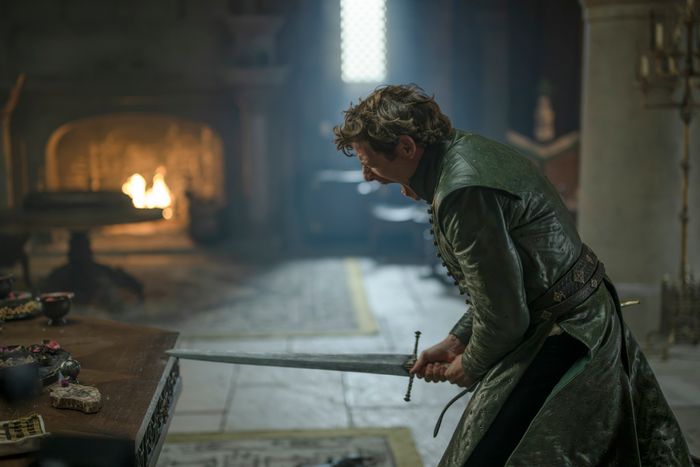
In House of the Dragon.
Photo: Kevin Baker/HBO
If you want to begin to understand the showy, self-tormenting psychology of Ormund Hightower, start with the pomander hanging on a chain from Norton’s armor. A small metal orb, the accessory was used in the Middle Ages to carry fragrant materials — this one is spritzed with lavender oil — and held up to the face to mask the era’s many horrid smells. Ormund is introduced in the third-season premiere issuing orders at his army’s encampment and then, with a put-upon air, closely sniffing his pomander as if offended by the whole dreary business. He’s a cold traditionalist, Norton suggests, who also has a few “ludicrous” impulses. Thus, the pomander. Thus, also, a certain wryness in his line deliveries. “One king is as good as another,” Ormund mutters to his attendants in the episode, after receiving news that there’s a new ruler in King’s Landing.
According to Condal, Norton’s arrival sets him up as a new “big bad,” though he’s careful to say this isn’t a universe with explicit heroes and villains; everyone involved in the civil war known as the Dance of the Dragons is pretty odious. This year, they’re also getting desperate, and more conniving, to end the conflict. After a season that was low on action and more tepidly received, the third starts at a sprint. Rhaenyra, queen of the Blacks, seizes the Iron Throne in King’s Landing with the support of Alicent, who has simply had enough of her unstable and terrible sons. The Greens appear to be in disarray, and Rhaenyra may hope this is the end of the bloodshed, but Ormund quickly becomes a new thorn in her side. When Rhaenyra demands he send over Alicent’s dragon-riding teen son, Daeron, who has served as his ward for most of his life, Ormund sends a decoy blond boy instead, keeping the real Daeron (who is secretly brunet and played by Benjamin Evan Ainsworth) by his side as a squire. With the help of the real Daeron’s dragon-riding abilities, Ormund plans to take the throne back for the Hightowers and rule through Daeron. Soon after Rhaenyra executes Otto Hightower, who was once mastermind of that family’s schemes, Ormund steps up to be the faction’s new heavy. Condal compares the new elder statesman of the Hightower family to Tywin Lannister, the power behind that family’s throne in Game of Thrones, played by renowned actor Charles Dance. “Dance brought that show to a new height and infused it with this sort of Shakespearean authority,” Condal says. (If Dance was chewing scenery, Condal says, it was “gourmet.”) The goal with Ormund was to find someone who could lend a similar energy to House of the Dragon. “His is the biggest role we’ve cast since the first season,” Condal says, “and we wanted someone with a name and a presence.”
As Norton tells it, he got here by straying from the expected career path of a British leading man. He studied at the Royal Academy of Dramatic Art and, before that, earned a degree in theology at Cambridge. He has worked steadily over the past two decades, his most memorable roles stretching beyond the realm of the typical period piece. In 2014, he started appearing in both Grantchester, a warm-as-a-cup-of-tea series in which he played a hunky, crime-solving vicar, and Happy Valley, a chilling drama in which his murderer character, Tommy Lee Royce, haunts a policewoman played by Sarah Lancashire. The latter got Norton a BAFTA nomination and gave him a calling card for his ability to probe twisted depths. “People talk about having ‘a face that has never seen an iPhone,’ which I am very pleased to have. It lets me be someone like Ormund,” Norton says. “But as I was starting out in my career, the BBC period drama was a massive thing, and I was afraid of just doing those.”
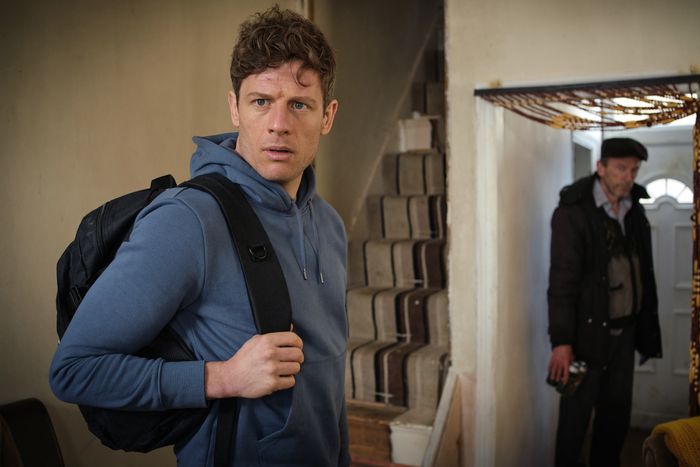
In Happy Valley in 2023.
Photo: Matt Squire/Lookout Point/AMC
Condal pursued Norton for the role both for his reputation — members of the House of the Dragon team kept mentioning Happy Valley to me with reverence — and because he knew he could trust him to calibrate the right level of ugly ambition without sacrificing a sense of the character’s internal conflict. In a scene in the fourth episode, Ormund emerges from his bath and issues orders to his attendants, a performance of cleanliness and rectitude that is also sexual intimidation — he’s doing so in front of a pair of nobles from the town he’s occupied, one of whom is a woman. Is Rhaenyra a queen, he muses, or “is she a bitch with a dragon?” “I cocked my hip in that take and thought, They’re never gonna use this,” Norton remembers, “And then I was in ADR and they used it and I thought, Fuck, good for you.”
The way Norton plays him, there’s always a threat of deviance simmering under Ormund’s behavior, particularly when he presents as a religious zealot. The Hightower family is closely connected with the worship of the Seven, the predominant faith of Westeros, and Ormund seems to be a model believer. Condal, referencing the archetype of a sneering Nazi apparatchik, suggests Ormund may be “racist against Targaryens,” who are technically foreign invaders. Ormund’s conviction is complicated by the fact that his most powerful asset, Daeron, is a Targaryen by lineage. Ormund needs Daeron but resents and even fears his potentially volatile nature, hoping he can somehow rein it in through a questionable paternal mentorship. In the writing, Condal imagined a “war for Daeron’s soul” as a major theme of the season. Norton describes it as a sort of love triangle between Ormund, Daeron, and his dragon, Tessarion, charged by both fatherly affection and, as Norton suggests, grooming (though, Condal clarifies, “not in a gross way”). “Ormund has as close as he is able to get to genuine love for Daeron,” Norton says, “but it’s often a sort of cat-and-mouse situation where he’s playing with him like an abusive father, overly controlling and coercive. He’s cruel, yet he loves him.”
On a soundstage in Leavesden, I watched Norton and Ainsworth work through the scene at the end of episode four in which Ormund lays out his plans for Daeron and Westeros. The two actors stand near a man in a latex bodysuit holding a giant dragon mask, a proxy for the eventual CGI Tessarion, while Norton mixes his character’s preening resolve with hints of his genuine fear of the creature. At one point, testing the tonal limits of the scene, they try a take where the dragon impulsively lunges toward Ormund and Norton trips and blusters into a pratfall. That’s a little too farcical for the moment, and the final cut lands more in a place of domineering intrigue. “Sometimes, you can push it to an extreme,” Norton says, “but they know what they’re making.”
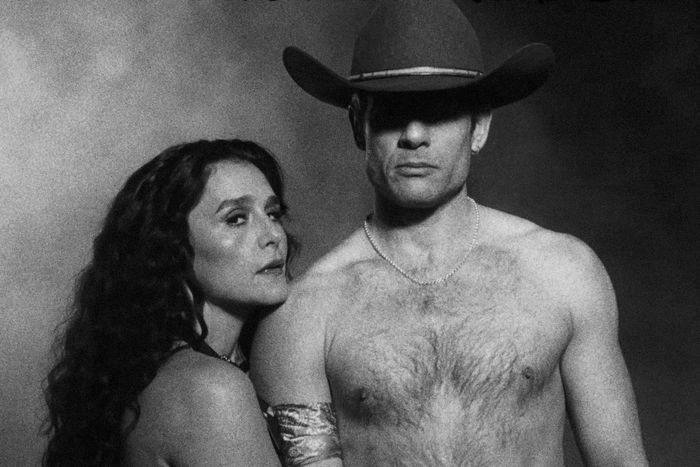
In Jessie Ware’s Ride music video as a cowboy who gets ridden.
Photo: Jessie Ware/YouTube
In April, months after he wrapped on House of the Dragon, I catch up with Norton. He’s in his plant-filled, sunbathed home in London enjoying a little downtime. His career hit a hot streak around his 40th birthday last summer, which Norton celebrated with a roughly 200-person party. He has started producing his own material, including the brutal, Thrones-adjacent medieval brawler King & Conqueror and the switched-at-birth realist drama Playing Nice, in which he plays a rather ordinary, gentle man. He showed up in a Jessie Ware music video as a cowboy who gets ridden. Now, he’s filming four Sam Mendes Beatles films at once, playing Brian Epstein, the “fifth” Beatle, who assembled and managed the group. Surrounded by a cast of rising British and Irish stars — Paul Mescal, Harris Dickinson, Barry Keoghan, Joseph Quinn — Norton can feel himself passing a torch. “I’m a bit older than them, and there have been moments where we as a group have been like, ‘That’s a bit meta,’” he says of playing the mentor to a crew of hotshot young talents. “Suddenly, I’m a more senior voice in the room.”
While Norton has avoided being pigeonholed, there is also the sense that to a wider audience — and especially to an American one — he hasn’t yet fully been exposed. He’s auditioned, in the past, for franchise projects but found the requirements a little baffling, at least in the case of Fifty Shades of Grey. “The casting director was like, ‘Okay, I just need you to be a little bit more charismatic,’ ” He says, “And I remember thinking, What the fuck does that mean?” Norton, throughout his career, was often mentioned on the shortlist of names who might be cast after Daniel Craig as the next James Bond. “Nearly every interview for ten years, I’ve been asked, ‘So … James Bond?’ ” Norton says. That was always just media speculation, he insists. But now, Amazon is reportedly looking to cast, specifically, a younger man as the next Bond, which would make Norton presumably too old for the part. When I spoke to him in late June, he seemed both relieved and a little wistful to put the era of Bond questions behind him. “Part of me is like, Wow, I’m getting old. Part of me is relieved because when I really spent time thinking about it, it would always have been a mixed bag. It’s an honor and it’s iconic and it’s a big cost,” he says. “Good luck to whoever young whippersnapper takes the role. I’ll be sitting there with my pipe and my book and my slippers.”
Chasing the particular, for Norton, has been rewarding. Onstage in London in 2023, he put himself through the grueling experience of starring in an adaptation of Hanya Yanagihara’s novel A Little Life, in which his character, Jude, suffers many forms of sexual abuse throughout a four-hour run time. Norton was deeply moved by audience members who spoke to him after, but he was also exhausted by the emotional and physical strain of the show. During the play, he would keep injections of insulin and packets of sugar onstage in order to prevent a hypoglycemic crash. “I did get through it,” Norton says, “but more than any other job, it left its mark.” (Not to be outdone, he will play Hamlet, for the radical German director Thomas Ostermeier, on the West End in 2027.) Norton is eternally keen to push himself to the brink and then discover whether he can go even further. He’s still anxious about how his big swings in House of the Dragon will be received, but mainly he’s curious whether his own experience of filming will be visible onscreen. “I’d love to know if you think that Ormund loves being Ormund as much as I loved being Ormund,” he says. “I don’t think he’s particularly happy, but there’s enjoyment to him. I wonder if that’s me having the time of my life as an actor or him.”
Production Credits
Photograph by
Valentin Hennequin
Styling by
Mitchell Belk
Wardrobe by
Lardini
Photo direction by
Amara Eno
Special thanks to
Port Magazine
Thank you for subscribing and supporting our journalism.
If you prefer to read in print, you can also find this article in the July 13, 2026, issue of
New York Magazine.
Want more stories like this one? Subscribe now
to support our journalism and get unlimited access to our coverage.
If you prefer to read in print, you can also find this article in the July 13, 2026, issue of
New York Magazine.