
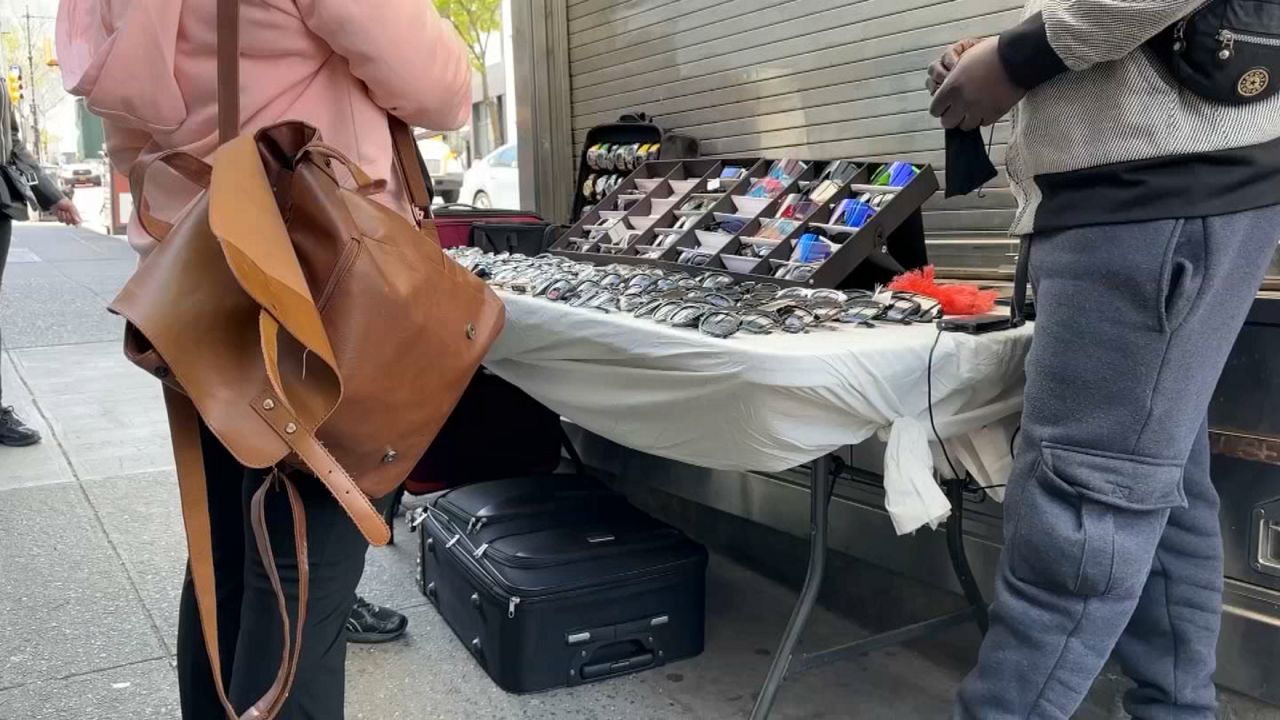
Canal Street is most known for street vendors selling knock-off luxury watches and handbags.
Chinatown was once the epicenter of the counterfeit market in the city, but now street vendors are selling in other boroughs as well, including in the Bronx.
What You Need To Know
Chinatown was once the epicenter of the counterfeit market in the city, but now street vendors are selling in other boroughs as well, including in the Bronx
Jamal, 27, says he came to the city two years ago from Senegal through the U.S.-Mexico border
He said that he is seeking asylum in the U.S. While Jamal has a work permit, he said he doesn’t speak English well and felt the only way he could make money was to sell counterfeit luxury goods
Susan Scafidi, who is a professor at Fordham Law School and the founder and director of the Fashion Law Institute, said she worries counterfeit sales drain billions of dollars from global fashion brands and the economy
Haggling is hardcore on Fordham Road in the Bronx.
“I have maybe $30, $25. I go home, pay, eat, go home,” said Jamal, who agreed to speak with NY1 on the condition that NY1 doesn’t disclose his last name because he knows he’s selling counterfeit luxury goods.
The NYPD also patrols the area.
The 27-year-old said the work is tough and the profit margin is low.
“Every day is possible. I have maybe two hours, three hours, I go home,” he said, referring to how long he usually stays out on the streets trying to sell his goods.
Jamal said he came to the city two years ago from Senegal through the U.S.-Mexico border.
He told NY1 that he was a fisherman and a political activist. He also applied for asylum, citing political persecution.
While Jamal has a work permit, he said he doesn’t speak English well and felt this is the only way he could make money. He added that other Senegalese immigrants got him started.
“We don’t have work. That’s why we are doing this. To survive. To pay our bills. To put food on the table. This is what we depend on,” he said through a Wolof translator.
Jamal said that what he makes is not enough to cover his rent, which is $600 for a room in the Bronx. So he also takes odd jobs.
“Sometimes [when] we are out here, [the] police will come and take our stuff. And then we have to go back, get more stuff, come out here and continue selling. We have responsibilities,” he said.
Between May and June, the NYPD seized more than 1,000 handbags from vendors on Canal Street near Broadway, including brands like Chanel, Gucci and Louis Vuitton.
The value of merchandise taken in after five operations. The NYPD said it was worth more than $100 million.
According to police, different precincts around the city conduct these raids based on the volume of 311 complaints in the neighborhoods.
Susan Scafidi, who is a professor at Fordham Law School and the founder and director of the Fashion Law Institute, said she worries counterfeit sales drain billions of dollars from global fashion brands and the economy.
“If you’re shopping for counterfeits, you’re probably not paying sales tax. And there might not have been appropriate tariffs paid as those things crossed the border since they shouldn’t have crossed the border in the first place. And most of them, the vast majority, are of course manufactured overseas,” she said. “Yes, the guy on the street corner who is just making a buck, and probably not very many of those. But the kingpins, the ones who are moving those containers, the ones who are manufacturing those products, and often it comes down to organized crime.”
Jamal said he knows the risks and worries about the police confiscating his goods and immigration authorities targeting migrant sellers.
But for many of them, selling is what they know because they did it back home in Senegal.
“There is no job. There is no work right now, and this is all [of] what we have. This is the only solution right now,” he said.
Jamal said he’s taking English classes and hopes to find a job with less risk and more income.
According to the U.S. Customs and Border Protection, nearly 90% of counterfeit goods seized in the U.S. come from China and Hong Kong.