
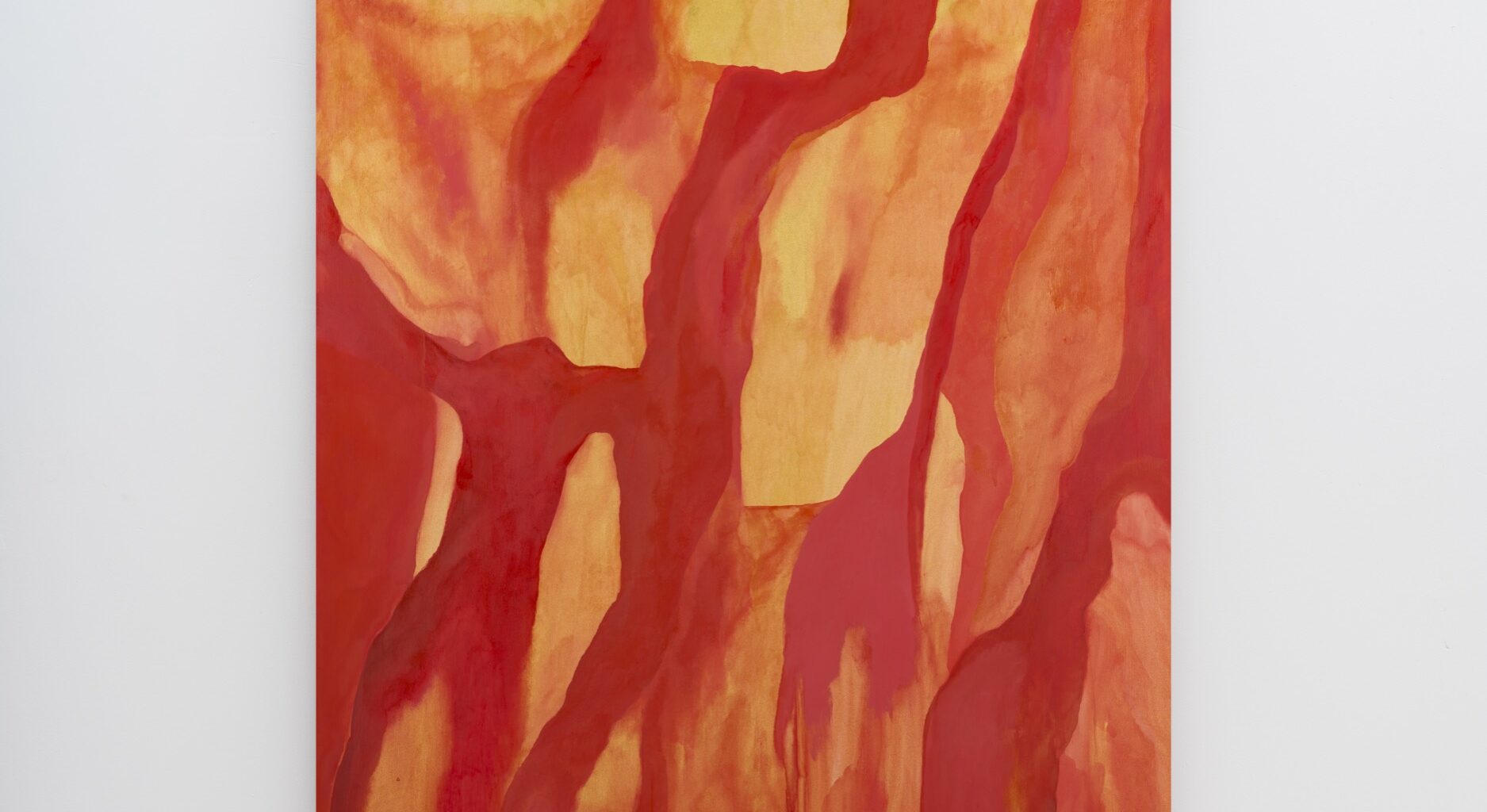
Encounter
Villa Magdalena
May 22 – July 22, 2026
Madrid
Lucy Mullican’s Encounter begins with ghosts from the past. Three framed found objects: a child’s shoe from the early 1800s, a photograph of an unknown woman in 1920s Glasgow, and a German decorative wall plate. Each carries its histories and silences. The instinct is to decipher, position, and contextualize. Yet, the harder you look for their stories, the more you realize you can only find your own.
Encountering these objects is a way to prepare for the artworks that follow. Mullican’s works play on our instinct to hunt for legibility, offering glimpses of a figure, a symbol, a name, yet never quite enough to reach a definitive understanding. You are left in a state of uncertainty, forced to let go. It is precisely within this condition that the work begins to reveal its full depth. By withholding a fixed narrative, it sustains a space in which multiple interpretations can coexist, drawing the viewer into a more personal and visceral experience. Within this framework, a review on this exhibition may seem contradictory, if not beside the point. My aim, then, is not to explain or resolve the work, but to offer a way of looking that shifts attention from the artist to the viewer—where the work becomes a site for recognition rather than explanation, and a means of encountering oneself.
It is no coincidence that the watercolors on paper in the exhibition function as a vocabulary, a lexicon of Mullican’s visual world. These small works on paper made with mineral pigments introduce a glossary of forms and motifs, including pockets and portals, strata and layered structures that recur throughout the paintings in shifting scales, colors, and configurations. Yet across the shifting imagery, one constant holds: the pair. Each work carries two forms in dialogue, at once in symbiosis and in tension, working with and against each other like a grammatical rule underlying the whole visual language. While they might initially read as preparatory, the watercolors’ relationship to the paintings is not one of hierarchy but of scale, unfolding through a reciprocal process of translation. Counterintuitively, it is the small drawings that offer the macro, almost aerial view of Mullican’s visual landscape, while the large paintings operate at the level of the micro, magnifying a single detail until it becomes its own territory.