
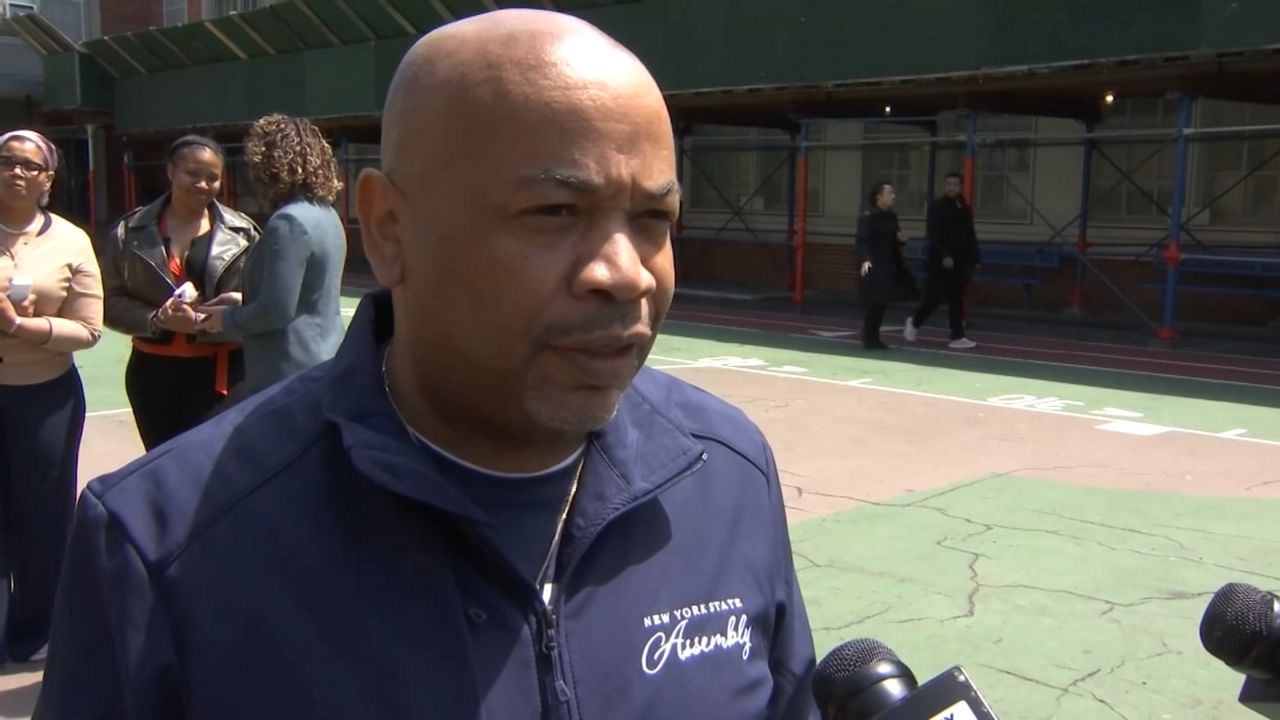
New York state Assembly Speaker Carl Heastie said Tuesday he is hopeful Gov. Kathy Hochul’s executive order placing a moratorium of up to one year on new large data centers does not signal that the state Legislature’s broader omnibus bill regulating the facilities is heading for a veto.
“We’re going to continue to look at getting a bill signed into law,” he said at an unrelated event in the Capital Region on Tuesday.
Hochul signed the executive order earlier in the day, establishing the first state-level moratorium on new data center development in the nation. It would apply to what the administration considers large data centers—those with the capability to consume 50 megawatts of energy or more. The order is more modest than the Legislature’s preferred one-year ban on centers using more than 20 megawatts, which also contained other provisions not included in the executive order.
Hochul stressed that while the process of reviewing the bill will take time, she wanted to take action now.
“We don’t believe there is a conflict between the innovation economy and our desire to just pause and make sure that as we lean into the future of how we power AI that we do it right,” she said. “We wanted to make sure we didn’t touch the data centers that are powering hospitals, schools and research centers, and this was kind of a delineation, even research centers, even bank back-office operations.”
Heastie indicated that interactions he has had with the governor since he became aware that the executive order was coming did not indicate the move means Hochul will not sign the bill, and he is “very pleased” that Hochul is addressing the issue.
“In my exchanges with her, this is not by any means mean that she’s looking to veto the bill, she said she absolutely wants to continue to talk about it,” he said.
Hochul often does not make a decision on significant legislation until the end of the year. Heastie acknowledged that if the governor pursues chapter amendments, as is frequently the case for complex legislation, the Legislature would not be able to pass those amendments until January.
Members of Hochul’s team have said the executive order doesn’t spell doom for the omnibus bill, and while the governor reminded reporters that she doesn’t speak publicly on deliberations over pending legislation, she wants time to consider the bill while establishing a path to act on the data center issue in the meantime.
“What I had to do was take bold, dramatic action to use the tools available to me and make a decision I think will benefit New Yorkers, certainly we are still looking at the legislation,” she said, stressing the need to determine whether provisions are “doable.” “As that process unfolds with that and other bills, I want to make sure we get ahead of this right now,” she said.
Hochul declined to predict if signing the bill in any form would result in changes to the executive order.
Republican Assemblyman Scott Gray told Spectrum News 1 that generally, he feels that a moratorium is a negative for attracting developers to the state.
“If you use that language, it has a chilling effect on developers,” he said, but added that he hopes the executive order is an indication Hochul plans to give the bill passed by the Legislature a thumbs down. “This kind of clears a path to clear out some of the egregious language in the omnibus bill that we passed, mainly the 90 percent renewable requirement.”
While several tech groups condemned Hochul’s executive order, environmental groups seemed to see it as a step in the right direction, even if they support the broader provisions in the omnibus bill.
“We’re going to have to keep a close eye on how this is implemented and there are a number of next steps that we’re going to be looking at coming out of this executive order, and New Yorkers are going to be watching but this serves a really important need,” said Liz Moran, New York policy advocate for Earthjustice