
All I thought / I loved
Casey Kaplan
May 14–July 24, 2026
New York
What defines a landscape? Is it its location and, therefore, the border that confines it to a single place? Is it the people or things it carries? Is it the sensory experience it enables? Is it the histories it evokes? Is it the future it promises? In Kevin Beasley’s solo exhibition, All I thought / I loved, at Casey Kaplan, he responds to these inquiries through a new body of work, marked by his inaugural turn to art history’s famed protagonist: paint on canvas.
The exhibition opens, though, not with paint, but with three small vistas in Beasley’s established medium: raw cotton and dyed resin. From these small slab reliefs, we witness the process through which Beasley typically builds his compositions. First, in a mold placed on his studio floor, he sketches the foreground: a loose landscape drawn with a thin Sharpie. Layers of dyed resin and raw cotton are then laid upon this image, creating an ambient background that adds color and texture to form.
Through the inclusion of cotton, these vistas reference America’s enslavement of Black people—specifically, Southern labor on plantations. Slavery did not merely accompany the nation’s rise: it generated it, holding an entire people as property and converting their forced labor into the wealth that crowned “King Cotton.” But this history is neither only economic, nor sealed in the past. Its afterlife persists, shaping how Black Americans inhabit and lay claim to land or, as Beasley puts it, “a contested site of belonging.”
Cotton holds a layer of personal significance for the artist; it was on his own family’s property in Valentines, Virginia, that he first encountered the crop, on land leased to local farmers. In response to that experience, and to the larger histories of slavery it evokes, Beasley’s vistas refuse the consolation of distance—the societal habit of fixing slavery at the safe, far end of a timeline that runs from then to now. Instead, cotton is present, serving as a witness to trauma that literally structures the landscapes in which Beasley resides and that he renders.
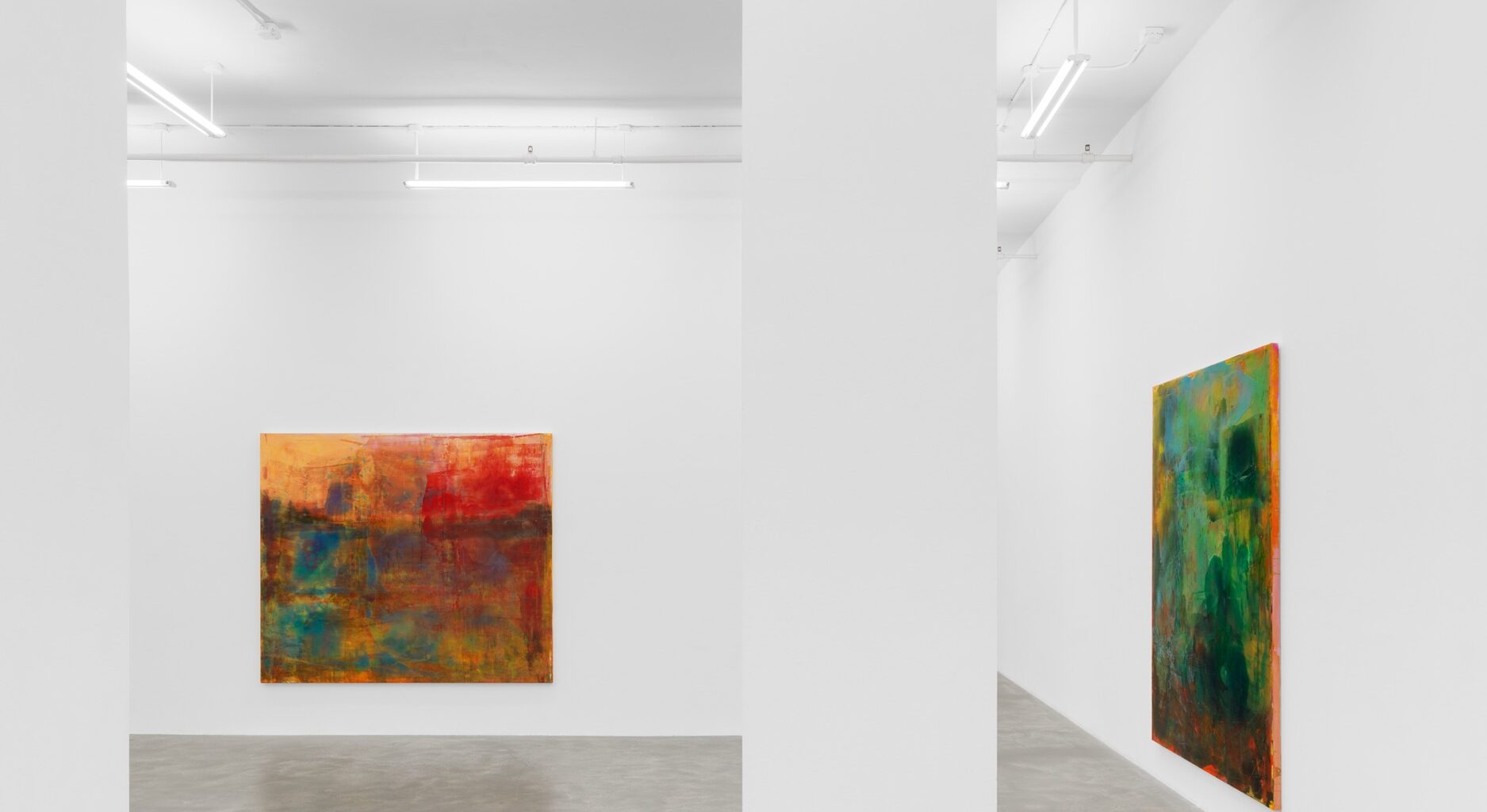
In Beasley’s new body of work, cotton re-appears in the disguised form of stretched canvases. Upon these surfaces, the artist uses acrylic to paint landscapes pulled from his memory: visual fragments from his family’s land and passing views on road trips through the Blue Ridge Mountains, among other places. However, by layering dyed resin upon the canvases’ surfaces, Beasley obscures these compositions. In a nod to Jack Whitten, the artist drags a plastic wedge across the quick-drying substance, blurring it.
Lacking an immediately tangible form, these large-scale canvases force a viewer to dig within their surfaces in search of grounding. Some works facilitate this more easily than others: in Down the land without a home (2026), my eye holds onto an obscured horizon line, quietly creeping across the canvas, accompanied by a murky scattering of what appear to be trees. And yet, without concentrated focus, this scenery falls out of consciousness entirely; foreground and background oscillate. Glossy and reflective, the milky resin glimmers as I lean in closer, attempting to grasp a landscape that has been intentionally obscured from me.
On Lake Gaston (2026) pushes even deeper into the realm of abstraction. The largely blue canvas does not explicitly trace the boundaries of a lake. Instead, it simply presents an expanse of color, defined by marginal shifts between warm and cool hues. Nonetheless, this surface—glassy and rippled—evokes the sensation of a cool body of deep water.