
Rothko in Florence
Palazzo Strozzi, San Marco Museum, Laurentian Library
March 14–August 23, 2026
Florence
It seems ironic that the works of an artist who was so concerned with the hanging and reception of his paintings have ended up, more than once, in display contexts that were less than ideal. Were Mark Rothko’s efforts to protect his paintings in vain or even counterproductive? A show now on view in Florence honors the American Abstract Expressionist painter and brings forward the importance of the architectural setting as an integral part of the work. A Rothko is not just about color; it is about a spatial setting that either allows the painting to open up or denies the possibility.
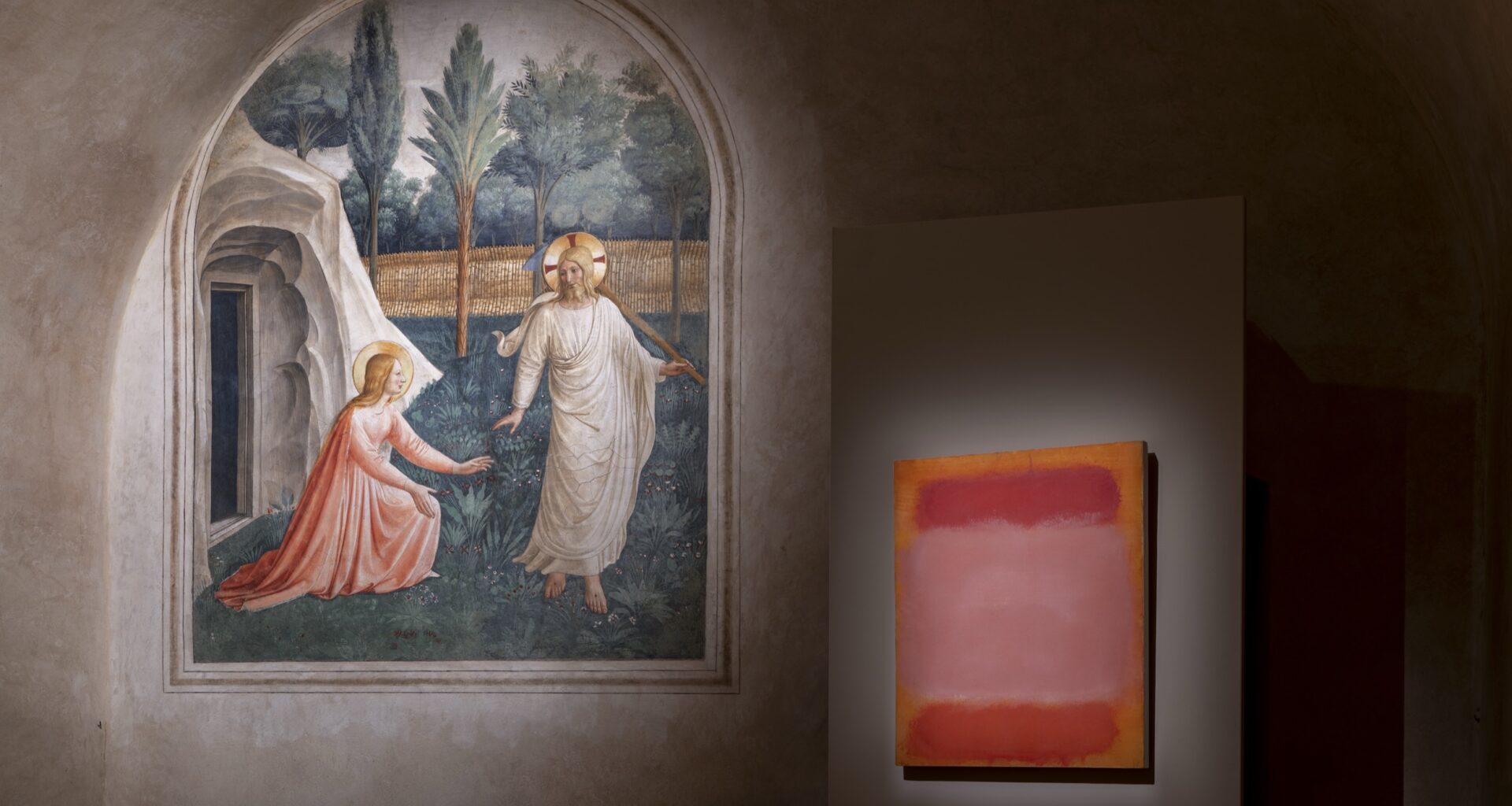
It started with the San Marco Museum and the Laurentian Library, Christopher Rothko explained. Co-curator of the exhibition Rothko in Florence, he is also the son of the artist and manages the Rothko estate with his sister, Kate. Italy had long been on their wish list as a place to stage a show, as the country was so important to their father. Born in 1903 in Russia (in what is now Daugavpils, Latvia), Rothko migrated to the United States when he was ten, but his European roots remained important. Italy was particularly crucial as a source of artistic influences and due to the attraction of the Renaissance as a period of high artistic achievement—something that Rothko longed for. Even if he was a reluctant traveler, he made trips to Italy in 1950, 1959, and 1966, and one of the highlights for him was seeing the work of Fra Angelico and its placement in the Convent of San Marco in Florence. Each monk’s cell features one wall painting and one small window, offering a setting for solitary retreat and contemplation. As part of the current exhibition, five small Rothkos now hang in the convent, one in each of five cells, next to the work of Fra Angelico. Two additional works can be found in the vestibule of the Laurentian Library, designed by Michelangelo, which had impressed Rothko as a confined architectural space. It would serve years later as inspiration for the “Seagram Murals.” The main body of Rothko in Florence is displayed in the fifteenth-century Palazzo Strozzi.
For an understanding of Rothko’s thinking, the two side venues are instructive. Yet as places to truly enjoy his paintings they are not necessarily the best, as there is little space to move and reflect. I wonder if Rothko himself would have agreed to be paired with Fra Angelico, or would have liked to see his work in a vestibule designed by Michelangelo. Out of respect for the old masters (or from self-doubt), he might have not agreed. Throughout the course of the exhibition, the questions that preoccupied the artist keep returning: What are the best viewing conditions for these works? What circumstances does a painting need to come to life? In the main venue, the Palazzo Strozzi, Rothko’s work definitely comes alive, and the conditions are excellent, with high ceilings and windows that are mostly above head level, allowing filtered daylight to fill the space. As a result, the world outside—the architecture of Florence—appears simply as a pleasant background. The palazzo also gives noble wall-, air-, and floor-space to the large paintings. The selection of works is compelling and balanced, and the combinations of paintings are thoughtful, coloring each room with a different mood and making clear how widely Rothko’s work ranged in terms of the psychology and atmosphere that can be collected in a painting.
The exhibition is laid out as a long chain of rooms that presents Rothko’s mature works from the 1950s to end of the 1960s, often composed of two or three fields of layered color that interact in the viewer’s perception. Perpendicular to each end of the axis, there are two rooms for early works and two for late works. Following Rothko’s path from hesitant figuration to his classic abstract style, you wonder at the end why he ever left that path. In the last big paintings from 1969, the canvas is divided horizontally into only two parts, a black above a grey, which suggests the feeling of a landscape, deserted, moonlike. What is strange in these final works are the hard edges—very unlike Rothko. There is no dynamic play between the color fields as in his other works. Was this a response to the more hard-edged Minimalism coming up in those years and pushing away interest in romantic abstract painting? Was it a sense that his end was near, as an individual and as a painter?
Only a decade before his suicide in 1970, things were going quite well for Rothko. He received two commissions for multiple paintings each, first for a restaurant in the Seagram Building in New York, then for a dining room at Harvard University. Rothko was able to make ensembles of works that together would set the tone for a whole space. And this is exactly what he wanted: the opportunity to bring a large number of paintings into a room to create what in contemporary curatorial jargon would be called an “immersive experience.” Yet in both commissions, the rooms would be used for dining, and this came with practical concerns, requiring Rothko to hang works higher than the step-in height he preferred. In the case of the Harvard commission, the works were actually damaged during events that took place in the room over the years. The Seagram project was never ultimately installed because Rothko withdrew, so the works went elsewhere. Yet both series are among Rothko’s greatest paintings, and this is one takeaway from the exhibition in Florence, even though just a small selection can be seen in the show. Studies for both projects are presented, excellent works in themselves that surprisingly work on a small scale, too. As for the motifs in these series, they are slightly different from the signature Rothko color bands, using verticals that echo an architectural context.