
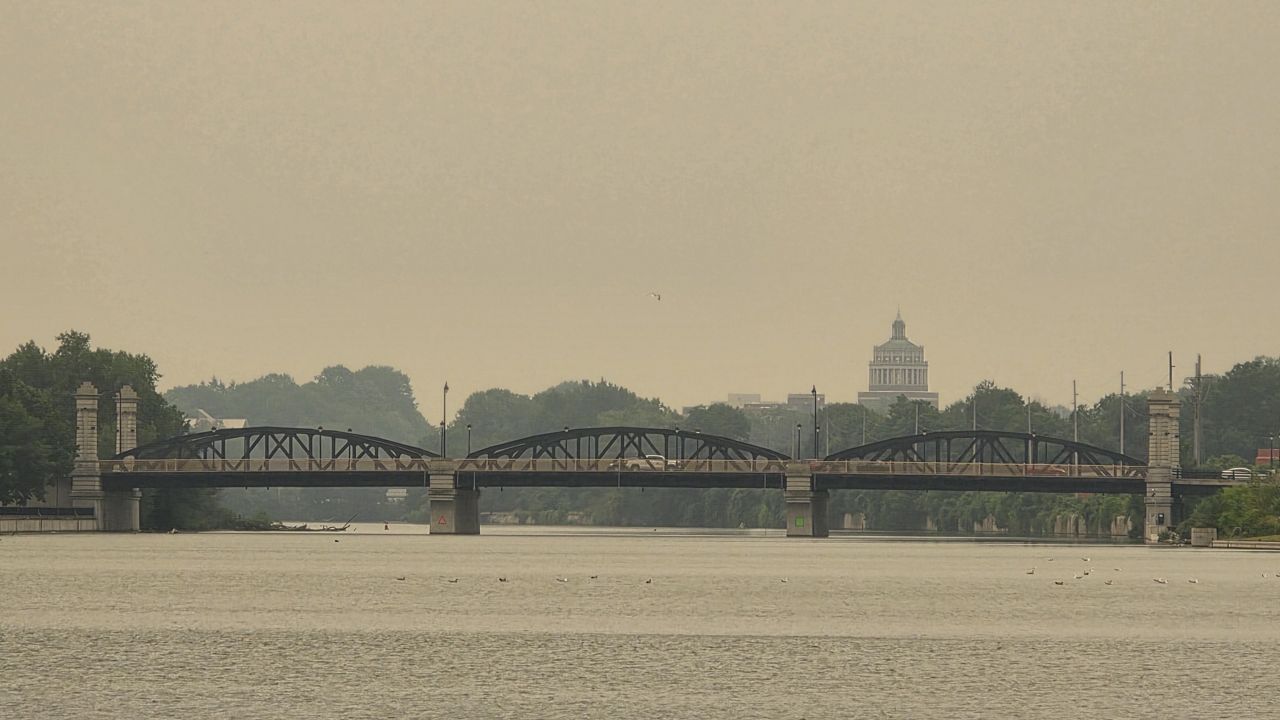
Wildfire smoke from Canada has returned, blanketing New York in a thick haze.
The smoke, combined with already high temperatures in the state this week, is creating unhealthy air quality conditions. Young children, the elderly and people with pre-existing health conditions are most vulnerable to the reduced air quality, but everyone is being urged to limit their time outdoors right now.
To limit exposure to unhealthy air quality, people should stay indoors with windows and doors closed. Avoid heavy exertion outdoors, using fans or swamp coolers that take air from outside, all wood-burning appliances, and lighting candles and incense.
The smoke is expected to stick around through Thursday, with conditions possibly being worse than Wednesday.
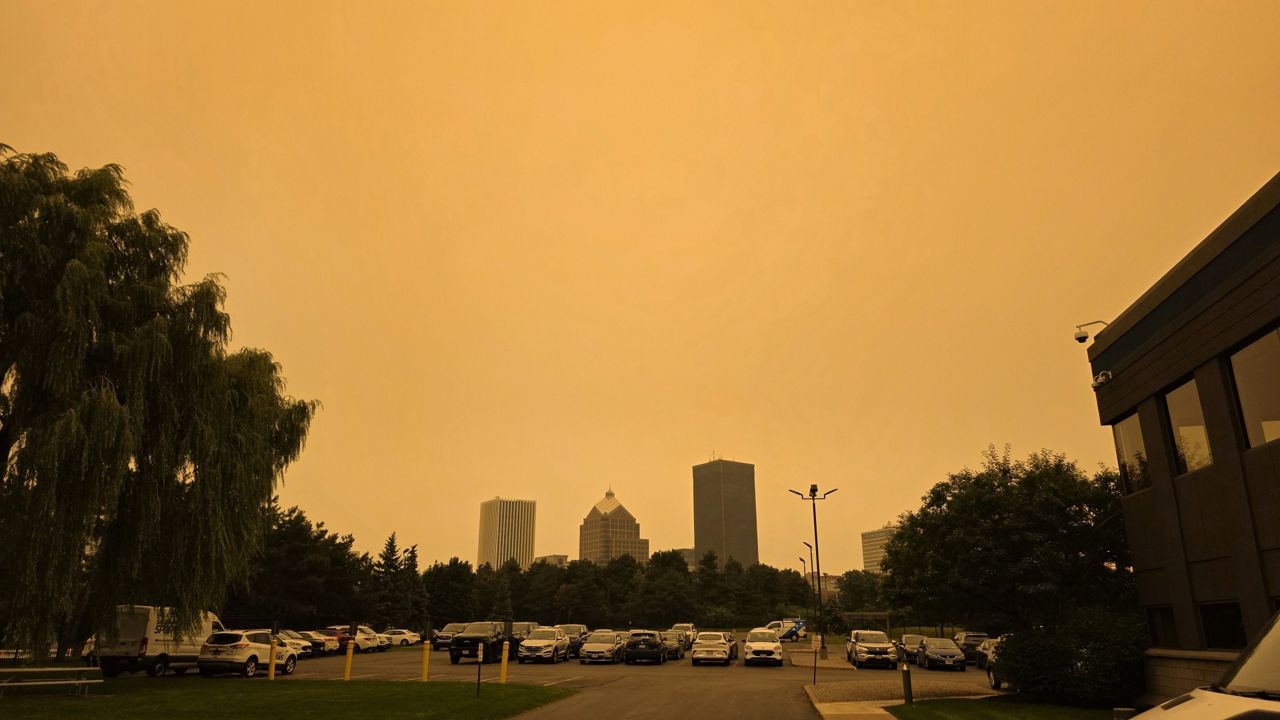
Air quality in ROchester on Wednesday. (Spectrum News 1)
Gov. Kathy Hochul issued an advisory on the conditions on Wednesday.
“Distant wildfires have impacted New York state in recent years, and this week unfortunately will be no different with expected hazy skies and poor air quality,” Hochul said. “We are now closely tracking these conditions, and I strongly encourage New Yorkers to stay informed and take appropriate precautions to stay safe. Sensitive groups should take particular caution.”
The governor’s office says the state updated an Air Quality Health Advisory for Wednesday to include all regions of New York due to the impact of wildfire smoke. While the western regions are expected to see the greatest impact, there will likely be spikes of poor air quality throughout the state.
The New York Department of Environmental Conservation and the Division of Homeland Security and Emergency Services will be closely monitoring conditions to make any necessary changes to advisories, according to Hochul’s office.
The DEC provides daily air quality forecasts to ensure air quality information is available publicly.
What is AQI?
The Air Quality Index — AQI — measures how clean or polluted the air we breathe is on a daily basis. The index focuses on the health effects that might be experienced within a few hours or days after breathing polluted air.
AQI is calculated based on ground-level ozone, particle pollution or particulate matter, carbon monoxide, sulfur dioxide and nitrogen dioxide. Ground-level ozone and airborne particles are the two pollutants that pose the greatest threat to human health in this country.
The index ranges from green, where the air quality is satisfactory and air pollution poses little or no risk, to maroon, which is considered hazardous. That level comes with health warnings of emergency conditions where everyone is more likely to be affected, according to AirNow.
New York’s Air Quality Index for Wednesday showed the entire state in either red or orange, indicating it as “unhealthy” or “unhealth for sensitive groups.”