
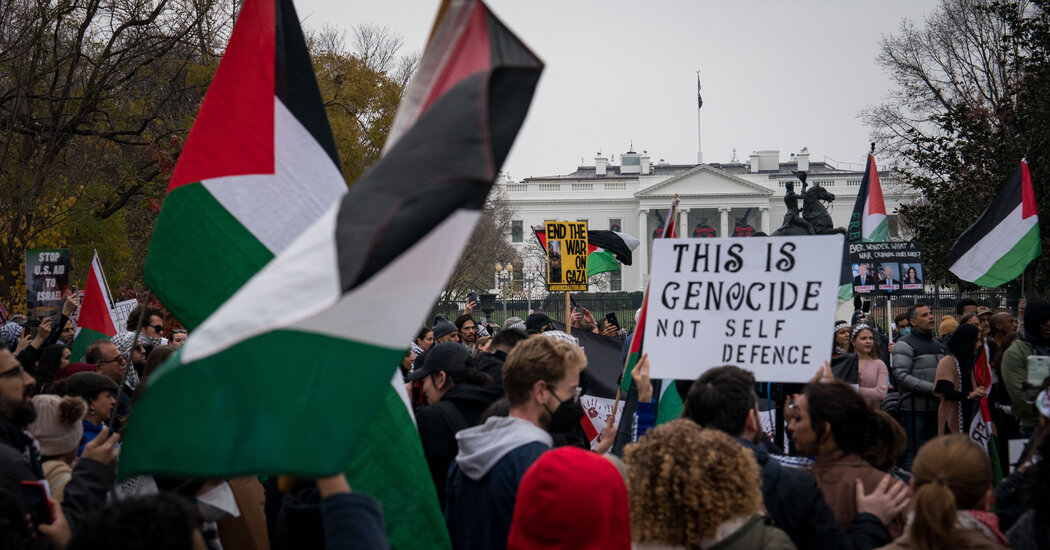
A federal design panel on Thursday indicated support for the Trump administration’s plan to add a permanent fence around Lafayette Square, a public space opposite the White House that is frequently the site of protests.
“This is definitely the president’s park, but also the people’s park, and it’s to be made open, but also closeable, so that it can be made safe,” said James C. McCrery II, the vice chair of the panel, the Commission of Fine Arts. He added that the White House fence was “a very good model.”
The move comes as President Trump and the Secret Service say they are concerned about the security of the White House during protests. A proposal the administration submitted to the panel, which advises on design projects in Washington but has no enforcement power, included photos of pro-Gaza graffiti left in the park, and of standoffs between police officers and protesters.
There is currently temporary fencing around the area, and the Secret Service has proposed a permanent fence that it could use to close off the park for security reasons.
The advisory panel, which is filled with Mr. Trump’s appointees, is likely to vote on the proposal at a later date. The administration is calling for an eight- to nine-foot fence to better help with crowd control at Lafayette Square, an eight-acre park perhaps best known for its statute of President Andrew Jackson on horseback.
The administration said there were “several examples of assemblies that elevate into nonpeaceful demonstrations which have resulted in violence towards law enforcement officers maintaining the necessary standoff from restricted areas and vandalism.”
Mr. McCrery said that it was important for the Secret Service to continue to allow people to express their First Amendment rights at the park, but that the behavior of some protesters prompted heightened security.
“The proposal is not to close the park, but to enclose the park,” Mr. McCrery said. “It’s still open.”
The proposal has drawn opposition from people who believe it runs counter to the free speech activities that frequently take place in the park.
Representative Eleanor Holmes Norton, a Democrat who represents the District of Columbia, has introduced a bill to prohibit permanent fencing at the park.
“Lafayette Square has long welcomed First Amendment demonstrations, vigils and public gatherings,” Ms. Norton said in a statement, adding, “Permanent fencing at Lafayette Square would send the wrong message to the nation and the world by continuing to transform our democracy from one that is accessible and of the people to one that is exclusive and fearful of its own citizens.”
The commission on Thursday also advanced a proposal to build a 33,000-square-foot security screening facility for visitors to the White House, the latest major change to the grounds overseen by Mr. Trump.
The panel previously ordered plans for the screening center to be sent back for changes, asking that more classical design elements be added to the structure. In response, the Secret Service added columns designed to tie the building to the White House and Mr. Trump’s partially built ballroom.
Andy Stohs, a senior adviser for technical operations with the Secret Service, said Mr. Trump had been involved in the designs.
“We have been working with the president, and this also is aligned with his vision,” he said.