
For the third time in as many years, straphangers in North Brooklyn are faced with a vexing, if familiar, question — is the G train running?
After planned signal upgrades meant a 10-week shutdown of the line in 2024 — and continued work on the signaling system meant scattered outages weeknight and weekend outages last year as well — riders in Greenpoint were angered to learn this spring that there would be yet more weekends with no G train service this summer.
MTA officials said they’d discovered a leak in the tunnel under the Newtown Creek — and that repairing it alongside the ongoing upgrades meant taking the trains out of service for multiple weekends between the Bedford-Nostrand and Court Sq. stations.
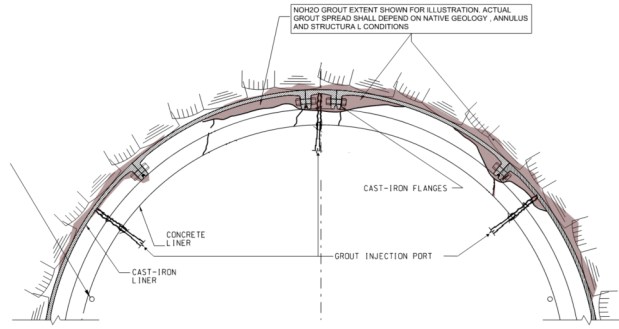 A diagram of the MTA’s efforts to stop leaks in the tunnel under the Newtown Creek. Crews drill through the concrete liner to inject grout around the tunnel. (MTA)
The announcement raised the ire of Greenpointers — especially the neighborhood’s small business owners, who say that, in Greenpoint, no trains means fewer customers.
“I lose 10-20% of my revenue when the train isn’t running,” Perri Salka, owner of The WonderMart gift shop on India St. and an organizer with Shop Small Greenpoint, told the Daily News. “The impact has felt significant to my bottom line.”
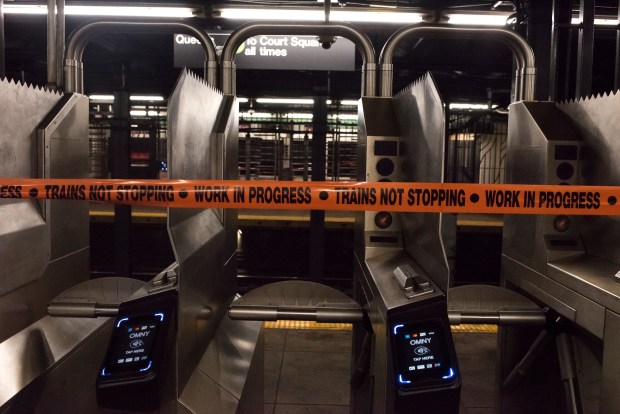 Caution tape reminds straphangers at the Greenpoint Ave. subway station that G trains are not running. The MTA is taking the train out of service for eight weekends this year in order to conduct upgrade work and repairs. (Evan Simko-Bednarski / New York Daily News)
Salka said she worries most about the MTA’s plans to close the train for three weekends in December — prime time for the retail business.
“I make just over a quarter of my revenue in the month of December,” she said. “How dare they?”
But the MTA says the work is necessary as part of a comprehensive overhaul of the line — one that will lead to much more reliable operation on a line where decades of infrequent service have earned it the nickname of “ghost train.”
On a recent Saturday at the 21st St. station in Long Island City, a yellow work-diesel pulled into the station, bringing a repair crew back from a 12-hour shift patching the tunnel.
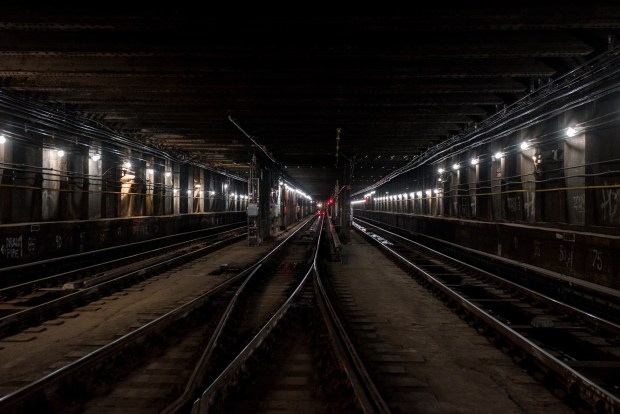 The Crosstown Line of the G line looking north from the 21st St. subway station in Long Island City, Queens. (Evan Simko-Bednarski / New York Daily News)
The train was one of eight along the closed section of G train, supporting nine different work teams along the tracks, said Jamie Torres-Springer, the MTA’s head of construction and development.
“We are making a massive investment in the modernization of this line,” Torres-Springer said. “It will only be the fourth line across the 22 lines that will be fully re-signaled.”
“We’ve enabled cell service across the entire G line as part of this work,” he added. “Five more stations [will] become A.D.A. accessible.”
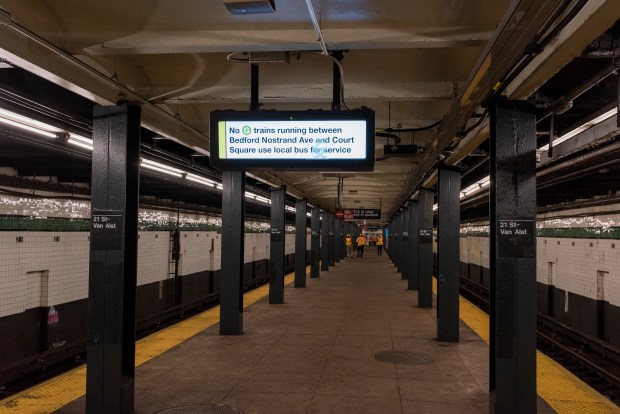 A sign in the closed 21st St. subway station on the G line announces the weekend outage. (Evan Simko-Bednarski / New York Daily News)
Torres-Springer also noted the MTA’s decision last year to swap out all the line’s older subway cars for the state-of-the-art R211.
But the primary reason for the work — the cause of the shutdowns that began in 2024 — is the first one: the installation of modern computerized signaling, known as communication-based train control, or CBTC.
The system — which is already in place on the L train, the No. 7 train, portions of the E, F, M and R trains — will allow the MTA to precisely track trains in the tunnels, letting them safely run more closely together. The upgrade will also streamline dispatching, allowing trains to be routed from the MTA’s Midtown rail control center.
To install the new system means putting in brand new switches and new traffic lights. It means adding small wireless transponders at regular intervals along the tracks, along with 5G radios to let them communicate. And it means wiring all of those devices up to a computer that can control them while talking to dispatchers.
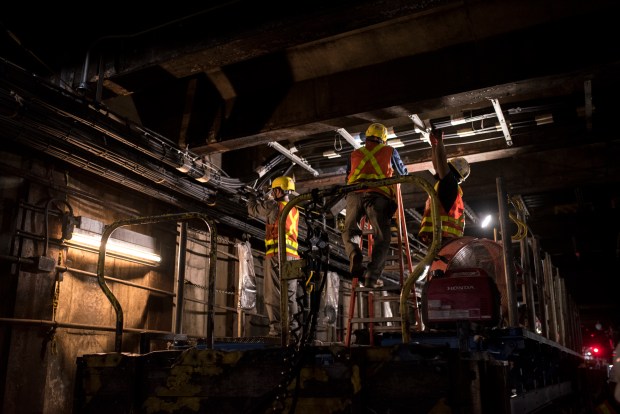 MTA contractors wrap wires along the ceiling of the tunnel beneath Queens. (Evan Simko-Bednarski / New York Daily News)
Last weekend, the last of those pieces were scheduled to be installed.
“This is one of the most exciting weekends of my life,” Jonathan Lopez, Construction Management Lead with contractor WSP, said with a smile. “This weekend is when we’re going to finish most of the hardware installation. After this weekend if everything goes well, I can say I did my job — everything we’ve installed in the ground will be functional.”
Lopez was quick to note the difference between “functional” and “operational.”
MTA officials expect to conduct more than a year of testing, troubleshooting, and software tweaks before turning the new system on. A large keyed switch in the newly-minted Train Control Room up the tracks at Court Square was marked “LEG[ACY]” for the existing signal system and “CBTC” for the new one. Workers can flip it back and forth for upcoming tests.
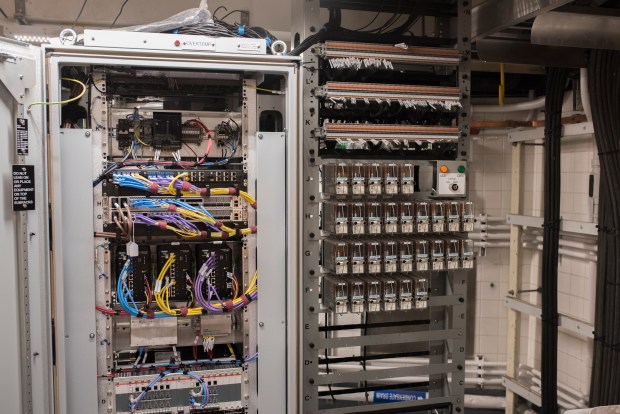 A test panel in the new Train Control Room at Court Square lets MTA engineers switch between old and new signaling systems for the purposes of testing. (Evan Simko-Bednarski / New York Daily News)
But MTA officials say it will be late 2027 or early 2028 before that switch is flipped for good. And all along the track-side, new signal lights were covered in black plastic, so as not to confuse train operators before the new system comes online.
As the tunnel approached Court Square, workers were spread out across the three subterranean tracks.
A crew was working on the motor that moves one of the newly installed switch tracks.
“At the end of the day, you can have all the software you want,” one engineer told The News, gesturing at the switch motor. “You still have to move the thing.”
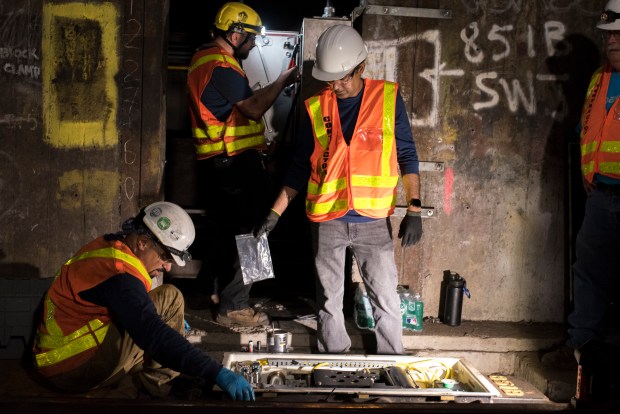 MTA contractors assemble a switch motor at the interlocking south of Court Square subway station. (Evan Simko-Bednarski / New York Daily News)
Nearby, on the uptown track, three men stood on a the flatbed car of a work train, reaching up towards the ceiling to organize and wrap up bundles of electrical cables. Somewhere nearby, still audible over the din of compressors and engines, a speaker belted out “Ramblin’ Man” by the Allman Brothers Band.
Turning around, walking along the downtown tracks and back past the 21st St. station, the tunnel began to pitch downward, under the Newtown Creek. The air began to feel more humid. The boots of an MTA work crew and one reporter began to slosh through mud.
“You see some gaps, the ties shifting?” said Anish Gandhi, a Vice President with MTA Construction and Development. Small gaps of just a millimeter or so were visible around one or two railroad ties embedded into the tunnel floor.
“The gauge has to be so many inches,” he said, referring to the distance between the rails. “The water’s seeping in and allows the ties to shift.”
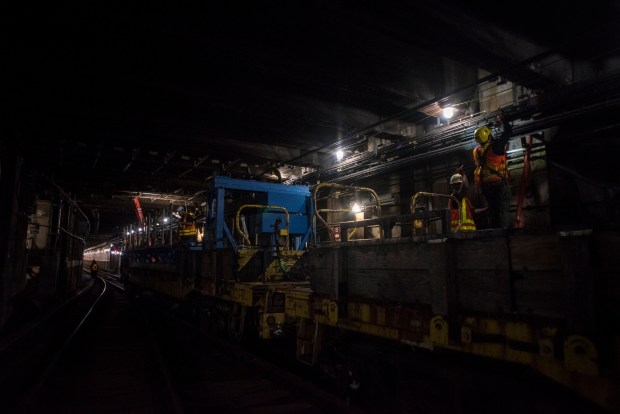 Work crews wrap wires south of Court Square subway station in Long Island City, Queens. (Evan Simko-Bednarski / New York Daily News)
“We went to install the [tie] plates,” Gandhi said, referring to the hardware that affixes the rail to the ties. “And that’s when we realized we can’t install them, because it’s crumbling underneath.”
As a bulwark against the gauge changing, NYC Transit has installed threaded “gauge-rods” between the rails to reinforce them. Paired with regular track inspections, the stretch of rail beneath Newtown Creek is safe to use, officials said.
But any repair won’t last without a more watertight tunnel.
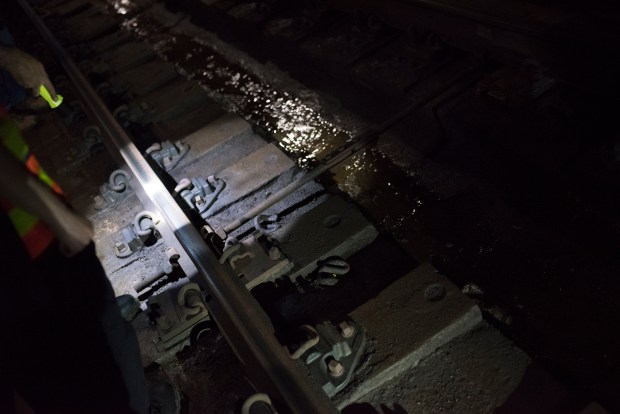 A threaded “gauge rod,” installed by MTA track workers, reinforces a stretch of track where water damage has threatened the railroad ties. (Evan Simko-Bednarski / New York Daily News)
Above, metal spigots jutted out from overhead — one in the center of the ceiling, one on each side, the trio repeating every 10 feet as the tunnel stretched out ahead.
The spigots serve as injection ports, where crews can pump grout behind the tunnel wall, with the goal of coating and encasing the entire tunnel lining under the Newtown Creek in a waterproof layer, filling any cracks along the way.
Torres-Springer said the damage could be traced back to repairs done in 2015 after 2012’s Hurricane Sandy.
That’s when “the old MTA,” as he put it, “made some repairs, but left the leaks to be remediated by somebody in the future.”
“We’re not doing that,” he said. “We went in and we saw that the leaks were extensive, and we’re repairing them.”
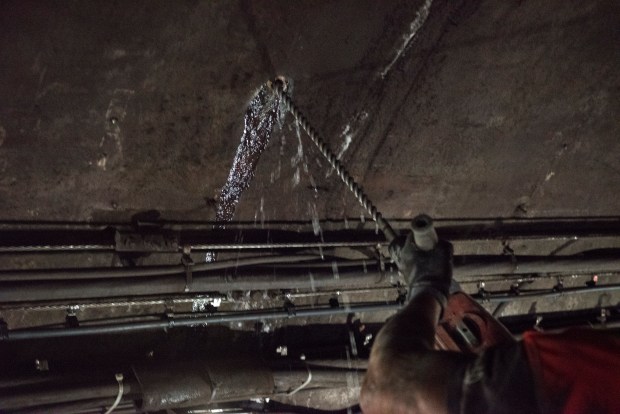 Water sprays from a hole after an MTA contractor drilled through the tunnel’s concrete liner. Work crews wrap wires south of Court Square subway station in Long Island City, Queens. (Evan Simko-Bednarski / New York Daily News)
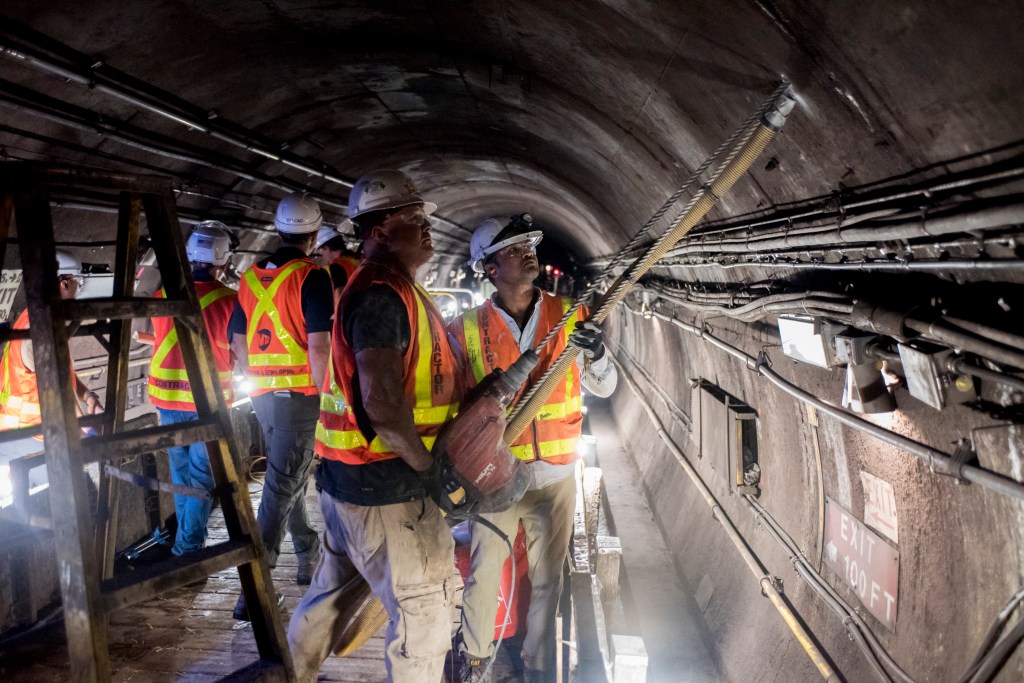
Further on down the tunnel, a work crew of contractors stood atop a flatbed car, wielding long drills and boring into the side of the tunnel. One man leaned his shoulder into the drill as another vacuumed up the dust of century-old concrete.
After a minute or two, a spray of water came from the hole, smelling suspiciously like the Newtown Creek.
Ten more feet down the tunnel, another crew was set up with another long drill. Later in the weekend, another team would come through to install spigots in the holes.
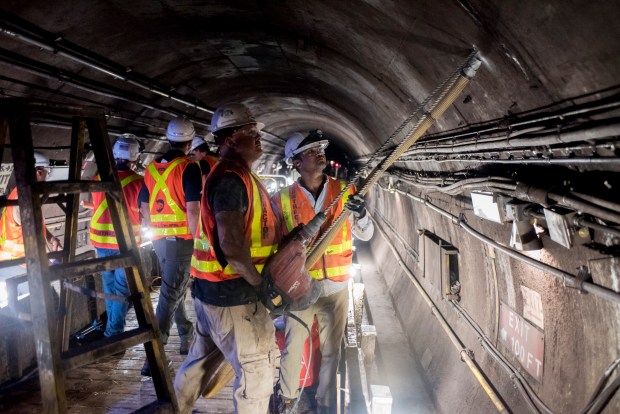 Work crews drill into the wall of the tunnel under Newtown Creek. The holes will be used to inject grout around the tunnel, sealing off leaks. (Evan Simko-Bednarski / New York Daily News)
MTA spokeswoman Sophie Deixel told The News that work crews had managed to drill along 1,000 feet of the tunnel that weekend — 100 sets of holes — and pump grout along 450 feet of tunnel.
Each tube of the 95-year-old tunnel is 3,200 feet long. The MTA estimates it will take until the year’s end to seal them both.
“I understand the pain of it,” Torres-Springer said, when asked about straphangers’ frustrations. “I wish everybody could come into the tunnels and see [the work.] It’s a massive upgrade of the G train.”