
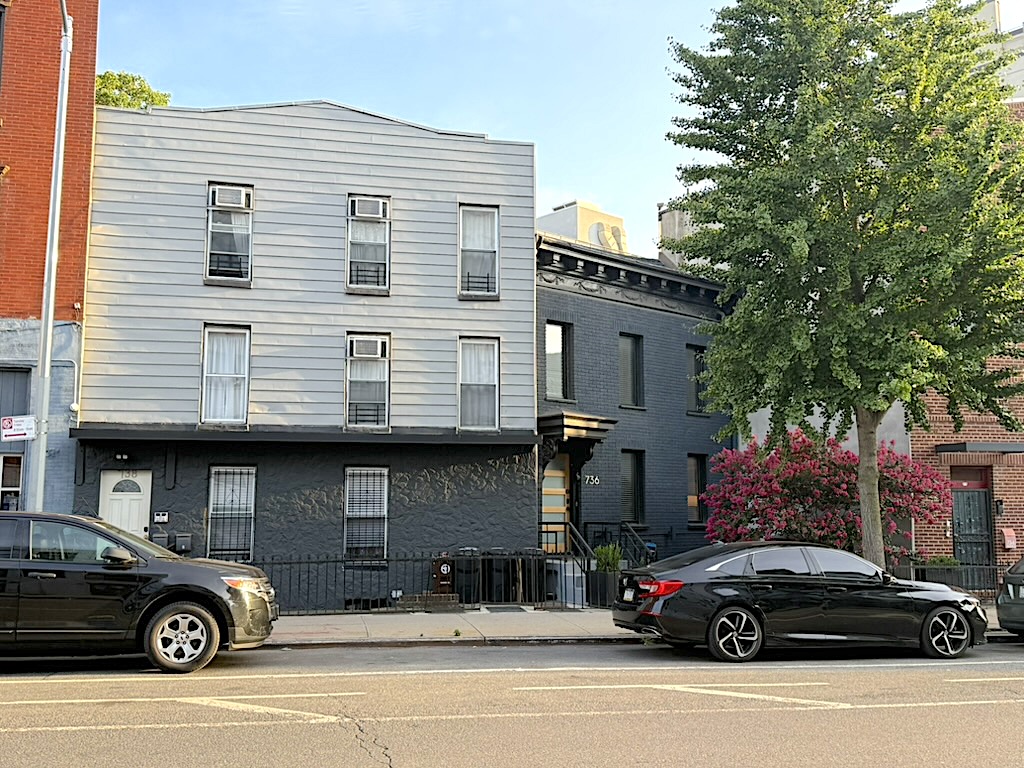
On the edge of Prospect Heights at 736 Bergen Street sits a charming slate blue row house.

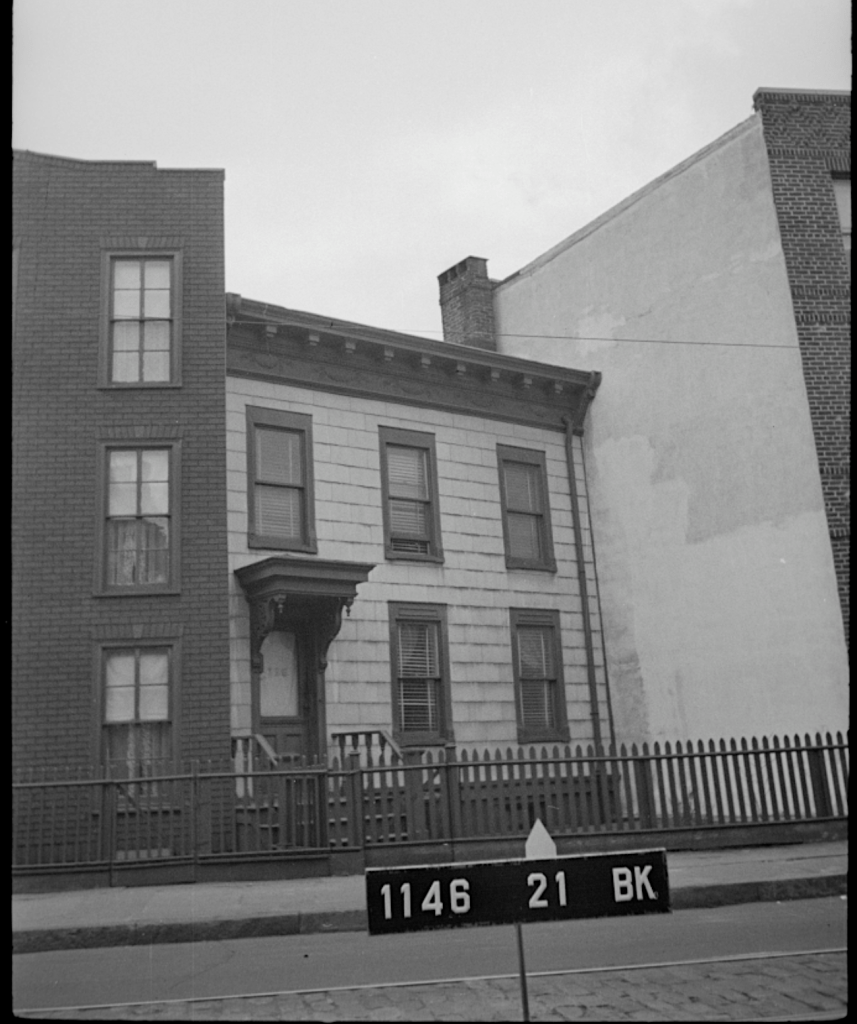
Just two stories high with a top half-floor (based on some Zillow interior photos), the little Greek Revival-style relic features long slender windows, an ornamental front entrance, and a cornice with decorative moldings.
Exactly when 736 Bergen Street was built or who its first occupants were—and if it debuted as a stand-alone dwelling or part of a row—isn’t clear.
But based on its architectural details, the house probably dates back to the early or middle decades of the 19th century. That’s about when similar Greek Revival houses began replacing estate land in several newly residential Brooklyn neighborhoods.

The house could also be a holdout from the post-Civil War era, when speculative developers began building residences in the area that became Prospect Heights.
These developers were lured by improvements in mass transit (today’s B65 bus actually began in the 1860s as a horse-drawn street car running along Bergen Street) as well as plans to build Prospect Park, which opened in 1867, according to the Prospect Heights Historic District report.
Yet something unusual makes the little house stand out. Unlike the rest of the homes on this block between Washington and Underhill Avenues, Number 736 is angled so it doesn’t directly face Bergen Street.
Instead, it’s tucked away out of harmony from its neighbors, oriented in a different direction.
What could explain the strange way it sits on the street? If the house was built after the Bergen Street streetcar launched, perhaps the occupants didn’t want to face a noisy road and the piles of horse manure left behind.
Or consider that before Bergen Street was laid out, the house might have been oriented toward one of the few main roads in Brooklyn at the time: the Old Flatbush Road, later known as Flatbush Turnpike.
Dating back to the early 19th century when Kings County was still a collection of separate towns, Old Flatbush Road “was situated to the east of present day Flatbush Avenue; it ran diagonally from northwest to southeast through the middle of the district,” states the Historic District Report.
“It was the major route between Brooklyn and the separate village of Flatbush.”
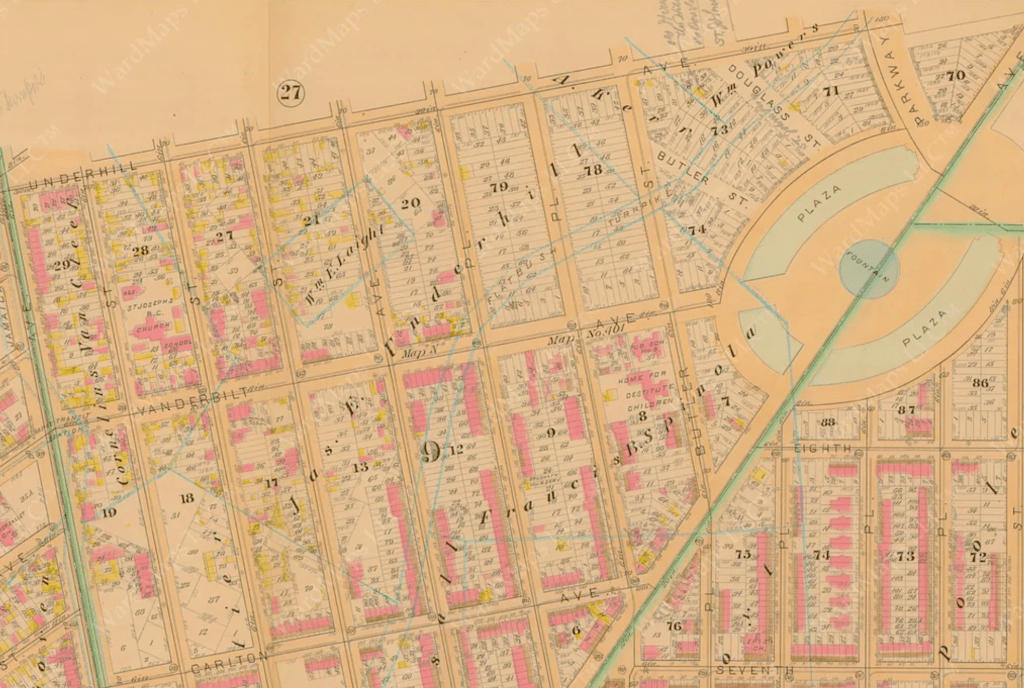
Click into the map in the third image, which was published in 1886, and you’ll see “Flatbush Turnpike” outlined in faint blue at the top right. It meanders through Underhill Avenue and passes Bergen Street as it snakes its way to the former town of Brooklyn.

Old Flatbush Road/Flatbush Turnpike was eventually closed, and the Flatbush Avenue on the map today—intended to be a straighter, easier way to travel through Brooklyn—opened in 1852, per the historic district report.
Brownstoner’s Suzanne Spellen wrote about 736 Bergen Street in a post from 2010, explaining that the proximity of Old Flatbush Road/Flatbush Turnpike to the little house could explain its incongruous orientation.
“The development of Prospect Heights is greatly due to the fact that the Flatbush Turnpike ran through it on its way past what is now Prospect Park, on out to Flatbush and beyond,” wrote Spellen.

“This house, as well as several others on nearby Underhill and Prospect Place, are oriented to the Old Flatbush Turnpike, hence the odd way they (almost) face the street,” stated Spellen.
“They are a constant reminder of Prospect Heights’ early years, and roads no longer traveled.”
[Third image: 1886 Atlas of Brooklyn/WardMaps; fourth image, from 1940: NYC Department of Records & Information Services]
Tags: 736 Bergen Street Brooklyn, 736 Bergen Street Old Flatbush Road, Old Brooklyn Houses Bergen Street, Oldest Houses in Brooklyn Prospect Heights, Prospect Heights Brooklyn 19th century, Where was Old Flatbush Road Flatbush Turnpike
This entry was posted on July 20, 2026 at 12:13 am and is filed under Brooklyn. You can follow any responses to this entry through the RSS 2.0 feed.
You can leave a response, or trackback from your own site.