

Mayor Zohran Mamdani unveiled more than 50 changes Monday aimed at making it easier to open and operate a small business in New York City — from seeking to eliminate a duplicative ice cream permit to assigning entrepreneurs a dedicated case manager to help them navigate city bureaucracy.
The package, called OPEN for Small Business (short for Overhauling Procedures and Expanding Navigation), targets fees, fines, licensing requirements, and delays affecting the city’s roughly 180,000 small businesses, which employ approximately 1 million New Yorkers.
Deputy Mayor for Economic Justice Julie Su, speaking at a press conference at La Bodega in the Bronx, said the administration had spent the past six months meeting with restaurant owners, bodega operators, barbers, child care providers and other business owners across the five boroughs.
“Their biggest frustration usually isn’t just the cost of a fee, although that matters,” Su said. “What weighs on them is the totality of things.”
In an apparent nod to Christopher Nolan’s current box-office hit, The Odyssey, an adaptation of the ancient Greek poem, Su said opening a business in New York “can feel like the odyssey,” with “always one more agency, one more form” and, when owners think they are nearly there, “another monster you didn’t know you had to get by.”
“The delays, the confusion, the sense that government isn’t on their side — that’s the journey that we’ve set out to shorten and to smooth,” she said.
Mamdani also signed a new executive order Monday expanding NYC BEST, the city’s Business Express Service Team. Under the administration’s plan, every small business seeking to open would be assigned a client manager who remains with the owner throughout the process and helps navigate permits, licenses, inspections and compliance requirements.
SBS and other city agencies also plan to contact businesses proactively before qualifying inspections and provide compliance education intended to help owners pass on their first attempt.
“We want to help you start operating as fast as possible, and we are building out our capacity to do just that,” Mamdani said.
The executive order will also establish OPEN as a permanent interagency task force that regularly examines regulatory problems and delivers an annual update identifying additional opportunities for reform.
What OPEN means for NYC businesses
Inspectors will be required to hand out physical copies of an expanded Business Owner Bill of Rights during inspections, while agencies will distribute the document at other points of service. According to the administration’s report, a 2025 Small Business Services survey of more than 500 businesses found that just 9% reported ever receiving it.
City agencies will also ensure that inspectors receive customer-service training annually, regularly review surveys submitted by business owners and consider that feedback in inspectors’ performance evaluations.
“Small business owners deserve a partner in city government,” Mamdani said. “Our administration will continue to find ways to repair a relationship that, for too long, has been defined by mistrust and antagonism.”
The broader package includes 25 changes affecting food-service and food-retail businesses, seven for transportation businesses, five for other retailers and four for child care providers. Other measures cover personal-care businesses, including barbershops, industrial and commercial businesses, and nonprofits that operate bingo and other games of chance. Six reforms would apply across industries.
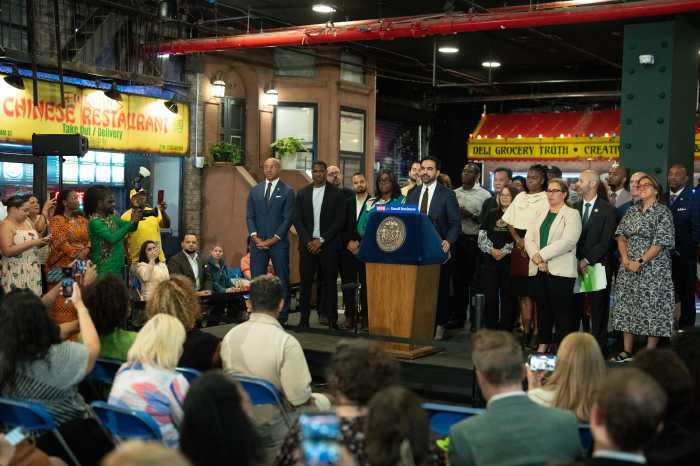 Photo by Michael Appleton/Mayoral Photography Office
Among the proposals, the administration wants to require a separate permit to serve frozen desserts on ice.
Restaurants that already hold a general food-service establishment permit must currently obtain an additional “manufacture of frozen dessert” permit before offering ice cream or similar products. Mobile food vending units and temporary food vendors face the same requirement.
The administration argues that the second permit does not provide protections beyond those already covered by existing food-service permits. The Health Department will work with the state to eliminate the requirement, according to the plan.
Barbershop owners can similarly face three overlapping requirements: a state occupational license to cut hair, a state license to own or rent a shop, and a city barbershop permit. The city said it will also work with the state to streamline those requirements.
Separately, the Health Department will extend the city barbershop permit’s renewal cycle from one year to three years.
Other changes would cut the temporary food-service establishment permit fee for street fairs and similar short-term events from $70 to $20 and reduce certain DEP cooking-equipment registration fees from $110 to zero for 12 months.
The Taxi and Limousine Commission plans to eliminate fines for losing a TLC license, missing the annual drug-test window and failing to complete a vehicle inspection on time. Drivers would also avoid replacement fees for up to three lost TLC licenses over three years.
The Health Department will authorize third-party providers to offer the required Food Protection Certificate course and exam at multiple locations. Earning the certificate currently requires traveling to a single city-run location.
The agency also plans to recruit dozens of additional food-safety inspectors to conduct more timely inspections of restaurants posting B and C grades, giving them a faster opportunity to earn an A.
Child care providers would receive a new Health Department ombuds office and a plain-language guide explaining the separate Health Department, Buildings Department and FDNY processes involved in opening and operating a center.
The city also plans to expand its child care permitting portal to cover renewals and modifications and include resources on DOB and FDNY reviews. The Health Department will continue upgrading the background-check request portal to accelerate processing.
The initiative grew out of a January executive order directing seven agencies to inventory fees and civil penalties facing small businesses and identify whether they could be reduced through administrative rulemaking, City Council legislation or state legislative action.
Not all of the changes took effect on Monday. Some can be carried out by city agencies, while others require rule changes, City Council legislation, or cooperation from Albany before business owners see the effects.