
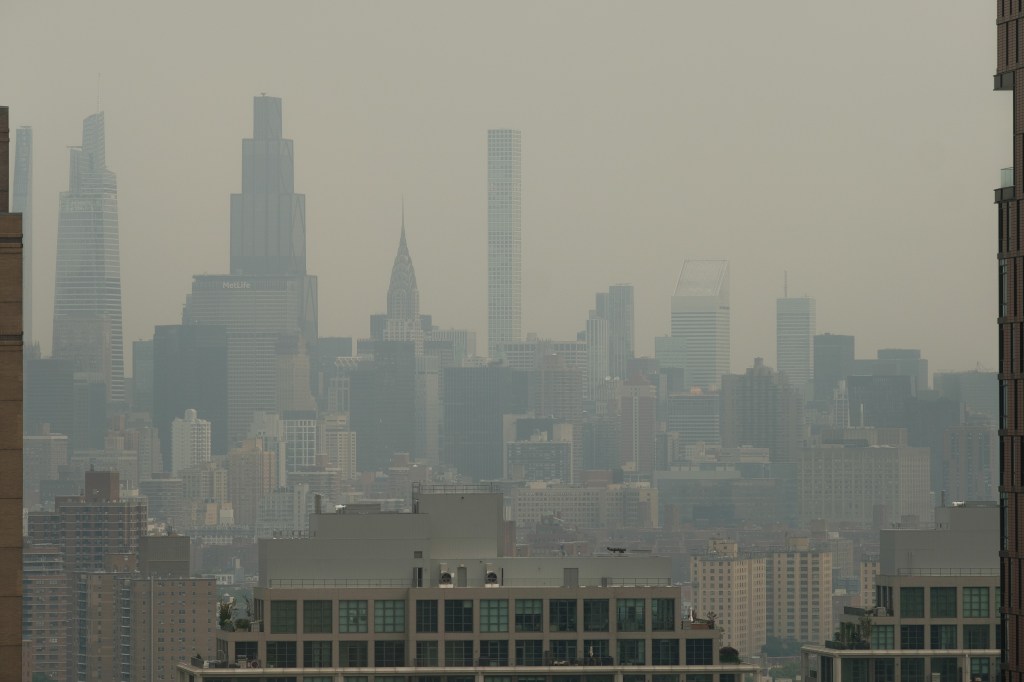
The last time smoke from forest fires made it hard to breathe in New York City was in June 2023. Last week, we repeated that experience, with smoke from wildfires in Canada — worsened by a hotter, drier climate that is amplified by our emissions of carbon to the atmosphere — blanketing a vast area from the Midwest to the Northeast.
Before 2023, the only comparable smoke events in NYC history were more than 100 years ago, during the Adirondack fires of 1903 and 1908. It’s worth asking why we were blessed with such a long smoke-free interval, and why we now are entering a “new normal” with negative impacts on public health and mortality.
The 1903 and 1908 fires also followed prolonged droughts, but were localized in the Adirondacks and ignited not by lightning but by sparks from wood- and coal-burning trains and a farmer’s intentional burning of a fallow field. They were made worse by piles of highly combustible slash left by loggers. The New York State government passed reform policies that stopped those fires from becoming recurring events.
In contrast, many of the current wildfires in Canada, and those in 2023, began in remote areas with no road access and were ignited by lightning strikes. More than two million acres have burned thus far this year, 90% in areas that have never been “managed.” Analyses of the 2023 Canadian wildfires, including in a recent report from the U.S. National Academy of Sciences, indicate that human-induced climate warming played a major role.
Our carbon emissions have heated the planet nearly 1.5 degrees Celsius. In Canada, temperature increases have been about twice that global average, and nearly three times as high in northern Canada. The smoke-filled air New York City experienced last week and three years ago is not the result of local circumstances like it was in the early 1900s. It’s a symptom of a global problem.
Adapting to the presence of unhealthy levels of smoke in ambient air means mostly staying indoors with the windows closed, using high-quality indoor air purifiers, and wearing a properly fitted N95 or KN95 mask outside. The NYC government helped make those masks available to residents and the state government has promoted the use of portable HEPA air cleaners and provided guidance for clean-air centers.
We should be ready for more wildfire smoke in our future. While NYC emergency management services do a laudable job of monitoring and reporting on air quality, air pollution is still not on the city’s list of priority health risks due to climate change, where it belongs alongside heat waves, flooding, and the power outages that both of those can cause.
Although the 2026 Canadian wildfires will likely be linked to the “super” El-Niño we are entering, we are a large part of the problem. American carbon emissions per capita are nearly three times the global average and are increasing following a brief decline. If we continue to burn billions of tons of fossil carbon each year, we shouldn’t expect a different result. Plants took millions of years to remove that carbon from the Earth’s ancient atmosphere. We’re reversing that geological process in the blink of an eye.
We don’t need to stay on this self-destructive course. The global revolution in renewable energy technology has made this a choice, not an inevitability.
Last week, billions of sports fans wondered how the smoke would affect the World Cup final for the first time in its history. Is this “new normal” the present, and the future, that we want?
Zarin is the executive director of Forests & Climate Change at WCS (Wildlife Conservation Society).