
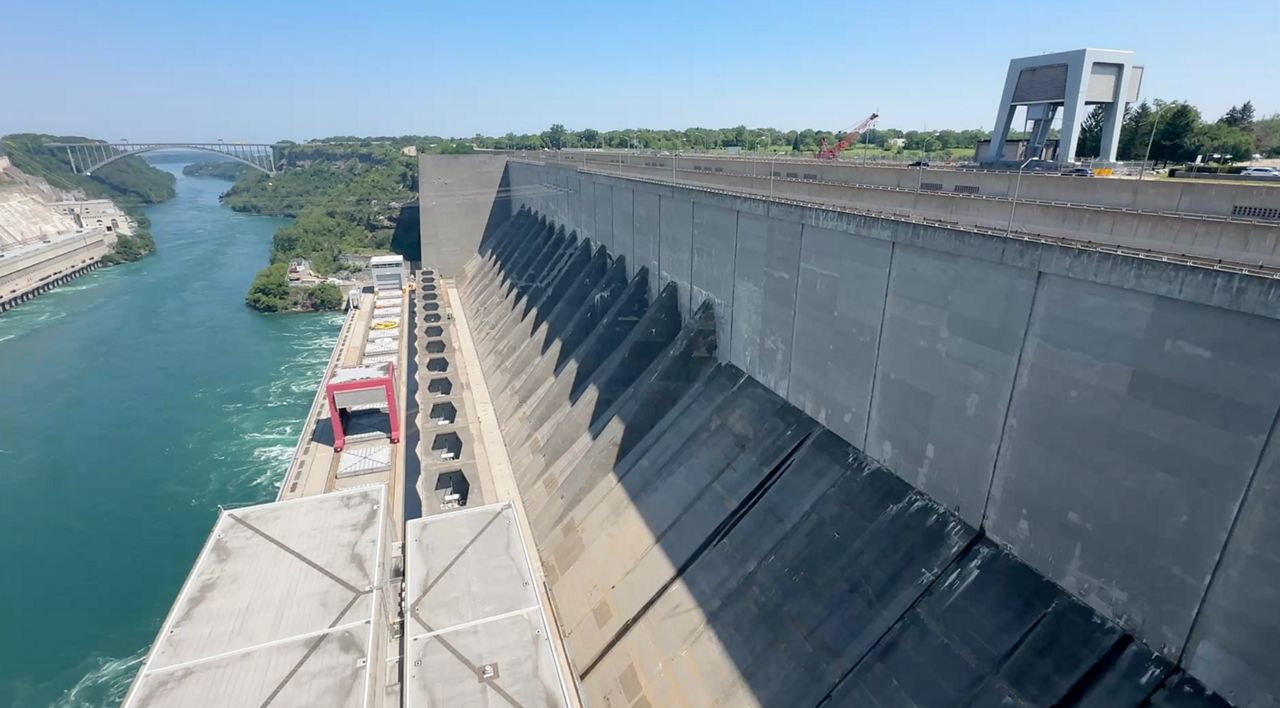
LEWISTON, N.Y.— As America celebrated its 250th birthday, Spectrum News 1 took you to Niagara Falls to share the history of progress versus preservation. Since the 1700s, the strength of the falls has been a source of power. We’re taking you back to Niagara County, where, in the present day, the state’s biggest electricity producer is located, using water.
The Niagara River brings over 200,000 cubic feet of water over Niagara Falls per second. Think 200,000 basketballs cascading over that cliff. Before it gets there, at times, half of that is diverted to either Canada’s hydropower plant or the one you’re about to read about.
What You Need To Know
The Niagara Power Project is the state’s biggest electricity producer
Eighty percent of the electricity that is generated at NYPA facilities comes from hydropower
Hydropower is a constant renewable form of energy when the sun isn’t shinining and the wind isn’t blowing
About 4.5 miles downstream from Niagara Falls is where you’ll find the New York Power Authority’s (NYPA) Niagara Power Project. From the observation deck of the Power Vista in Lewiston, there are breathtaking views of the Niagara Gorge. But between four and five stories below, there’s a gentle hum.
“Niagara Power Project generates about 2.675 GW of power,” said Jairo Florez, regional manager and senior vice president of Western New York for the NYPA. “This facility alone is good to power more than two million homes.”
Florez starts our tour of the Niagara Power Project on what’s called the transformer deck.
“This is the area where the power that is generated by the turbines is taking a step up, you know, in a fashion that allows us to send the electricity for long distances,” Florez explained.
Because what’s generated here gets sent across the state.
“Eighty percent of the electricity that is generated at the NYPA facilities comes from hydropower,” Florez said.
He says the Niagara Power Project accounts for 10% of that. Florez says hydropower is reliable when the sun isn’t shining and the wind isn’t blowing.
“Hydropower is that catalyst that, that, balance to make sure that the, those renewables, are supported when needed, when they are not able to generate power,” Florez said.
Florez says the reservoir can hold about 20 billion gallons of water.
“Just to give you an idea of how much water it is between the forebay and the upper reservoir, with the water there, you can fill about 33,000 Olympic-sized swimming pools,” Florez explained.
That water starts its trip in the Niagara River.
“But it does give you a really pretty good idea of the magnitude of the drop that the water will experience as it comes down from here, from the forebay,” Florez explains as we stand inside a control tunnel.
Between the Robert Moses Niagara Power Plant, and the Lewiston Pump Generating Plant, 25 turbines spin 748,000 gallons of water per second. Inside the turbine pit, it spins more than 100 times per minute. The water wheel is below. Above it is a generator with magnets and coils.
“Gravity is doing the mechanical work,” Florez explained. “And then, a bunch of magnets are spinning inside, coils that create the current to generate the electricity.”
It’s sent up to the transformer deck to get supercharged for long-distance transmission, and back down to the power tunnel, specially designed to keep it all cool.
“As the current travels inside the cables, it goes through the switchyard,” Florez said. “They go underground to the switchyard. Once it goes in, it jumps and connects into towers, and then travels.”
Florez says there are 1,500 miles of circuit lines.
Niagara Power Project is 65 this year, and the need for electricity is only growing. Florez says they’re investing $1.2 billion to ensure it stays a reliable source for generations to come.
“There are newer designs that can be implemented, and those newer designs that new digital technology and more fine-tuned control systems can give you the ability to fine-tune output, with the same amount of water,” Florez said.
The billions of gallons of it, flowing from Lake Erie to Lake Ontario, take a detour to keep us going.
Beyond producing clean electricity, the Niagara Power Project is an engine for economic development. Florez says that through the power generated here, statewide, there are about $55 billion in economic investment and 450,000 jobs.
If you visit Niagara Falls, you can even take the Niagara Discovery Shuttle to get to it. At the plant, there is the Niagara Power Vista. It is a free exhibit on all things electricity.
It takes you through the three years it took to build the Niagara Power Project and the history of Tesla and Edison. It shows you how electricity works and takes you on an immersive ride where the character Watter and their friends take you through the process of hydropower at the plant. But beware, water is involved a little in that ride.