
My recent coverage of a short documentary keyed to the tenth anniversary of the Barclays Center reminded me of this anniversary-related article that I needed to update and publish.
Since its September 2012 opening, the Barclays Center, home to the Brooklyn Nets, has become a touchstone of Brooklyn borough identity, for example, as shown in the rebrand of a Key Food in Crown Heights, which posted images of both the arena and the Brooklyn Bridge.
But is this commercial venue, sited at a key intersection at the edge of Downtown Brooklyn, the icon and centerpiece of a city-sized borough?
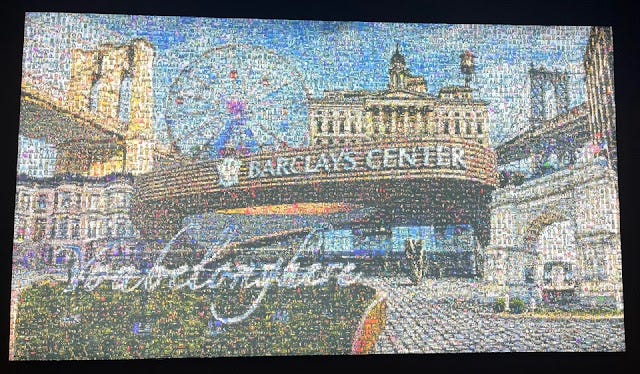
Well, that’s the (unsurprising) message of a photo mosaic Barclays Center operators unveiled Dec. 1, 2022, inside the building’s street-level concourse, said to be comprised of fan-submitted photos from arena events during its first decade.
It’s a clever–even brilliant–composition, distortingly centering Barclays among longer-standing borough icons, while honoring fan experiences. Many, but by no means all, of the photos have captions:
Father/Son Outing (Mavs. vs Nets March 2019)
Hokie fans celebrate their ACC championship!
Took big sis to Mary J B. concert for her birthday
Salsa Festival Here We Are!
The realist and youngest Brooklyn Nets fan!
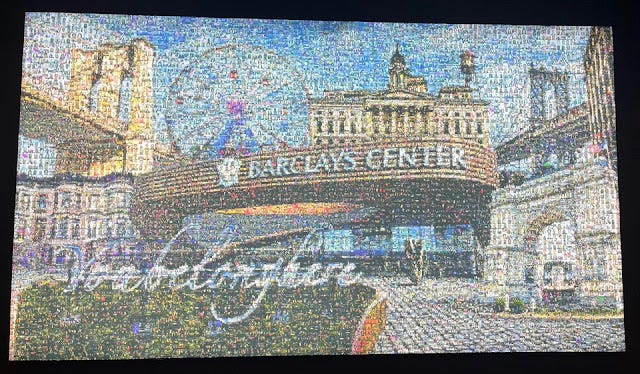 Photo: Norman Oder
The strategy behind it, though, is a bit insidious.
At the montage’s center is the arena, looking modestly scaled and with–atypically– no visible commercial message blaring in the oculus’ digital screen or the LED signage over the doors.
Similarly, not legible is the signage over the door branding SeatGeek Plaza, named for the arena’s ticketing sponsor, but soon replaced by Ticketmaster.
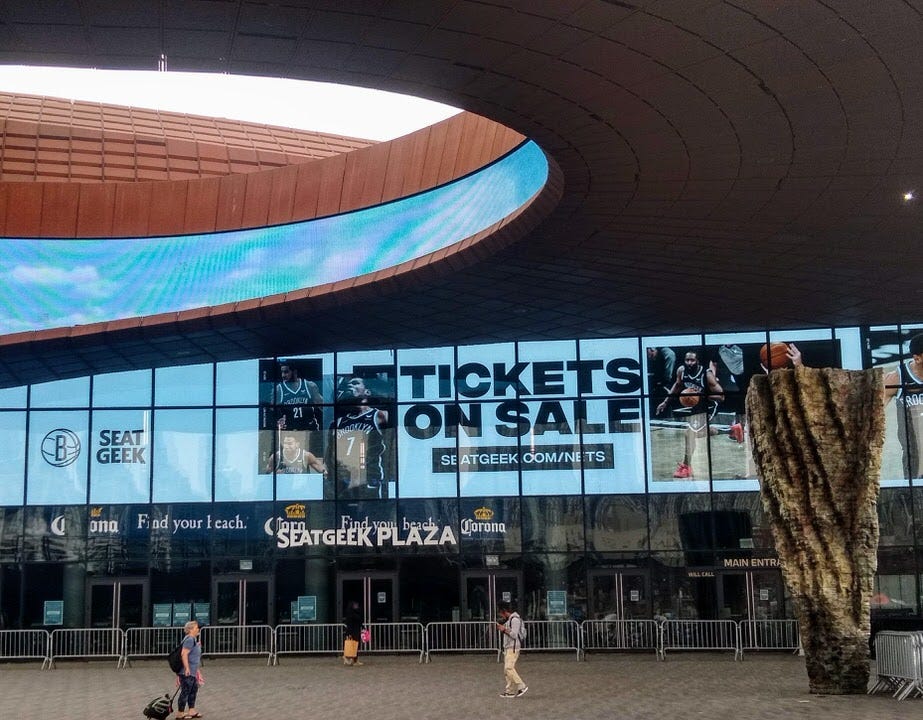 A closer-up view, though the oculus, actually, has no visible advertising. Photo: Norman Oder
Close-up in the foreground of the anniversary image, positioned over the entrance to the transit hub below, is the neon “You belong here” message unveiled in October 2021.
Though not visible in this case, that neon sign is coupled with “We belong here,” an opposite-facing message that greets those exiting the arena or entering the transit hub.
While billed as art, as well as a homage to the protestors who filled the plaza during the 2020 demonstrations after the police murder of George Floyd, the “Belong/Brooklyn” work by Tavares Strachan, as I’ve argued, also doubles as advertising for Barclays, since it implicitly encourages visitors to buy tickets.
It also implicitly justifies the presence of the highly contested arena.
The Art at Barclays Center page credits Strachan’s signage first to the holding company Brooklyn Sports & Entertainment, then says it was commissioned by the Social Justice Fund, the questionable philanthropic entity funded by Joe and Clara Wu Tsai, prime owners of Brooklyn Sports & Entertainment.
In the mosaic, the oculus, at 30 feet above ground, lines up with the second-floor windows of the 19th-century row-house cluster positioned at left, though, if the oculus were scaled accurately, it should rise over the roofline.
Of course, the rest of the building–including a green roof anchored by another “band” of rusted metal mesh–is missing, as shown in the photo at right. The arena peaks at 137 feet, its overall scale diminished by a below-grade event floor, well taller than a three-story house.
Photo: Norman Oder
In other words, it’s a decidedly demure image, also missing the three towers behind the arena, notably Brooklyn Crossing, the glassy box at left in the “You belong here” photo above. Also absent: steady traffic on adjacent Atlantic and Flatbush avenues.
In the mosaic, the oculus, again 30 feet above ground, is positioned to cap, to its right, the 80-foot Soldiers and Sailors Memorial Arch at Grand Army Plaza. The latter seems a guest on the arena plaza, rather than the gateway to Brooklyn’s grand Prospect Park.
Other borough icons fill out the mosaic.
Starting at the top left and moving clockwise, we see the 1883 Brooklyn Bridge; the 1920 Wonder Wheel, from Coney Island; the 1851 Greek Revival Borough Hall (formerly City Hall, during Brooklyn’s 19th-century independence); and the 1909 Manhattan Bridge coupled with a former early 20th-century industrial building in DUMBO (Down Under the Manhattan Bridge Overpass), the once-moribund waterfront zone transformed, in the last quarter-century, into Brooklyn’s buzziest neighborhood.
The sign on the Wonder Wheel, the only commercial structure, is not legible, thus not competing with the arena.
By the way, if you click through 10yearsinbk.com to see the individual photos, a considerable number consist not of fan photos, but of headshots, labeled “Employee since Day 1,” especially in the lighter-colored sections (bridge, arch, Borough Hall), where the light-colored backdrop for such photos makes a better composition.
As a list of Brooklyn icons, it’s not unreasonable, though surely Junior’s Restaurant in Downtown Brooklyn, famous for cheesecake, and Nathan’s Famous, the Coney Island hot dog emporium, have more iconic neon signage.
One might argue for more civic buildings like the Brooklyn Public Library’s Central Library, the Brooklyn Academy of Music, or the Brooklyn Museum, or adding Prospect Park, which welcomes far more visitors each year. But the latter’s sense of repose would be hard to cram into this limited canvas.
Then again, parts of the borough, notably nearby Downtown Brooklyn, the adjacent Fourth Avenue corridor, and the North Brooklyn waterfront, have been transformed by high-rise buildings (mostly residential).
That might’ve been hinted at had the mosaic more accurately depicted the arena and its setting. However, of course, was not the goal.
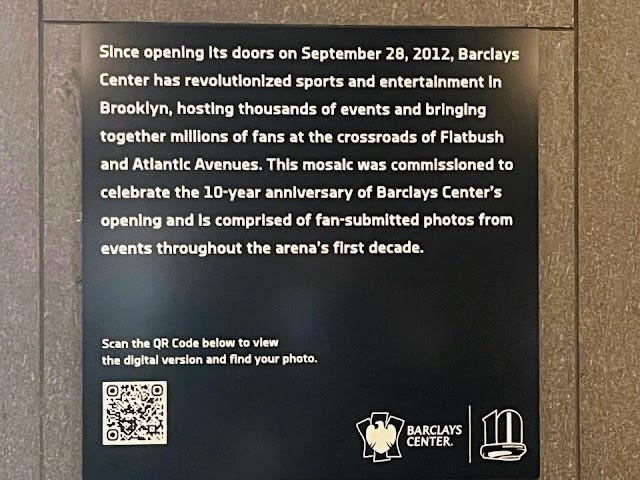 Photo: Norman Oder
Instead, we get Barclays Center, named for a sketchy, admittedly criminal British bank, front and center. (Oh, and given that the arena’s technically government-owned, to enable tax-exempt bonds, it’s also sketchy that the public gets no share of naming rights or the Tsai’s notable profits.)
Any commercial name, of course, comes with risks. In early 2023, the arena operator short-circuited its ticketing contract with SeatGeek to return to industry leader Ticketmaster, giving the plaza its fourth sponsor in little more than a decade.
The change came amid allegations of undue pressure from the latter’s parent booking company. Those were later aired in court, though it’s not clear whether that testimony helped a jury determine that Ticketmaster’s parent Live Nation is a monopoly.
The 20-year naming-rights contract with Barclays, which never launched a U.S. retail banking business as contemplated, is decidedly undervalued, at $10 million a year
In 2021, rumors surfaced that Joe Tsai, the billionaire who owns the arena operating company and the Nets might seek a new naming-rights partner.
That didn’t happen, and Tsai and his wife Clara Wu Tsai have successfully built the WNBA’s New York Liberty into a valuable brand, selling profitable slices of parent company BSE Global (now Brooklyn Sports & Entertainment) and the Liberty, without giving up control.
Today, 2032 is not so far off. If Barclays decides not to renew, and/or if the Tsais find a “better” deal, that exterior Barclays Center moniker would be replaced by the next sponsor.
Surely, coordinates for Brooklynites, including the renamed (as of 2012) Atlantic Av-Barclays Ctr subway hub, would have to change. Also, they might have to take down that mosaic.