
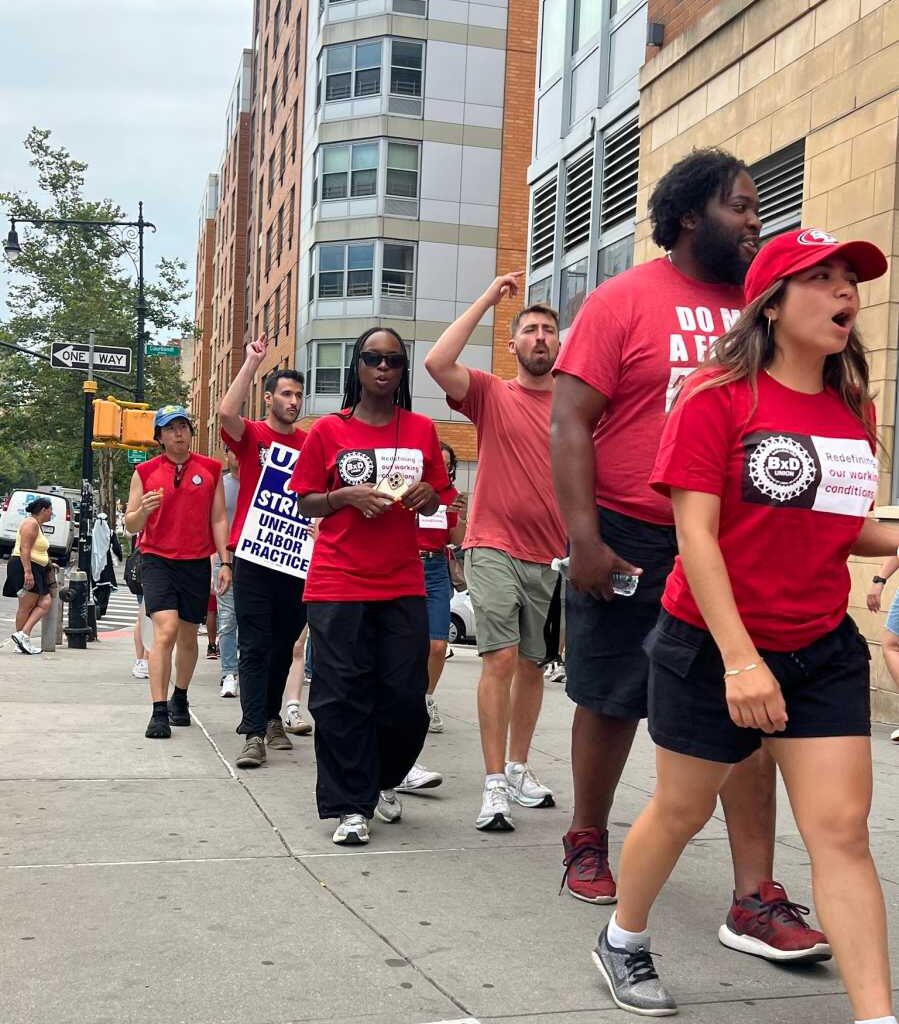
The Bronx Defenders Service on Tuesday became the third public defense firm in the city to authorize and set a strike date this month, citing a breakdown in contract negotiations, ongoing disputes over wages and a commitment to ensuring all legal service providers – from attorneys to social workers – receive a fair contract.
The 300 defense attorneys and legal service professionals serving roughly 20,000 Bronxites annually — many of whom cannot afford legal representation and wouldn’t otherwise have it — say they will walk off the job on Monday, July 27, if management doesn’t meet their demands.
If they do, the Bronx Defenders would join the Brooklyn Defenders Service, where hundreds of Brooklyn and Queens public defenders have been on strike since July 16, and the Harlem-based Neighborhood Defenders Service, which has authorized a strike for July 24, in striking for better wages and working conditions.
All three groups are part of the same union — The Association of Legal Advocates and Attorneys UAW Local 2325 — but each have separate contracts, since they’re all separate firms.
Abhi Hu, a Bronx Defenders staff attorney and bargaining committee member, told amNewYork it’s significant – and intentional – that the city’s public defense firms are all gearing up to strike at once.
“Seeing the power of a strike that could shut down arraignment courts in four different boroughs shows the city and shows our management that we really mean business,” Hu said. “We are serious about our demands, we are serious about reaching a contract, and we are serious about making sure that everyone at our offices is cared for and provided for in a way that means that we can show up for our clients every day and not burn out after a couple of years.”
Ensuring attorneys are fairly compensated ensures they’re able to stick around, which means better legal services for clients, which is why the union is pushing so hard to increase compensation in their contract.
Hu said she has seen attorneys and other providers move to Legal Aid, another public defense firm she says pays better, not because they are burned out from criminal defense work — but because they are burned out and working for too little pay.
“We don’t want to create a situation for clients where they’re having a new attorney, a new social worker on their case four or five times throughout their case,” Hu said. “That is really disruptive to the kind of services that we can provide and the kind of representation we can deliver for our clients.”
Bronx Defenders management told amNewYork that its mission is to provide zealous, holistic, and client-centered advocacy, and that commitment has and will continue to be its “north star in these negotiations” as the group seeks to arrive at a “fair and equitable contract” when asked for comment on strike date.
Executive Director Juval Scott has previously said she respects the union’s decision to strike, but without additional city funding, she cannot responsibly offer the defenders more money.
Hu says the union doesn’t buy it: Bronx Defenders entered into a $4 million contract with the Mayor’s Office of Immigrant Affairs this year, and Mayor Zohran Mamdani included 32 million in the recently passed city budget to increase support for public defender organizations.
Why the Bronx Defenders are ready to strike
Bronx attorneys said they didn’t want to reach a point of authorizing a strike, but felt they had with no choice, calling the negotiations, which have been ongoing since April, “disappointing and protracted.” Their contract expired on June 30, and Hu said they weren’t even close to reaching a deal then, despite months of bargaining.
Approximately 92% of the 95% of the union members who voted cast a ballot in favor of striking on July 27. The union also went on a one-day strike last year during a renegotiation of wages.
Beyond pay, the union said they chose to authorize a strike because management was trying to pit different union positions against each other – making acceptable offers to attorneys, but jipping other workers, like social workers and legal assistants.
That doesn’t work, Hu said, because the Bronx Defenders’ model is to offer a holistic defense — meaning clients are supported with strong legal counsel as well as social support to get and keep their lives on track. If the entire union isn’t well compensated and supported, that model doesn’t work.
“Management’s proposals are an obvious attempt to pit workers against each other, but we know that each and every one of our union siblings does important work for our organization and our clients, and we know that each and every one of our union siblings deserves more,” said Emma Caridad Perez, a bargaining committee member and criminal defense attorney. “A wall-to-wall union means we fight for a fair contract for all Bronx Defenders.”
Additionally, the union has a slew of non-economic asks it is seeking, such as ensuring management doesn’t start tracking their locations during working hours; and provisions to protect non-citizens, such as not allowing ICE into their buildings.
The union said its members are prepared to return to the bargaining table and make every effort to avert a strike, but the ball is in their management’s court.
“Management can avert the extreme disruption a strike will cause by agreeing to the Union’s reasonable proposals for fair wages for all members,” the union wrote in a statement.
What the court system and city says about a strike’s impact
Both the Bronx Defenders and the currently-striking Brooklyn Defenders Services have said supervisors will pick up the slack left by a strike, covering case work and court appearances that would have been handled by striking attorneys and legal providers, union members say.
That’s not realistic, Hu says: Public defenders do too much work for supervisors to cover, even for a few days.
“Obviously, there’s a tension here between wanting to make sure that client work doesn’t truly slip through the cracks,” Hu said. “But we also want the withholding of our labor to be powerful. … We hope and expect that by striking, if we are forced to do that, we can show them that our labor is necessary and powerful, and that they won’t be able to function without us.”
The state’s Office of Court Administration said it was monitoring the “developing circumstances” and “hoped the parties can forge meaningful resolutions” while emphasizing that all courts currently remained fully open.
“The [court system] is aware of this situation and is in contact with our partners in the city and the public defender organizations,” OCA spokesperson Al Baker said. “While we always hope that our courts and those they serve experience no disruptions, our entire judicial system remains committed to ensuring full operations should any arise.”
For now, of course, the Courts remain fully open. As in the past, the UCS continues to closely monitor these developing circumstances and hopes the parties can forge meaningful resolutions.
When asked for comment on the strike authorizations, a Mamdani spokesperson said it was “critical that an agreement is reached that values the essential work of public defenders while maintaining uninterrupted services for the New Yorkers they represent.”
“A fair, dignified defense is the right of every New Yorker, not just those who can afford it,” the spokesperson said. “Public defenders play a vital role in our democracy by protecting the rights and dignity of low-income New Yorkers in criminal, civil, family, and immigration proceedings. Tens of thousands of people rely on their services each year.”