
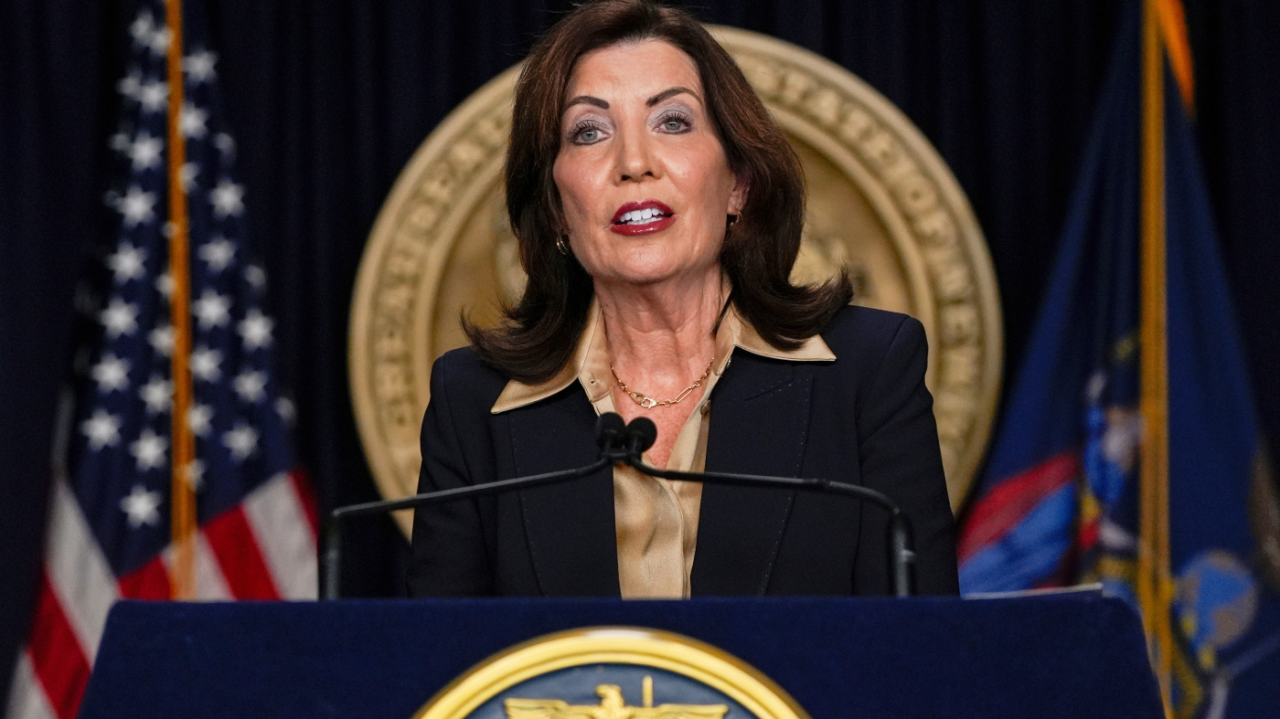
New York Gov. Kathy Hochul (D) is imposing the nation’s first-ever statewide freeze on new “hyperscale” data centers.
Hochul is pausing state-level environmental permits for “up to” a year to give the state time to put together a framework to protect the environment, the energy grid and New Yorkers’ electric bills, her office said.
Hochul aides told reporters that the pause would apply to data centers that can use 50 megawatts or more of power.
“As data center development threatens to hike up utility bills, deplete our natural resources, and create uncertainty for New Yorkers, it’s my responsibility to take action and lead,” the governor said in a written statement.
“New York will lead the way in creating the strongest standards in the nation for data center development, ensuring that when companies succeed because of New York, New Yorkers succeed too,” she added.
According to the International Energy Agency (IEA), data centers can vary in terms of their size and power use. The IEA says that “conventional” data centers can use between 10 and 25 megawatts while “a hyperscale, AI-focused” data center can use 100 megawatts or more.
Hochul’s announcement comes after the New York state legislature passed its own one-year moratorium last month. The bill would block data center permits for “hyperscale” facilities, which it defines as those with a peak load of more than 20 megawatts.
It’s still unclear whether the governor plans to sign or veto that bill. Hochul aides said that her office needs more time to look at the legislation and work on it with the legislature.
The aides said that in light of this, executive action is the fastest way to get something done.
It will be in place for up to a year, aides said, as the governor’s office works on a regulatory framework that relates to the centers’ environmental impact and impact on both water quality and quantity. The state will also seek to have the centers pay into a fund for the electric grid and will put together an investment fund framework to help localities negotiate their own agreements.
Hochul is also expected to back the repeal of a sales tax exemption for large data centers, though this would require action from the state legislature.
The move comes as data centers have received significant pushback. The power-hungry facilities may have significant environmental impacts, and their high levels of power use may also raise Americans’ electricity bills and destabilize the electric grid.
In response, several municipalities have frozen new data center construction locally, but no state has done so. Maine’s legislature recently passed a moratorium, but Gov. Janet Mills (D) vetoed it because it did not include a carveout for a project that was already underway.
Several progressive lawmakers at the federal level, including Sen. Bernie Sanders (I-Vt.) and Rep. Alexandria Ocasio-Cortez (D-N.Y.), have embraced the push for a moratorium and are calling for a nationwide halt to data center construction.
They were recently joined by a key mainstream voice in Rep. Frank Pallone Jr. (N.J.), the top Democrat on the House Energy and Commerce Committee.
Amid the backlash, several major tech companies signed onto a voluntary White House pledge in March, committing to cover price hikes to consumers caused by their data centers.
The server warehouses are crucial to AI, providing the computing power needed to run and develop the technology. But the vast demand created by the AI boom has prompted a push to quickly build more data centers that is running into a complicated reality on the ground.
The Data Center Coalition, an industry trade group backed by several major tech companies, argued Tuesday that New York’s moratorium “overlooks the role of data centers in attracting robust supply chain investments and jobs” and will “undermine New York’s economy and send a signal that the state is closed for business.”
“As hundreds of billions of dollars are being deployed to build out the nation’s digital infrastructure, Gov. Hochul’s statewide moratorium on data centers will ensure that those investments, jobs, and economic activity flow elsewhere rather than to New York — with impacts far beyond the data center industry,” Dan Diorio, the group’s executive vice president of state policy and government affairs, said in a statement.
Updated at 5:44 p.m. EDT
Copyright 2026 Nexstar Media Inc. All rights reserved. This material may not be published, broadcast, rewritten, or redistributed.