
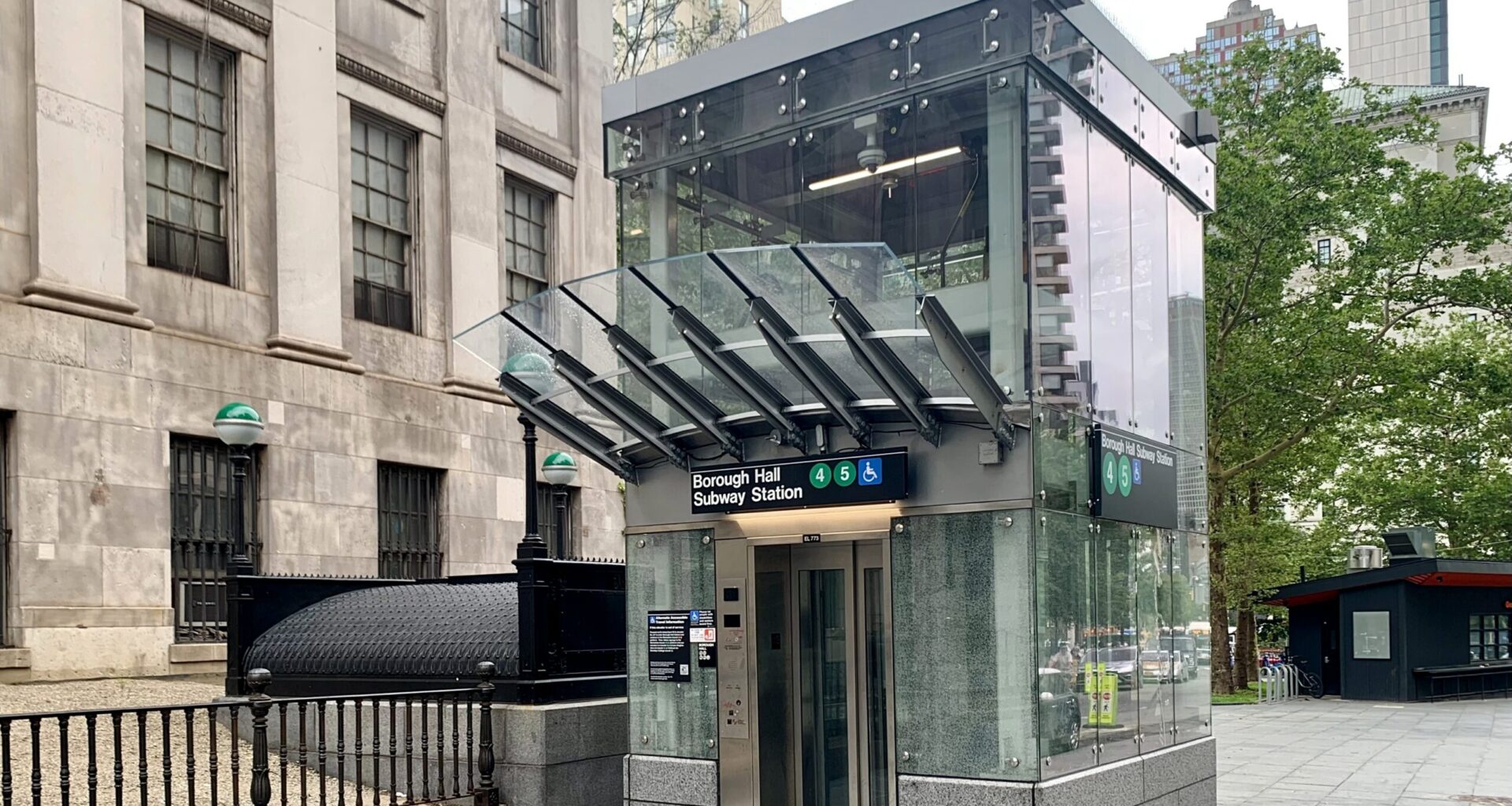
DOWNTOWN BROOKLYN — After more than two years of construction, the Metropolitan Transportation Authority announced Wednesday that one of New York City’s oldest subway stations is now fully compliant with the American Disability Act.
The Brooklyn Borough Hall station now features three new elevators that connect the street, mezzanine and platform levels for the 2, 3 and 4, 5 lines.
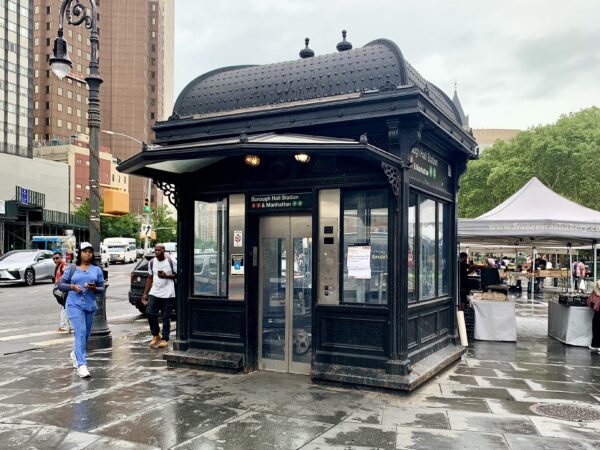 The 2 and 3 trains, and the 4 and 5 in the Manhattan direction only, have previously been accessible via an elevator in Columbus Park, shown here. Photo: Mary Frost/Brooklyn Eagle
One of the new elevators, connecting the street level to the mezzanine, is located on Joralemon Street, on the south side of Brooklyn Borough Hall. Two other new elevators connect the mezzanine to the subway platforms.
The $106 million project is about more than just adding elevators. In an exclusive interview with the Brooklyn Eagle, MTA Construction and Development President Jamie Torres-Springer described the agency’s accomplishments and challenges at the historic station, and revealed some of the behind-the-scenes issues the agency faced in modernizing a subway station built at the turn of the 20th century.
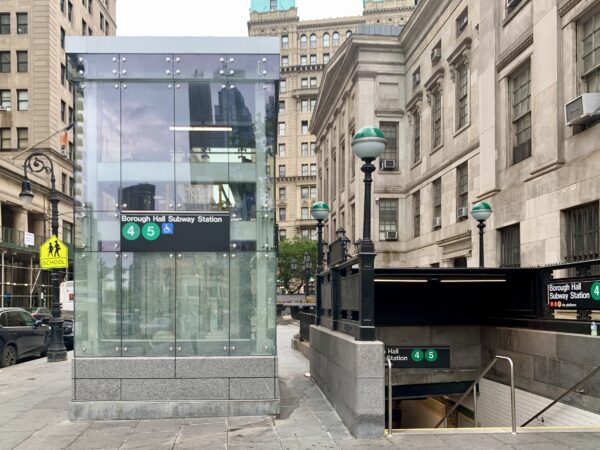 The subway construction under Joralemon Street required propping up Borough Hall, which shares a wall. Photo: Mary Frost/Brooklyn Eagle
Committed to making stations accessible
“This is a project that’s bringing full accessibility to a major Brooklyn hub,” Torres-Springer told the Eagle. Brooklyn’s Downtown Business District is one of the city’s top business districts, and Borough Hall is the fourth busiest subway station in Brooklyn, with an average of 21,143 weekday riders, he said.
While the 2- and 3-train section of the station has long been accessible via an elevator in Columbus Park, only the 4 and 5 trains to Manhattan were accessible. These latest renovations bring accessibility to the 4 and 5 trains in both directions.
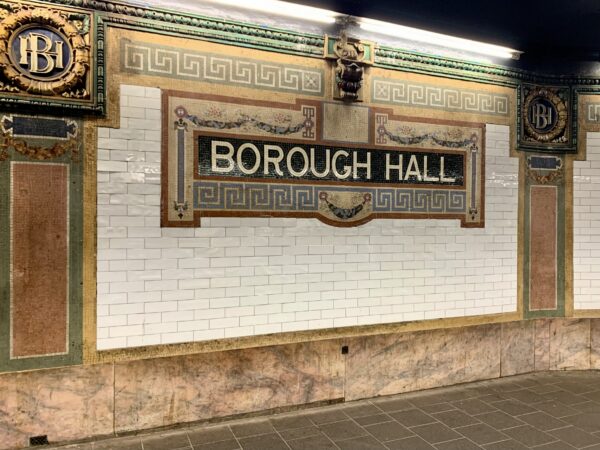 This mosaic and subway tile wall has been meticulously restored. Photo: Mary Frost/Brooklyn Eagle
Making a station ADA accessible is not just about providing an elevator to get folks down to the platform, he said. “We also have to make the whole, what we call ‘path of travel,’ ADA accessible.”
That means that someone who’s using a mobility device like a wheelchair has to be able to get from the street down to the train, and then be able to get onto the train. To do that, MTA creates an “ADA boarding area” on the platform, where the platform level lines up exactly with the opening of the train, with minimal gap.
“But in order to do that, because the platform was so old, we had to replace almost the whole platform on both sides,” Torres-Springer said.
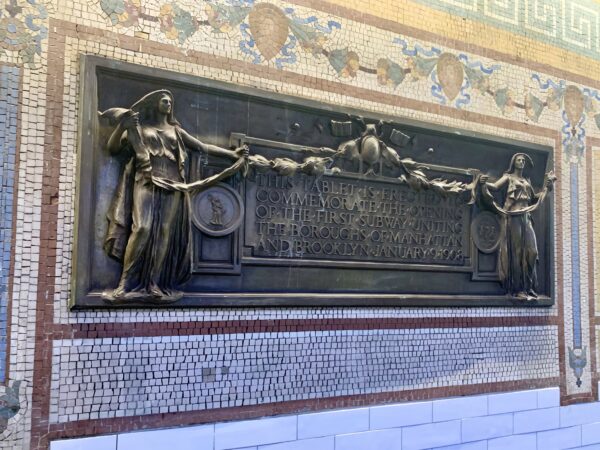 The Borough Hall subway station opened on Jan. 9, 1908 as the first subway uniting the boroughs of Manhattan and Brooklyn, according to this restored plaque. Photo: Mary Frost/Brooklyn Eagle
And that was just part of the job. As one of the oldest stations in the system, Borough Hall had “a huge slate of good-repair issues,” he said.
“At one point (in 2018), the ceiling fell in. That was because of the failure of the waterproofing and some of the system elements,” he said. “And so that meant there was actually a lot more structural work, a whole lot of ceiling, column and girder work.” This included redoing the waterproofing and replacing the entire ceiling, and paving the road surface above the station with protective layers to prevent water infiltration.
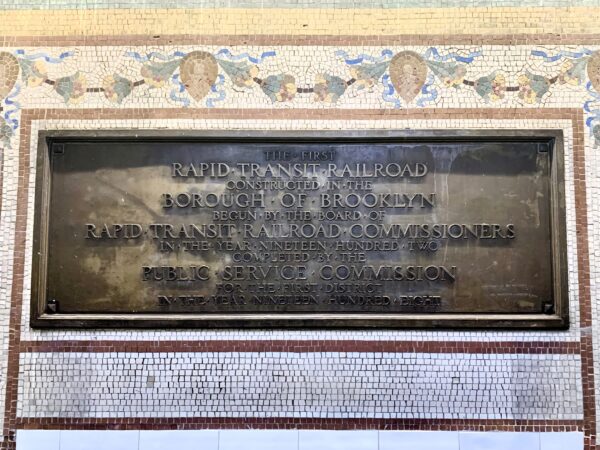 This plaque and restored mosaic commemorate the first Rapid Transit Railroad constructed in Brooklyn, completed in 1908. Photo: Mary Frost/Brooklyn Eagle
Meanwhile, doing construction under Joralemon Street required propping up Borough Hall in the process, “which was a really complicated activity,” Torres-Springer said.
“We had to demolish the stair entrance that is adjacent to Borough Hall, on the north side of Joralemon Street, and rebuild that stair and add the elevator, which is there now,” he said. “But that shared a wall with what was holding up Borough Hall. And so a lot of work was required to make sure everything got held up while we did all this construction.”
 Detail from a mosaic by artist ruby onyinyechi amanze, titled “May Your Road Be Light and Fun.” Photo: Mary Frost/Brooklyn Eagle
Historic restoration, new contemporary mosaic
The project also includes the historic restoration of 118-year-old wall mosaics, and the replacement of broken and missing subway tiles on the 4 and 5 platform. “We restored the historic design of the station,” Torres-Springer said.
To cap it off, a 110-foot-long mosaic by artist ruby onyinyechi amanze, titled “May Your Road Be Light and Fun,” was installed in the passageway connecting the 2,3 and 4,5 subway lines. The work, commissioned by MTA Arts & Design, repeats several motifs, including a leopard-human hybrid, a space alien and the themes of architecture, pool, bike and paper.
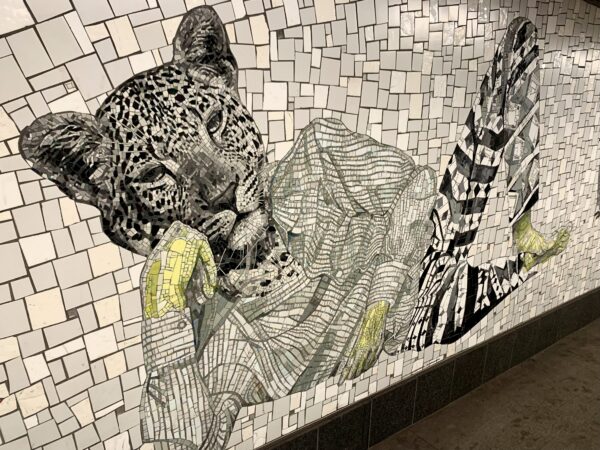 Detail from a mosaic by artist ruby onyinyechi amanze, titled “May Your Road Be Light and Fun.” Photo: Mary Frost/Brooklyn Eagle
“It’s a really beautiful piece of artwork,” Torres-Soringer said. “It’s really improved the look and feel of the station.”
There is still some work to be done on restoring the historic tile and making other improvements in the station, according to posted signs, but the accessibility part is fully functional.
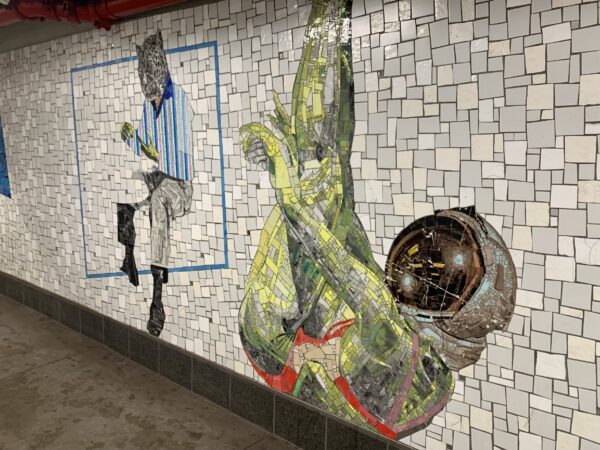 Detail from a mosaic by artist ruby onyinyechi amanze, titled “May Your Road Be Light and Fun.” Photo: Mary Frost/Brooklyn Eagle
More convenient for everyone
MTA is holding a press conference at the station on Wednesday to celebrate the ADA completion, and “it so happens we’re celebrating this during Disability Pride Month,” Torres-Springer said. “The Americans with Disability Act passed in 1990, and if you think back to that time, there were only 15 subway stations that were fully accessible.
“Now with Borough Hall, we’re bringing that number to 160 across the city, and we’ve got out 40 of those just in the last few years. We’ve really ramped up how much work we’re doing.”
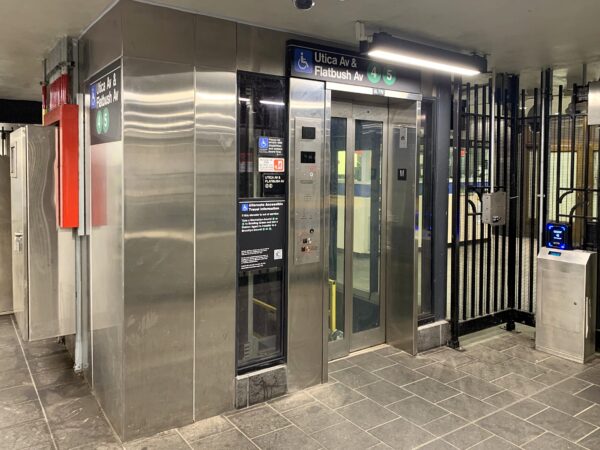 One of Borough Hall station’s new elevators on the mezzanine level. Photo: Mary Frost/Brooklyn Eagle
In Brooklyn alone, there are 169 subway stations, and 43 of them are currently accessible. Of these, 17 became accessible just since 2020, Torres-Springer said. “So we’ve done almost half of the stations that are accessible in the last few years.” Another 12 stations are in construction, he said, crediting a “better, faster, cheaper approach” at the MTA. “But the point is, once we’re just finished with what’s in construction right now, about a third of Brooklyn stations will be ADA accessible.”
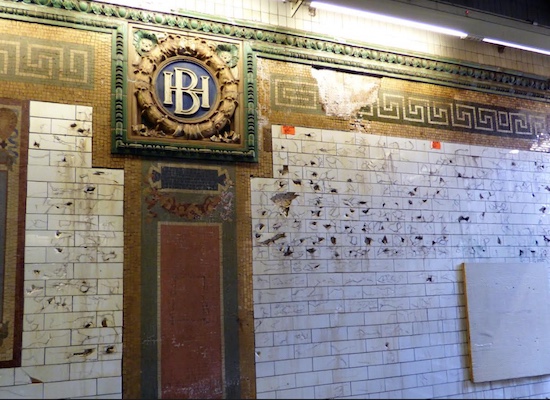 A mosaic at the Borough Hall station as it appeared in 2015. Photo: Mary Frost/Brooklyn Eagle
These accessibility upgrades will benefit a wide variety of transit riders, he said. “We’re not just focusing on people with disabilities … but also making the system more convenient for parents of young kids, or seniors who have trouble getting around.”
As a parent himself, Torres-Springer said he has memories of “hauling strollers or small kids down those stairs, and it’s incredibly difficult.” The accessibility upgrades “enable us to keep everybody mobile, and that’s something that we’re committed to.”
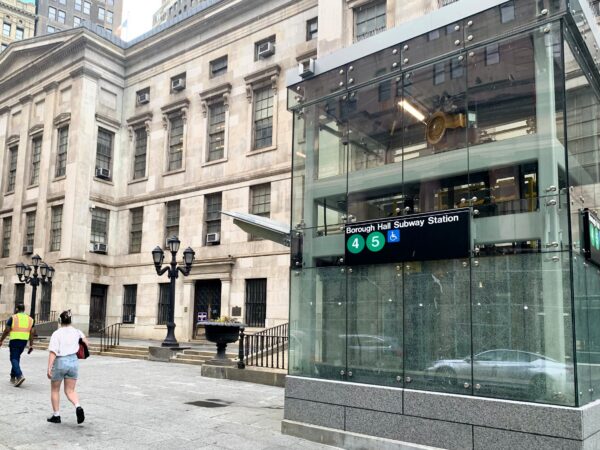 A new elevator on Joralemon Street connects to the Borough Hall subway station’s mezzanine level. Brooklyn Borough Hall can be seen rear left. Photo: Mary Frost/Brooklyn Eagle