
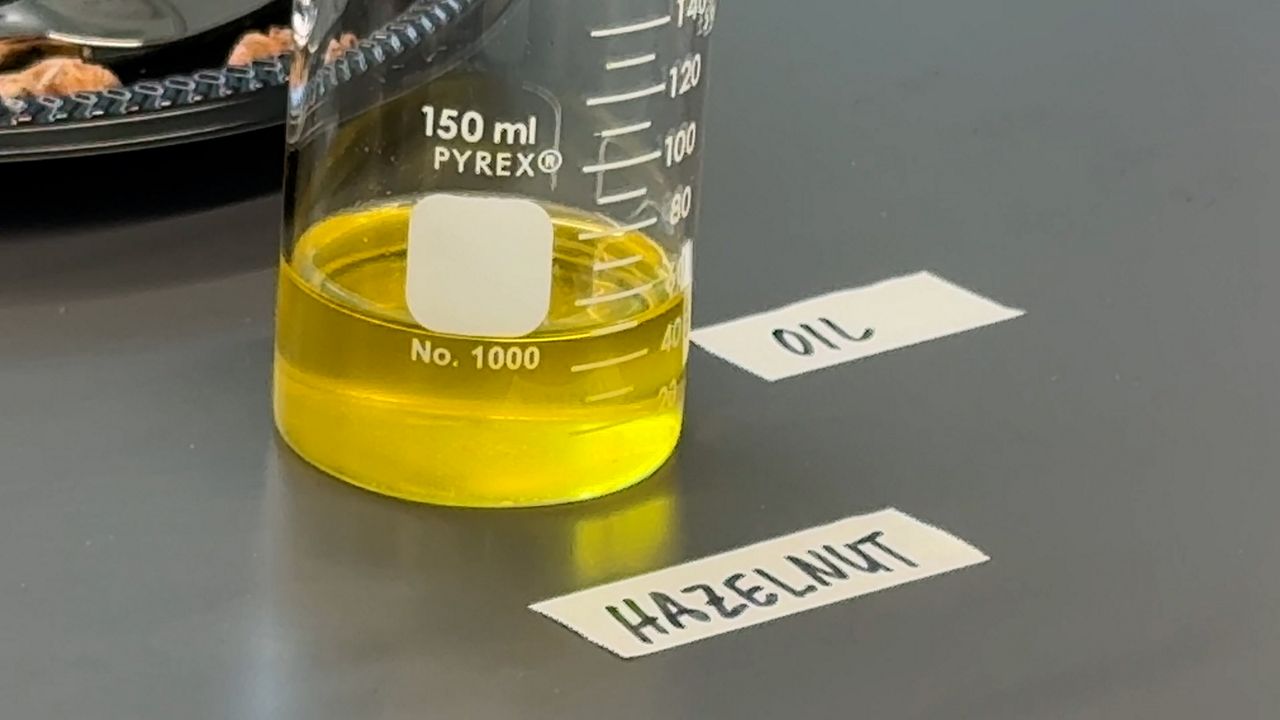
Many areas across New York state are switching to renewable diesel fuels, and SUNY Morrisville students are learning about these alternatives.
What You Need To Know
Many areas across the state are switching to renewable diesel fuels
SUNY Morrisville students are learning about these alternatives
Students are able to produce fuel with animal fats, sunflower seeds, hazelnuts, hemp and more
“You can make biodiesel or renewable diesel pretty much out of any animal fat or vegetable oil. On campus, we’ve grown sunflowers, hemp, soybeans. So pretty much any existing traditional crop could be used as an oilseed crop. Soybean or corn, there’s even corn oil,” said SUNY Morrisville professor of renewable energy, Ben Ballard.
It’s one area of study for students at SUNY Morrisville’s Renewable Energy Training Center. Ballard said another renewable fuel students work with comes from hazelnuts.
“We grow hazelnuts on campus, mostly because I have a personal interest in having perennial crops that could be grown for various applications and uses. And it turns out that hazelnuts actually have really good quality oil,” Ballard said. “Not only could it be a good food grade oil, but it has some really neat cold flow properties when you turn it into biodiesel.”
Ballard said depending on growing conditions, an acre of sunflowers could produce at least 50 gallons of fuel.
Petroleum diesel alternatives are in use across the state. University at Albany converted their petroleum diesel vehicles to renewable diesel last year, as did New York City the year before.
Erie County launched a renewable diesel pilot program last September for its public works department.
“When you have more energy products available to you, that keeps things affordable, reliable. Renewable liquid fuels, they’re able to use the same existing equipment that they already have,” said Empire State Energy Association Executive Director Kris DeLair.
Ballard said it would be challenging to produce enough biodiesel or renewable diesel to replace all petroleum diesel uses right now.
“Right now, rather than try to meet all of our transportation needs with renewable diesel or biodiesel, if we focused on heating oil, for example, or a replacement or an additive to heating oil, that’s a much narrower market, and we could have a bigger impact on that market by using renewable diesel or biodiesel,” Ballard said.
According to the New York State Energy Coalition, since July 1, 2025, all heating oil sold in New York state contains at least 10% biodiesel fuel.
“A lot of biofuels as a concept is how to use waste products, whether it be used cooking oil from fryers, it is a very common thing. You can take your fryer oil from your local fast-food place and can make that into biodiesel,” said SUNY Morrisville student Will Shamblen.
“There’s not going to be one solution to solve all of our energy problems,” Ballard said. “We’ve really got to keep all energy options on the table and keep moving forward.”