
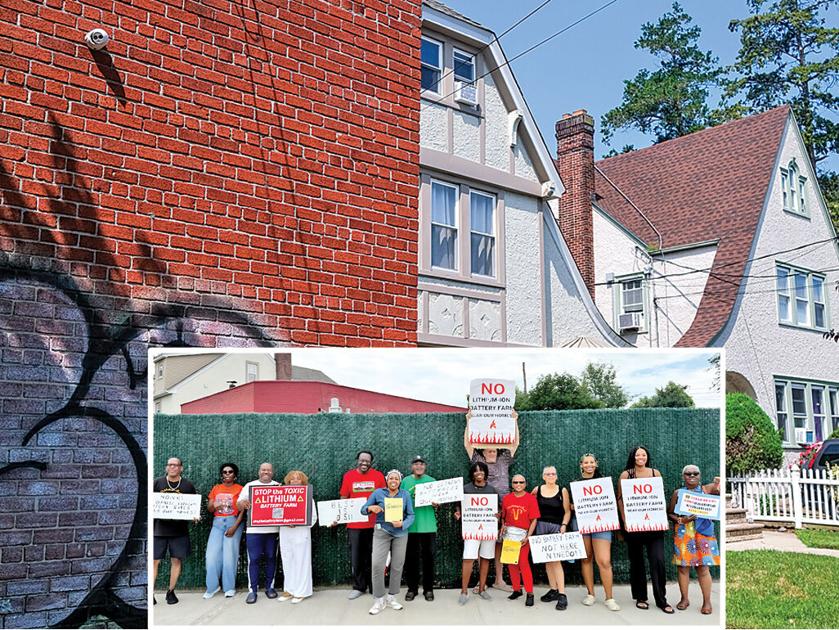
“The way we found out about it was that our building was shaking,” Jasmine Lawrence, who works at JFK Airport, told the Chronicle. She bought the house with her husband, a retired cop, in 2008, and says it has been in her family since her grandfather first bought it in the 1950s.
Soon, construction workers were at their door, requesting access to their driveway, and negotiations commenced before the pair ended up in court, turning down about as much money as they would end up spending in legal fees.
“They kept upping the amount and finally got up to $25,000, but by then we realized that this was not something that we wanted right next door. It was really going to devalue our property,” said Jasmine.
The dispute is now the subject of at least two lawsuits, one from NineDot seeking to force the Lawrences to allow the company to access their property in order to redevelop the long-shuttered gas station next door.
NineDot won a ruling this past May from a Queens judge who decided that the Lawrences’ “opposition is wholly without merit,” and ordered them to let the energy company in.
The Lawrences, however, have filed a separate lawsuit, which is in front of a different Queens judge, seeking a ruling that would stop the battery site from being built in the first place. That case has been waiting a ruling since last December and that’s a win too, they say.
“Because of the lawsuit, I think we’ve delayed them and they have not yet been able to progress on it,” Jasmine said.
The former gas station remains largely untouched behind a tall brick wall.
NineDot is being contracted in New York by Con Ed to build a handful of BESS sites that would store energy to be discharged when there is a high demand for power.
Over in Middle Village, the company is building a storage facility at 64-30 69 Place where the company has already encountered stiff opposition from the area’s local politicians.
In Southeast Queens, the outfit is building at least two other facilities, in addition to the one in Addisleigh Park. Those two have not been hit with challenges in court and are “nearly operational,” per a NineDot rep.
One is in Hollis, at Jamaica Avenue between 180th and 181st Street, and the other is in South Ozone Park, at the corner of Linden and Lefferts Boulevard.
“Building battery storage facilities in residential neighborhoods is a fire hazard and should not be permitted,” Paul Kerson, a lawyer for the Lawrences, told the Chronicle. He says he’s gotten “emotionally involved” in the case.
“You know a fire is going to happen. It’s going to happen. It can’t not happen,” he says. “Queens County has 2.3 million people. What are they doing here, it’s too dense and it’s too stupid. It wouldn’t cost them very much to put it in an upstate county 100 or 200 miles from here.”
Asked about the company’s choice of locations, a spokesperson for NineDot Energy says the FDNY says the batteries are safe, and pointed to the recent heat wave, during which Con Edison shut off power for nearly 10,000 people in southern Queens.
“As the last heat wave showed, there is a need for battery storage across New York City. Therefore we use the same criteria in SE Queens that we use for any location we build at: where the FDNY and DOB say our site plan is safe; where Con Ed says we can connect to the local grid; and where land is available for long-term lease or purchase.”
In the filings, Kerson is challenging the legitimacy of those safety declarations, pointing to “a bitter and vicious fight inside the New York City Fire Department” over the safety of lithium ion batteries, which are used to charge devices including e-bikes as well as store energy.
In 2023, Kerson says, seven former FDNY officials sued the city over their termination, in part citing a disagreement over “inaction on lithium-ion batteries.”
NineDot lawyers call that argument “misplaced” and say the battery facilities it operates are different from the kinds of lithium ion batteries used to charge e-bikes.
Both use the same underlying technology, but, on its website, NineDot says “the way our technology is deployed, monitored and managed, far exceed safety regulations even now in place with e-mobility batteries.”
In Middle Village, protests against the battery site have been taken on by City Councilman Phil Wong (D-Maspeth), who told the Chronicle last month that “NineDot knows that the community doesn’t want this battery power plant.”
In Southeast Queens, the former assemblyman Bill Scarborough, has taken up the issue from his perch running both the Southeast Queens Environmental Justice Coalition and the Addisleigh Park Civic Organization.
Since the battery projects were announced last year, Scarborough told the Chronicle that he’s wrangled at least 50 protests in front of the site next to the Lawrences’ home. The most recent was July 11 and the next one is planned for Aug. 8.
Scarborough sees the dispute as playing out local class politics.
“There are none of these in Manhattan. They’re not putting them in any of what would be considered the more affluent areas of Queens,” he said. He’s not moved by NineDot’s declarations of safety either.
“There’s no system that can guarantee that a fire will not proliferate,” he said. He wants a 300-foot buffer between any battery storage devices and people’s homes, the subject of a bill in the state legislature last year, sponsored by Sen. Joe Addabbo Jr. (D-Woodhaven), that Scarborough says was “unfortunately blocked in Albany.”
Scarborough said he suggested at least five other locations in the area to NineDot, but the company didn’t take him up on that either.
“They’re putting them in areas where they feel that they can do so without as much of a fight,” he said.