
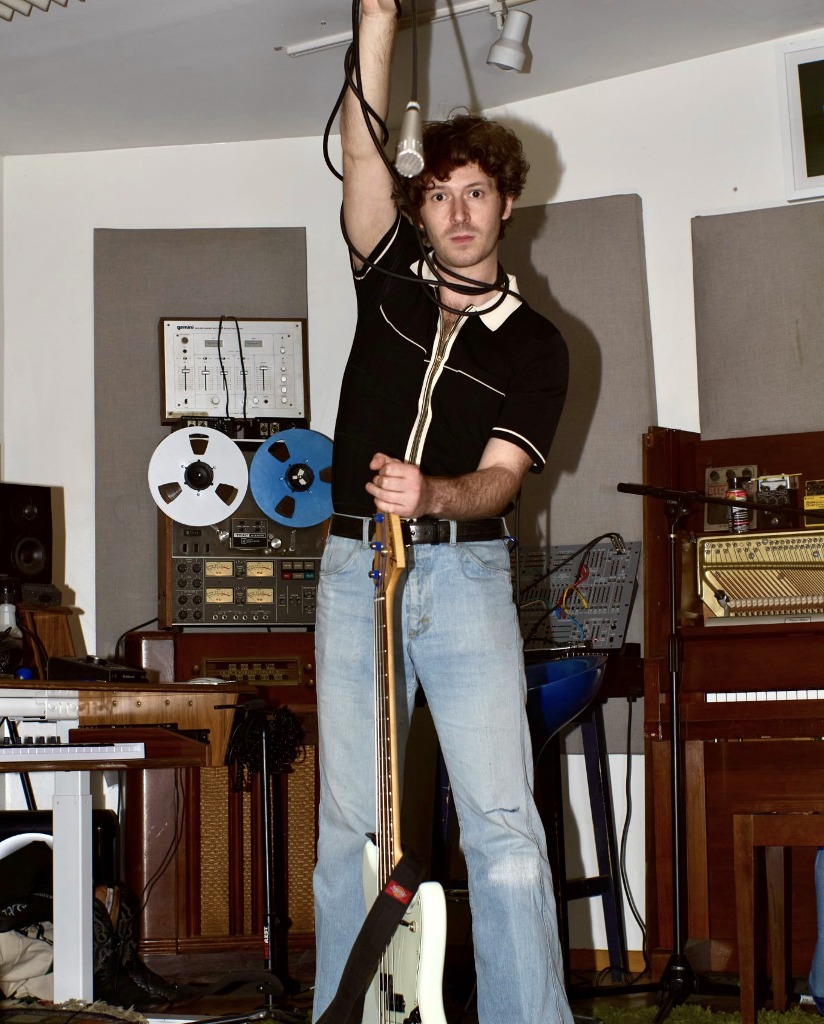
Your influences range from LCD Soundsystem to Talking Heads — artists known for reinvention and curiosity. Who else has shaped your sonic identity, especially in terms of posture and experimentation?
I’ve been writing music my whole life, pretty much, with some slips over the years. Throughout that journey, I’ve dipped my toes into pretty much every genre. Electronic, Folk, Punk-Rock, Acoustic Fingerstyle, Lo-fi Garage, Surf Rock… hell, even Ambient. I got bored really easily and was always in search of the next thing that would spark my curiosity. For years, I thought it was a weakness. I thought that if I could just get good at one style, then everything else would flow. But, here we are now, and I’m still not nailed down.
Finding artists like Bowie, James Murphy & King Gizzard really helped open my eyes. It was a lightbulb moment where I realized I didn’t have to be just one thing, much to the chagrin of radio/labels. I’m free to be an explorer without a destination. That’s where the good life lies, I think, and it’s incredibly exciting. The moment monotony rears its beige head, I know I need to switch it up. Being independent has its perks.
Growing up between London and the U.S. gave you a unique cultural vantage point. How has that outsider perspective shaped your writing, production, and artistic identity?
It’s true that I moved around a lot. I was exposed to a lot of different beliefs, interests, and even disappointments. I’m grateful for that. It’s hard for me to “settle down”, both literally and creatively, but I think I’ve found people to call home here in Brooklyn. I don’t think it’s influenced my production style. Writing wise, I guess it influences the words I borrow? Some of my lyrics are quite unconventional. I think any form of travel – by choice or otherwise – is good for the soul. It helps you understand that there’s always more than one side to a story, which helps me as an artist see things more holistically.
Before going solo, you toured internationally as Sid Simons’ bassist. What did those experiences teach you, and how did they prepare you for launching your own project?
Man, that was a great time. Touring can be tough, but at the end of the day, you’re just getting in a van with your best friends, driving around and playing music. It’s an adventure for sure. It taught me a lot about what it takes to pull off a gauntlet tour, how to bring your best to the stage no matter what, and how to use individual strengths to help the group. There’s so much behind the scenes stuff that the audience never sees, so I feel a lot more prepared for the future. Also, learning how to take better photos didn’t hurt.
The Europe leg was especially grueling – I think it was 24 shows in 25 days? – something like that. Some countries were a bit of a blur, but once you push past a certain comfort level, a second wind kicks in and then it’s over before you know it. I’m very thankful to Sid & the band. Best summer of my life, and I wouldn’t trade it for the world.
You handle everything yourself — producing, recording, mixing, and mastering at Parasol Studios. What does complete creative control allow you to achieve that collaboration might not?
First and foremost it’s convenient. If you’ve got the studio setup, the liveroom, the mics and whatnot, why not use them? I’m really comfortable in my own environment, which leads to being looser and experimenting more. There’s also the side to it that recording/producing/mixing/mastering my own stuff is really a practice of going mad. If I subjected my bandmates to listening to the same riff for hours on end they’d probably form an angry mob with pitchforks outside the studio doors. It’s easier to get in the flow state without worrying about other people’s comfort/boredom. Part of it is an exercise in control, probably, which isn’t the healthiest. I get obsessive.
All this is not to say that there’s zero collaboration. I find it really valuable to get another set of ears on something after you’ve listened to it a bajillion times. Fresh perspectives from my colleagues both inside & outside of the studio have helped me a ton when I’m stuck like a skipping vinyl. I prefer to do the gruntwork myself, though, as I really get to know the songs inside and out.
Your singles explore very different emotional territories — from the prophecy themes of “Anasia” to the generational weight of “Little Falls.” How do you decide where each song needs to go sonically and emotionally?
The simple answer is that I don’t decide. There’s always a beginning – a lyric, a guitar riff, a drum groove. It starts like a block of marble, and the more you chisel away at it, the more a sculpture emerges, but the fact is that the sculpture was there the whole time. I let a song become what it wants to be, and try to take myself out of the equation. Maybe it’s spiritual woo-woo, but it’s really the best way I know how to write. It taps into something – source, subconscious, whatever you want to call it – that’s hard to describe, but I think every creative person knows what I’m talking about.
The caveat is that even when practicing this, there’s always a piece of yourself that makes it in. Sometimes the song ends up being super out-there, sometimes it forms into something deeply personal. Sometimes, both.
“Little Falls” draws on your grandfather’s story and generational trauma. How important is personal history in shaping the narratives you build in your music?
It really depends on the song. For “Little Falls”, I was going through a dark period, even if I didn’t know it at the time. I was struggling with feelings that I kept making the same mistakes over and over again. My grandparents passed away some years back, and I guess my grandfather in particular was on my mind, as were his struggles. Often families pass on things that were left unresolved within their own lives. Maybe being human is just a constant cycle of trying to break the cycle.
We’re all different people throughout our lives, and a song is a way of capturing that moment, much like a photograph. I was talking with a friend on the phone the other week about music & art, and I think she put it beautifully. She said that music is “the gift of the sacred mirror”. You capture a snapshot of the person you were, and present it as a gift of self-knowing, so that the listener can see themselves more clearly. It’s beautiful because it’s so temporary.