
Let the 2028 presidential games begin!
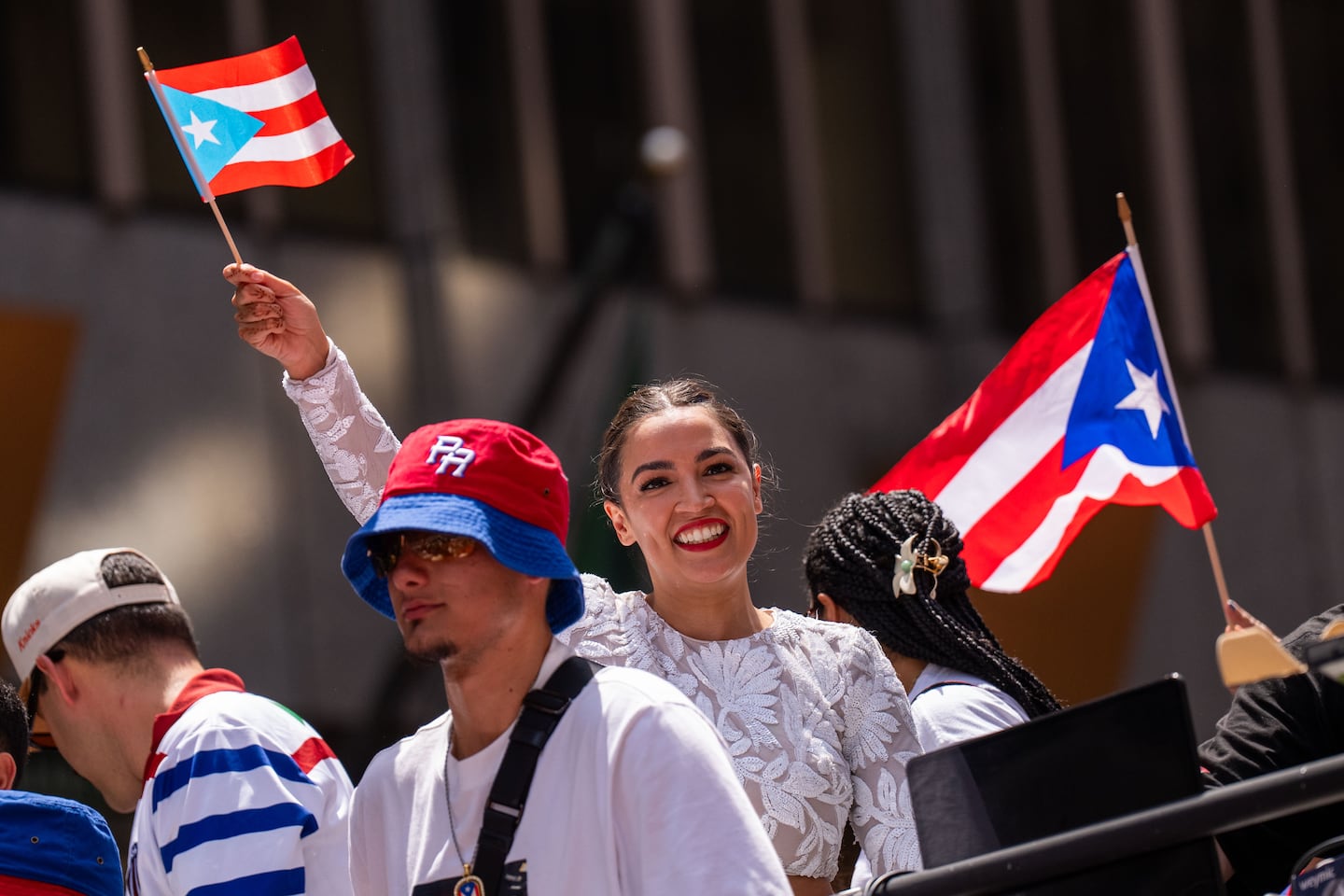
For the first time, a Latina leads a presidential primary poll — and it happened in one of the whitest states in the country. US Representative Alexandria Ocasio-Cortez, Democrat of New York, now sits at the top of the prospective Democratic field in New Hampshire.
A new University of New Hampshire survey puts AOC — as the Bronx-born progressive congresswoman of Puerto Rican descent is commonly known — narrowly at the head, with 22 percent support among likely Democratic primary voters, one point ahead of Pete Buttigieg, the former US Secretary of Transportation. After them, the field drops sharply: US Senator Mark Kelly of Arizona drew 9 percent, California governor Gavin Newsom 8 percent, US Senator Bernie Sanders of Vermont 6 percent, and Kamala Harris, the party’s most recent presidential nominee, just 5 percent.
Yes, it is absurdly premature to be handicapping 2028. Election Day is still more than 800 days away, and polls this early mostly measure name recognition and vibes. A one-point lead is a statistical tie. That’s why we should pay attention to the trend: Ocasio-Cortez trailed Buttigieg in this same survey last October and February, when she drew just 15 percent, and another poll caught her surging into second place in June.
So, while it’s a stretch to view these numbers as meaningful forecasts, the mood itself is worth reading. Are Democratic voters demanding the generational change their party keeps promising? Has AOC become a genuine national contender rather than a progressive celebrity? And does her identity as a young Latina from the Bronx and former bartender make her more or less electable?
Let’s start with the generational question. According to the UNH poll, which was conducted between July 15 and July 20, Ocasio-Cortez, 36, is now the best-liked figure in the field, viewed favorably by 64 percent of the Granite State’s likely Democratic primary voters and unfavorably by just 9 percent. And her appeal skews young: The Yale Youth Poll this spring found her running first among Democrats under 35, while Newsom leads among seniors.
Nor is the appetite for generational change confined to one party. In the same UNH poll, Vice President JD Vance, 41, leads the Republican field with 36 percent, and Vance himself has said he considers Ocasio-Cortez the Democrats’ leading candidate. I can see it: A contest between two rival versions of millennial populism, one that is nativist and exclusionary, the other multiracial and pro-immigrant.
As for whether AOC is a contender or a celebrity, one way to read her surge has to do with the other popular Democrat of the moment: New York City Mayor Zohran Mamdani, whose endorsed insurgent candidates for the House in New York State swept in June. The two seem to have a strong coalition, and it’s possible AOC is benefiting from the “Mamdani effect.” She has also been campaigning heavily in Michigan, rallying with progressive US Senate candidate Abdul El-Sayed ahead of the August 4 primary. That result will offer another data point on whether her surge can be read as a national coalition or just a New York moment.
But celebrity alone doesn’t explain the Ocasio-Cortez surge. For instance, she has been making substantive policy arguments on immigration, framing the Haitian and Syrian TPS ruling from the Supreme Court that allows the Trump administration to terminate the humanitarian programs as a kitchen-table economic issue. “[W]ho is going to be helping repair your home?” Ocasio-Cortez said. “I can tell you long-term care is going to go up. Healthcare is going to rise. You know, hospital workers. There are a lot of costs that are going to go up by these mass disruptions of our labor market, driven by pretty repressive and non-data-backed decisions.” In other words, she’s bringing it back to the affordability crisis, which voters keep ranking as their top concern.
Then there’s the question of identity. The UNH poll landed as the Democratic National Committee is in the process of selecting up to five new states for its early primary season. It was reported this week that Nevada and South Carolina — with their large Latino and Black voting blocs, respectively — are the top states the DNC would recommend to lead the 2028 calendar. New Hampshire would still be in the mix but not first. And that’s a good thing! I’ve supported both the New Hampshire primary and Iowa caucuses losing their longstanding first-in-the-nation status on the basis that their overwhelmingly white populations are not representative of the country’s diverse electorate.
So why focus on a poll that measures an electorate that may not get to vote first? Because, in my view, it can only get better for AOC. Nevada — and New Mexico, which is reportedly lobbying the DNC for an early primary slot with the argument that Democrats should prioritize Latino voters who walked away from the party in 2024 — would be potentially excellent terrains for the first Latina frontrunner, particularly because of what Latino voters are saying right now.
A recent poll of 2,000 registered Hispanic voters conducted by Equis Research in May found Trump’s approval among Latinos dropping to net -31 — that is, disapproval (63 percent) outpaces approval (32 percent) by 31 percentage points. It marks the first significant decline since last summer. The collapse is sharpest on the issues Latino voters themselves rank first: cost of living (-52) and the economy (-45). Among young Latino male voters, one of the groups that swung hard toward Trump in 2024, his cost-of-living approval sits at a staggering -63.
Those voters are up for grabs, yes, and AOC could be a good messenger. But for Carlos Odio, Equis’s cofounder and senior vice president of research, one of Ocasio-Cortez’s strengths lies in the fact that her base isn’t uniquely Latino. “She’s representative of how identities work today,” Odio told me, “where people can hold a few identities proudly without being flattened down to one dimension.” Odio doesn’t have recent polling on how Ocasio-Cortez would fare with Latino voters but he told me he will have some data on it soon.
Speaking of political identities, AOC is a self-described Democratic Socialist, an often-misunderstood label that is somehow both on a winning streak and still radioactive to some voters. So even if you can’t imagine AOC as the inevitable nominee now — plus, 800 days is several political lifetimes — she should be taken seriously. She embodies what Democratic voters say they want: A new generation, a blunt economic message, and a fighter.
This is an excerpt from ¡Mira!, a Globe Opinion newsletter from columnist Marcela García. Sign up to get ¡Mira! in your inbox each week.
Marcela García is a Globe columnist. She can be reached at marcela.garcia@globe.com. Follow her on X @marcela_elisa and on Instagram @marcela_elisa.