
The New York Rangers don’t play NHL games until September, but a collection of players will be in action at the Shoulder Check Showcase charity game Thursday in Fairfield, Conn. Adam Fox, Matt Rempe, J.T. Miller, Pavel Dorofeyev, Drew Fortescue and Gabe Perreault will all play in the game, which aims to raise mental health awareness.
Other than the charity game, the hockey front is relatively quiet. That makes now a good time for a mailbag. I’ll take Part 1 today, and colleague Vincent Z. Mercogliano will handle the second part later in the week.
Let’s dig in.
(Some questions have been lightly edited for clarity and length.)
Can Gabe Perreault get to Nikita Kucherov’s level?
Scott Wheeler, Corey Pronman and more
We all know the floor, but what’s a pie-in-the-sky but also realistic ceiling for the 2026-27 team as currently rostered? — Kit Y.
The Metropolitan Division is weaker than the Atlantic and guaranteed at least three playoff teams, so postseason hockey feels possible for the Rangers after their offseason additions. If Igor Shesterkin plays out of his mind or the Rangers get a favorable matchup (think Philadelphia beating Pittsburgh last year), New York could perhaps win a round. That feels like the realistic best-case scenario. The Rangers would need to add to their forward group before a deeper run becomes feasible.
Is there a scenario where Alberts Šmits has such an outstanding camp that he not only makes the opening day roster but also bumps Marcus Pettersson down to the third pair? — Howard L.
Even if Šmits was regarded by some evaluators as the most pro-ready defenseman in the 2026 draft class, getting second-pair minutes from him seems ambitious. Since the 2020 draft, only seven defensemen have played games the season immediately following their selection. Of those, only two — Matthew Schaefer with the Islanders in 2025-26 and J.J. Moser with the Coyotes in 2021-22 — played more than half their team’s games. Schaefer, a unicorn who receives praise from Hall of Famers and current stars alike, appeared in all 82 games and averaged 24:41 a night. Moser logged 43 games, averaging 18:42. In short, recent history doesn’t include many examples of a freshly drafted rookie slotting in on a second pair, and New York presumably didn’t give up a first-round pick for Pettersson, a player coach Mike Sullivan knows well from his time in Pittsburgh, to move to the third pair.
If Šmits performs really well in camp, what’s the highest realistic spot he might take? — Keith N.
As discussed in my response to Howard’s question, the third-pair left defense spot is probably the highest Šmits would get with a fully healthy defensive corps. That would bump Matthew Robertson to the extra defenseman. But even if Šmits is on the third pair, Sullivan could find ways to get him extra ice time, whether that’s by giving him special teams minutes or throwing him on the ice for occasional shifts with defensemen higher in the lineup.
The Rangers have the option of playing Šmits in the AHL and allowing him to log big minutes and further round out his game. New York could also do a combination of the two approaches and reward him with some NHL games while still keeping him in the AHL for long stretches. That will come down to how he plays in camp and what the development staff believes is best for his game long term. That must remain the priority with a prospect of this caliber.
After an injury-plagued season, is Matt Rempe out of favor with the Rangers? Last training camp, Mike Sullivan was raving about him, but now it seems as if he’s an afterthought. — Paul F.
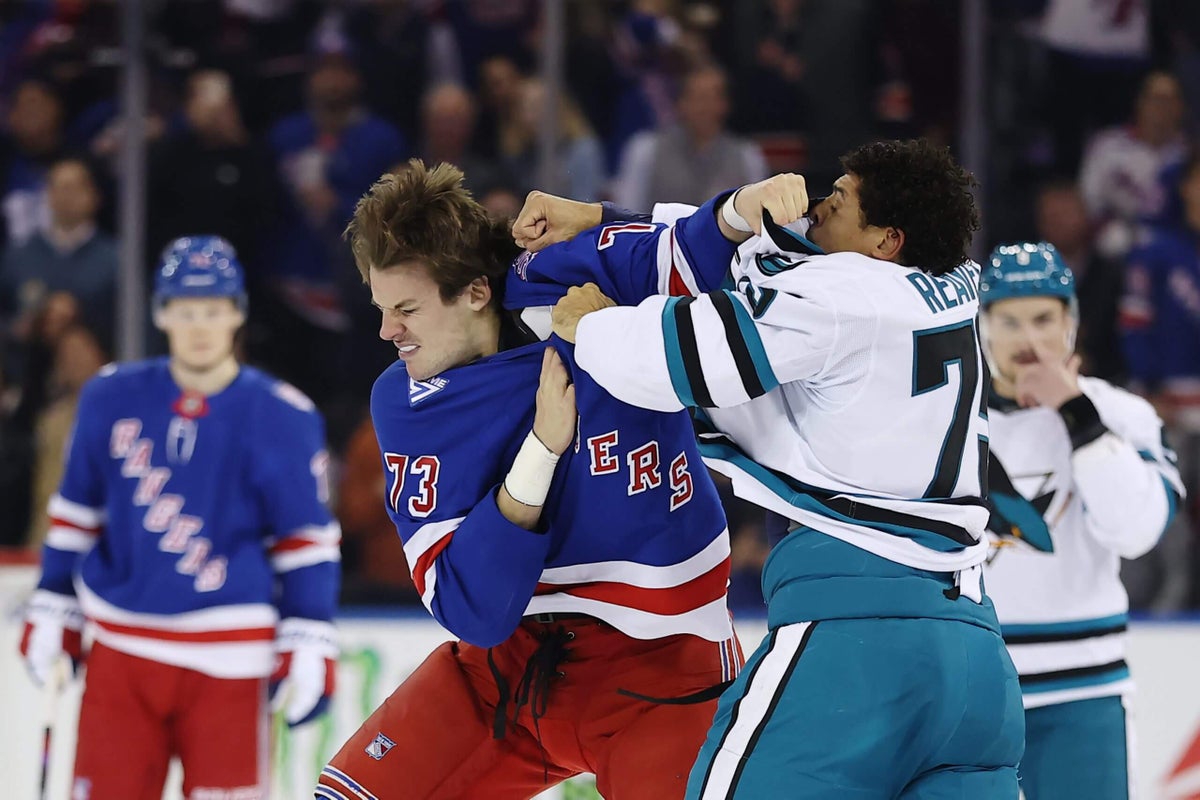
Rempe, as you alluded to, had a trying 2025-26 campaign while dealing with a lingering thumb injury from an early-season fight with the San Jose Sharks’ Ryan Reaves. Though the 24-year-old hasn’t been much of a discussion point this offseason, it’s notable that New York — after getting strong showings from Jaroslav Chmelař and Adam Sýkora — traded waiver-eligible depth wingers Brett Berard and Adam Edström but held onto Rempe.
Rempe will need to clear waivers this year to go to the AHL, so don’t be surprised if New York wants to avoid risking losing him for nothing and keeps him on the active roster to start the year. That, of course, doesn’t guarantee a spot in the opening-night lineup. If the team is fully healthy, Rempe will likely battle Chmelař, Sýkora and potentially rookies like Liam Greentree and Cole Beaudoin for roles. Training camp will be important for Rempe, both to show he’s recovered from his thumb injury and to rediscover some of the swagger he played with to start 2025-26.
Can a team with average five-on-five offense, great special teams and defense, and elite goaltending win a Stanley Cup? That seems to be the best-case outcome for the Rangers for the next three years. — Albert K.
Among Stanley Cup winners since 2009-10, 10 of 17 champions were in the top 10 in the NHL in goals scored, and all but four were in the top half of the league in five-on-five goals. The four major outliers were the 2024-25 Panthers (22nd in NHL in five-on-five goals), 2023-24 Panthers (26th), 2014 Kings (27th) and 2012 Kings (29th). But all of those teams were among the highest-scoring teams on a rate basis in their respective championship playoff runs. The 2024-25 Panthers were second out of 16 playoff teams in postseason goals for per 60 minutes, per Natural Stat Trick. They were fifth the year before, and the Kings were third in 2014 and second in 2012.
The other teams who finished in the top half of regular season goals but out of the top 10 (the 2020-21 Lightning, 2018-19 Blues and 2013 Blackhawks) were all top three in playoff goal rate.
The closest comparable to the vision outlined here is probably the 2023-24 Panthers. That team boasted a top-10 power play and penalty kill, excelled defensively, and had Sergei Bobrovsky, who finished third in Vezina Trophy voting. But as the Panthers showed in the playoffs, they still had plenty of offensive firepower between Sam Reinhart, Matthew Tkachuk and Aleksander Barkov.
NHL free agency: Early winners and losers
Shayna Goldman and Madison Eades
If the Rangers aren’t committed to Braden Schneider beyond this year, then why did they trade Will Borgen who would have been a cheaper option on the third pair? If Schneider isn’t traded for a forward or high draft pick, what did (team president and general manager) Chris Drury accomplish signing a third pair RD for $5.5 million for one year? — Sally
Essentially, this was a decision to punt. The Rangers neither committed long term nor walked Schneider to unrestricted free agency, where they’d risk losing him for nothing next summer. He’ll still be a restricted free agent next summer. Now New York can see if he progresses with a more manageable workload while keeping their long-term options open. They can ultimately work out an extension with Schneider, trade him, or give him another short-term deal in restricted free agency next summer. Borgen ($4.1 million annual cap hit through 2029-30) was a cheaper option, but he’s a longer-term commitment. Plus New York wasn’t in desperate need of cap space for this season. It still has around $2.4 million, per PuckPedia. Schneider will be 25 at the start of this coming season, so he’s younger than Borgen, and Drury said the team values the skill set he brings.
What’s the benefit in unloading Edström for zilch? — Eric G.
The Rangers have a logjam at bottom-six wing, as we touched on a bit earlier this mailbag. If Edström didn’t make the team out of camp — which the Rangers clearly believed was a real possibility — he would’ve gone on waivers, and New York might’ve lost him for nothing. Instead, Drury picked up a fifth-round pick from the Nashville Predators in exchange. Not much, but not nothing.
Drury traded away two of their own first-round picks. Think that comes back to bite him? — Chris M.
This question touches on the inherent gamble Drury made this offseason. He actually traded three first-round picks if you count the late 2026 one (originally Dallas’) that went to Vegas in the Pavel Dorofeyev deal. The Golden Knights also got the Rangers’ 2028 first-round pick, which becomes an unprotected 2029 first if it falls in the top 10 in 2028. Vancouver gets the Rangers’ 2030 first-round pick, once again top-10 protected, in the Pettersson trade.
Drury has repeatedly said he doesn’t want to discuss the timeline of his retool, but the Dorofeyev and Pettersson trades indicate he is counting on his team to be at least in the playoffs by 2027-2028 (or 2028-29 at the latest). If the Rangers make the postseason in 2028 and 2030 and those picks are in the back half of the first round, then they will probably have been a worthwhile acquisition cost for two contributing players. If New York remains out of the postseason and has to give up a lottery pick (or two in a worst-case scenario), then we’ll look back at those offseason decisions as disastrous.
My understanding is that goalie Dylan Garand is subject to being claimed on waivers if Drury tries to send him down to Hartford. Is that true? Is he is likely to be claimed if this happens? — Dale C.
That is true: Garand is no longer waiver exempt.
It’s difficult to gauge the likelihood of a waiver claim, but goalies are always a hot commodity. Carolina claimed Brandon Bussi before last season, and the Sabres claimed Colten Ellis. So it would be a risk letting Garand, now likely behind newly acquired Joonas Korpisalo on the depth chart, get to waivers.
The Rangers have the cap space to carry three goalies, but it would be difficult in that case to find a rotation in which Garand — a 24-year-old goalie in need of games — would get the amount of playing time most beneficial for him to develop. If the Rangers go the conventional tandem route, they’ll keep one of Korpisalo and Garand as the No. 2 behind Shesterkin and then waive or attempt to trade the other.