
One at a time, visitors procure a small coffee cup, smudge it with grounds, then place the result in the machine. It takes a few minutes to receive a printout—the artists have programmed the work to operate locally and that requires far less energy (“Each prediction consumes roughly ten percent of the power needed to heat a small cup of coffee” explains Mass MoCA’s text). The slower pace resists the immediacy we expect of technology in its pursuit to push us into its designed future. Notably, the work also uses a LoRA Adapter and a “quantized” multi-modal model that limit the AI’s capacity to expand. The artists have not relinquished control to the machine; it remains a creative tool.
Hakopian’s work thus brings tradition and friction into a medium that more often feels futuristic and instantaneous. On a recent evening, the machine spit out a prediction for me that read more like an ominous poem than like any self-help passage or message to conform to any societal standards.
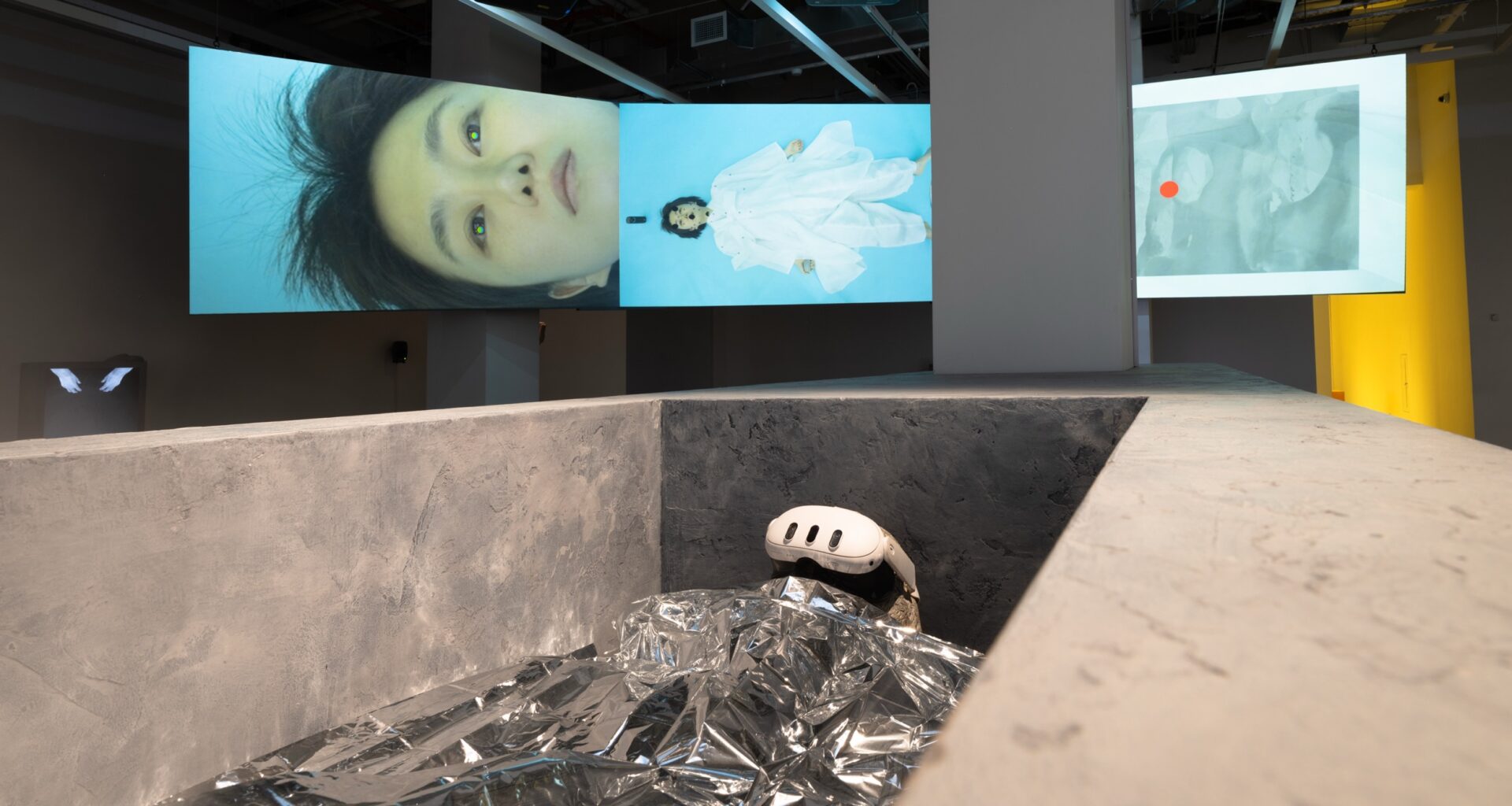
Here and across the larger show, artists suggested how new technologies can aid in connection and cultural preservation. Lakota artist Kite presented a video work called Wičháȟpi Wóihaŋbleya (Dreamlike Star) (2024), made by training an artificial intelligence on the Lakota language, then prompting it to (visually) interpret dreams that she records with pen and paper. An essay she co-authored, “Making Kin with Machines,” explains their rationale for embracing AI:
Indigenous epistemologies are much better at respectfully accommodating the non-human…We retain a sense of community… through complex kin networks anchored in specific territories, genealogies, and protocols. Ultimately, our goal is that we… figure out how to treat these new non-human kin respectfully and reciprocally—and not as mere tools, or worse, slaves to their creators.
As we use bots as oracles, therapists, and stand-ins for romantic partners, we diminish the value of the real, live people who offer care and compassion alongside critical, complicated interactions that challenge us as well. It’s too easy for these technical endeavors to be merely of service to our desires.
Conversely, Nick Doyle’s recent show at Perrotin, Collective Hallucinations, recalled the southern California brand of mysticism, which nonetheless infiltrates the out of body yearnings of Silicon Valley ideology. Co-Star’s direct, of-the-moment voice was emulated by Doyle’s installation Mirror Mirror (2026), which was the heart of his exhibition. For this presentation, he created a “psychic parlor” that appeared in the center of the gallery, surrounded by a suite of bleached denim on panel paintings. Some resembled enlarged tarot cards, introducing Doyle’s prophetic themes. The parlor’s exterior resembled a small cinderblock building with a black banner that read “ORACLE AVA ~ 1:30” centered between signs of two spades.
Inside the darkened booth, Oracle Ava appeared as a blond woman projected onto a screen. She asked me questions about what had brought me. Her Australian accent with a bitchy affect stung when she said: “Okay, mystery woman,” apparently displeased with my reply to one of her queries with: “it depends.”
Ava’s sniping encouraged further disclosure, but the condemnatory tone was perhaps appropriate: Doyle’s work had me sitting in a dark booth, asking a simulated consciousness about the matters closest to my heart. I exited and another woman walked into Oracle Ava’s domain. From outside the walls, I heard her ask a question related to her employment.
Divulgences weren’t just to Ava but to everyone else in the gallery—paralleling the data collected by private companies from our use of these generative AI platforms. We submit to such surveillance and information extraction, at this point, knowingly—it’s no secret anymore. We may wish to peek into the future, but apparently not about the use of this personal information (for or against us) in some not too distant moment.
It is embarrassing, I thought, to be a twenty-first century gallery-goer, with unlimited information at our fingertips, asking a screen about the future of our careers, romances, and lives at large. Adorno has something to say about that, and it isn’t flattering: “Indulgence in astrology may provide those who fall for it with a substitute for sexual pleasure of a passive nature. It means primarily submission to unbridled strength of the absolute power.” Those of us looking to the oracle are finding catharsis and release in our domination, not in our own power or autonomy.
Turning to art and poetry, though, offers a reminder that even (especially?) the most brilliant of female artists have grappled with this kind of seeking and subservience. The erotics in Adorno are on a continuum with Sylvia Plath’s iconic poem “Daddy,” in which the speaker has a “gipsy ancestress… weird luck / And my Taroc pack and my Taroc pack” while acknowledging that “Every woman adores a Fascist, / The boot in the face, the brute / Brute heart of a brute like you.” In her 1974 essay “Fascinating Fascism,” Susan Sontag articulated the allure of fascist aesthetics and, like Adorno, linked them to the occult.