
True Colors
FREIGHT+VOLUME
June 13–August 22, 2026
New York
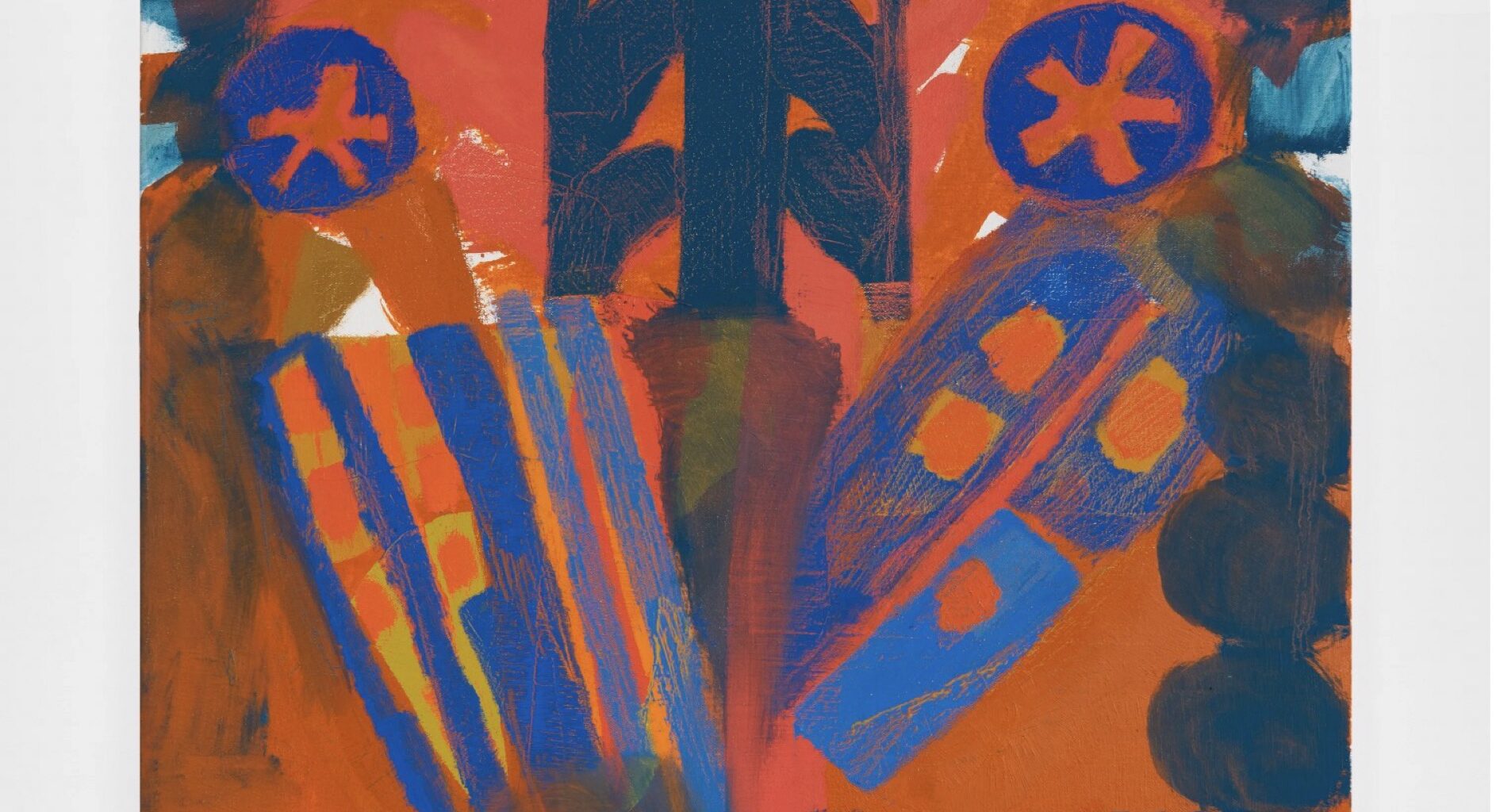
FREIGHT+VOLUME’s True Colors summer group show includes the work of eight artists: Meghan Brady, Mary DeVincentis, Jai Hart, Riad Miah, Ilse Sørensen Murdock, Julia Rooney, Cordy Ryman, and Paul Sevigny. Although some of the artists have exhibited with the gallery fairly regularly, they do not share any immediately perceptible pictorial-aesthetic approach. Under closer scrutiny, one can espy a broader thematic tendency—one consistent with so-called post-minimal “casualism” or “provisional painting,” a description Raphael Rubinstein applied in 2009 to “works that [intentionally] look casual, dashed-off, tentative, unfinished or self-cancelling.” According to Rubinstein, artists working in this manner “deliberately turn away from ‘strong’ painting for something that seems to constantly risk inconsequence or collapse.”
This self-conscious teetering on the borders of inconsequence plays out in various ways, ranging from deliberate unfinishedness (e.g., unpainted or bare expanses of the canvas) to inchoate forms (e.g., indefinite figurative elements or undefined geometric cantons). In Meghan Brady’s loose washes of flaxen and navy flower petals, this oscillation consists in the thickness of the artist’s tottered stroke and its refusal to delineate that which is represented. Like Judy Ledgerwood’s textile-inspired fields, Brady’s Everything Is (2025) uses ornamental cinquefoils, but the blanched, wide daubs are haphazard. Dark azure-apricot flanks of arboreal and leafed stems are muddied about—as if viewed from an intimate vantage, the blunted stalks are vertical rectangles tessellated into a brume. The works are hardly impressionistic in the traditional sense, as the motifs’ lack of structure and their intimate scale preclude sensory reference to vistas or wilderness widely observed. Of Brady’s three compositions, the best in the show is The Renters (2025), where stacked white-chalked stalks figure as formal elements but retain some naturalist indication, with the petals aptly distinguished from the lime, titian, azure, and charcoal blooms below.
Mary DeVincentis’s two works make use of a similar pressurizing of the picture plane, weighting the upper or lower third of the canvas with a semicircular motif atop a dry, indefinite field. In both works, a lilliputian figure breaks through the craggy brushstrokes. Alone in This Together (2021) is particularly evocative, as the lone presence—perhaps a female nude—is indicated through a flickering brown oscillation. By positing the crimson-fanned humanoid atop an onyx path-cum-mound in From this Broken Hill (2022), the latter painting foregoes this otherwise welcome shrouding effect.
Jai Hart’s works—especially Landscape with /// and :::::”s and Hairpin Turns in Red, Green, Blue and Yellow (both 2026)—are excellent. The artist’s use of poly-fil stuffed canvas tubing puffs up the bright yellow frames of the former work into a French-fry-gold trellis around sinuous teal, fuchsia, and highlighter acid-yellow deposits. As we see in Rain beams +clouds (2025), some of Hart’s broadly abstract tracts are plotted over by the rising silhouettes of gray clouds, which effectively break up the primary color scheme. Working with play-mat yellows and blues—her palette reminiscent of Niki de Saint Phalle’s—Hart effectively brings to bear the gleaming plastic finish characteristic of Fisher-Price ring stacker toys. Here, we find the artist accomplishing a difficult phenomenological feat, transfiguring the sensory-tactile characteristics associated with cheap childhood toys into abstract sculptural and pictorial forms while avoiding the all-too-easy option of pictorial reference to the garish trinkets. The spatial recesses of Hart’s “formed paintings” figure as dented quadrants and parcels. In Hairpin Turn in Red, Green, Blue and Yellow (2026), the stroke-pocked internal grid is incised by baby-blue and light canary undulations; the sloping formal cut is doubled in green, pale beige, and tomato-vermilion diagonal stilts that project from the bottom of the puffed canvas. Much ink has been spilled about artists “occupying” the proverbial borderlands partitioning sculpture and painting, emptying the notion of meaning. But Hart cleverly engages both mediums without rendering sculpture as a vehicle for painting or vice versa. Hart’s balancing act is anchored in both the Day-Glo palette her painterly-sculptural constructions share and her ability to keep the two mediums distinct.