
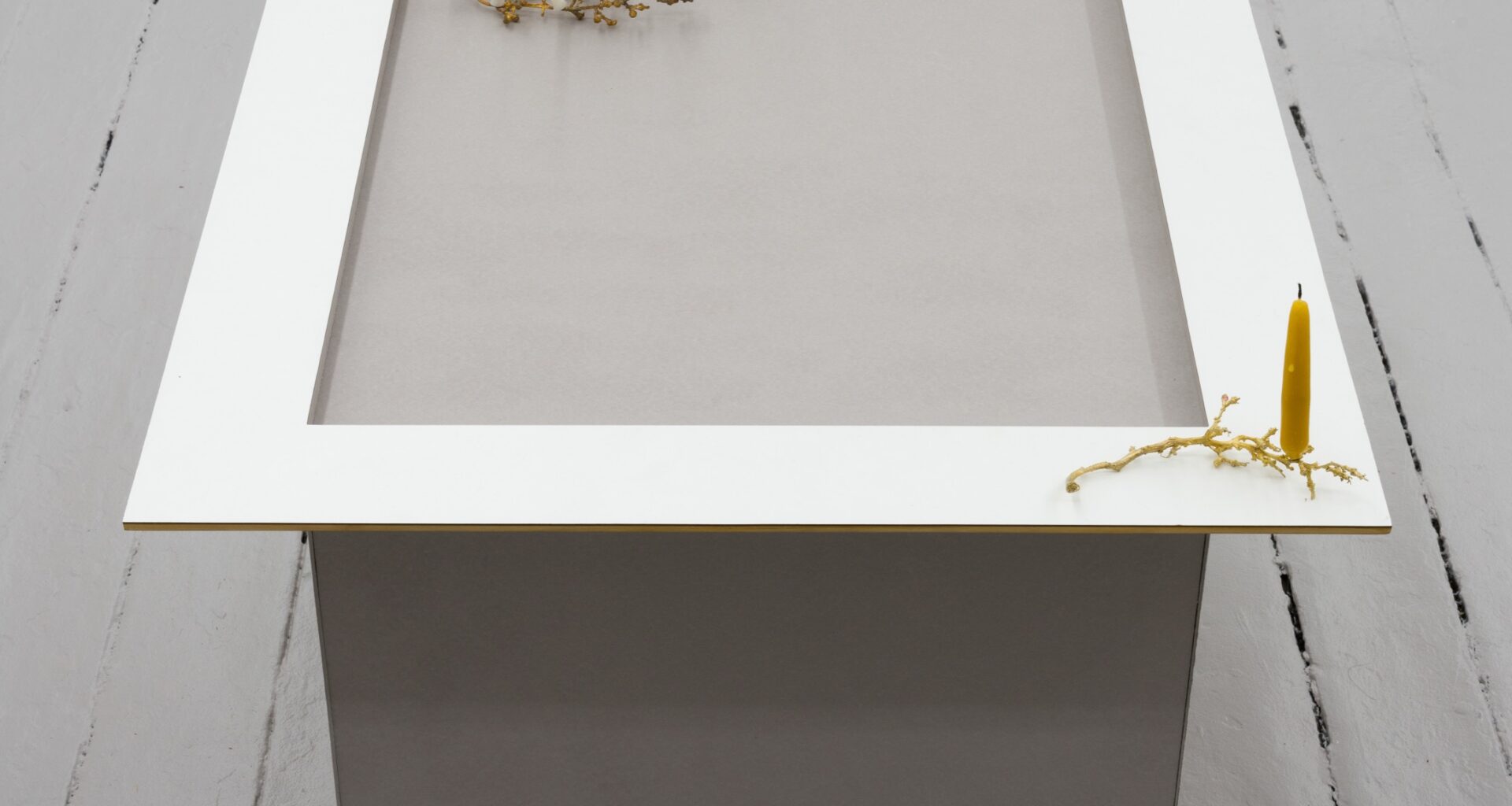
The candle is on the table
Theta
May 15–June 20, 2026
New York
Molly Rose Lieberman’s The candle is on the table is her second solo show at Theta in Tribeca. Included in the exhibition are seven paintings on panel and linen and four sculptures that are made using the materials and conventions of bookbinding. While Lieberman is mostly known as a painter and has regularly shown in New York since 2021, I found myself thinking about all the other ways I’d categorize the work—as boxes, as containers of time, as diaries, or concrete poetry. Lieberman seems particularly interested in expanding the reach and definition of her paintings, incorporating different strategies and speeds of making.
Several of the paintings appear in ornate Art Deco frames. The found picture frames are a hallmark of Lieberman’s work. She repurposes deaccessioned museum frames, often misusing them, turning them backwards, painting on them, or as a sculptural component of the artworks. In the corner of the gallery is the sculpture Skyscraper (2026): a stack of book boxes set on top of a lacquered piece of furniture making an improvised tower. The book-like structure of the show extends especially to Lieberman’s keeping of a kind of index for the artworks. Textual references that explain just how the paintings came to be, along with their inspiration, scraps of texts, or anecdotes that informed their making, are all documented in her book A landscape shredded (2026).
For instance, I learned that the painting Btw 2 bridges (2025) originates from an encounter with a man in orange and yellow who Lieberman saw buying a green coat on the train. This became the first palette for the painting. As she completed the work, the figure of the Manhattan Bridge then emerged, which in turn compelled her to cross the bridge in the form of a ritualized performance. This then found its way back into the painting as the dots of red mimicking the headlights she saw streaming across the bridge at night. On the one hand these are banalities, scraps of narrative present in every artist’s process. But Lieberman’s insistence that the paintings can be made to hold all manner of things—a poem, a snapshot, a chance encounter—starts to explain the peculiar temporality of her work and the feeling that they’re not quite reducible to what’s simply in front of us.
There’s an almost compulsive will towards complicating the relationship between action and resulting mark, something methodical and careful masquerading as improvised. The painting is mostly composed of smears of a thick putty-gray, with snatches of red and daubs of turquoise appearing throughout. At first the paint looked casually, even haphazardly, applied. But these areas had been methodically taped-off to perfectly correspond to the little spaces between other painted marks. Lieberman seems driven to displace the event of the painting away from the act of painting. Still the total effect isn’t as overwrought as it might sound. Instead, Btw 2 bridges feels breezy and untroubled.