
Let Us Gather in a Flourishing Way
Buffalo AKG Art Museum
March 6–September 6, 2026
Buffalo, NY
Encompassing Latin American and Caribbean diasporic experience in the United States—across affiliations such as Chicano, Nuyorican, and Dominican-American identity—the Latinx category remains resistant to fixed contours, since to define it too tightly is also to delimit it. Let Us Gather in a Flourishing Way, curated by Andrea Alvarez at the Buffalo AKG Art Museum, embraces that expansiveness while attempting to take stock of a sprawling and remarkably diverse field. With fifty-eight artists—two more than the 2026 Whitney Biennial survey of American art—the exhibition carries, not unreasonably, something of the same ambition and scale: less a fixed account than a provisional census of a field in motion.
Let Us Gather is loosely organized around seven thematic groupings: “(New) Histories,” “Bodies & Figures,” “Identity/Place,” “Land/tierra,” “Community,” “Pinturx,” and “Abstractions.” Yet Alvarez resists describing the exhibition as a survey and maintains that these thematic categories remain deliberately porous. And so the exhibition is perhaps best understood as its title suggests: a flourishing and cacophonous gathering. It’s a phrase borrowed from a Spanglish poem by former US Poet Laureate Juan Felipe Herrera, printed on the wall at the entryway with stanzas recurring throughout the galleries. Like the composite syntax in Herrera’s poem, the exhibition is multivocal in a way that is irreducible to any single one of its parts—a chorus that doesn’t resolve so much as resound.
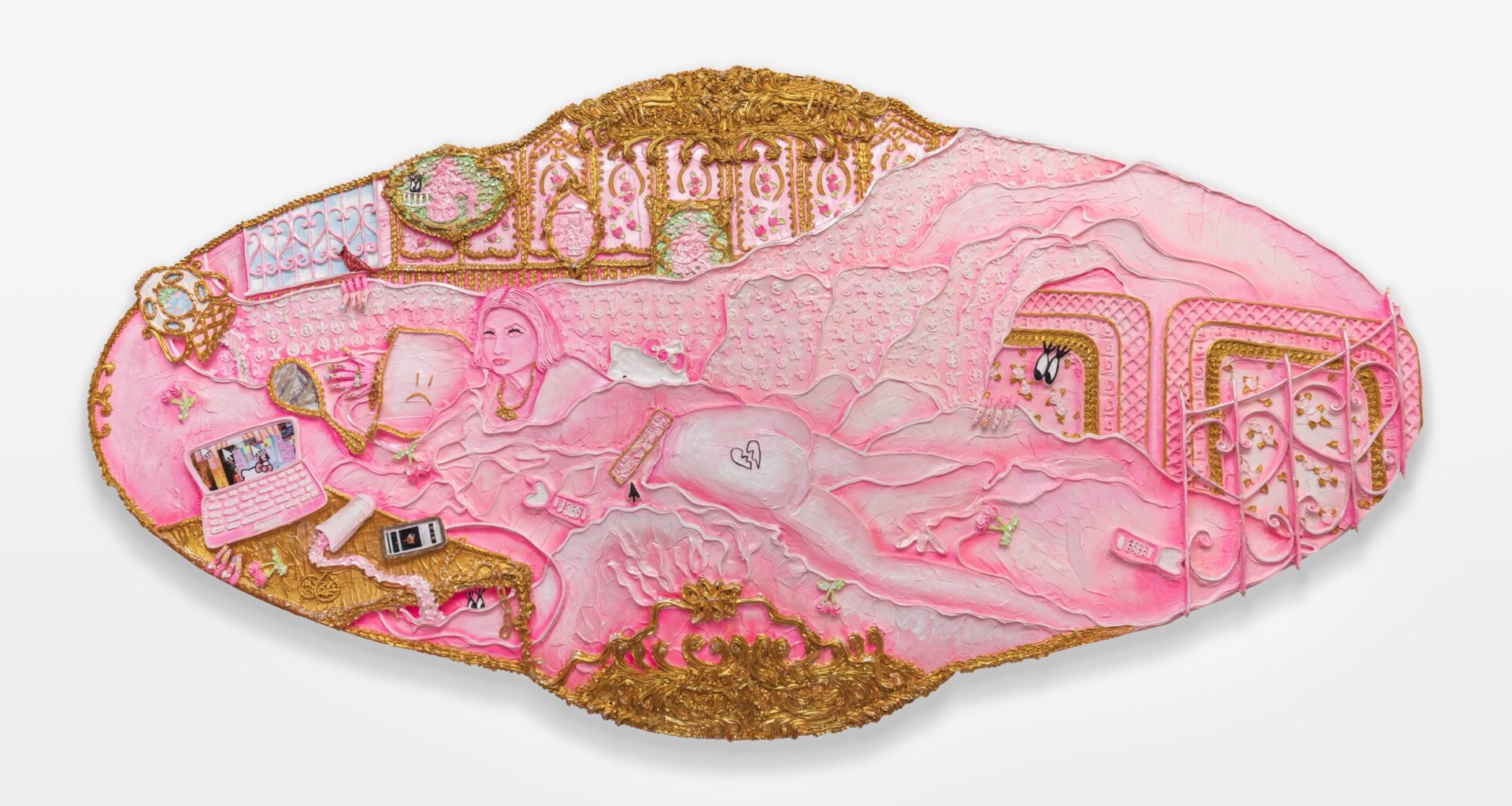
Several artists in the exhibition adapt the visual and material languages of family trades, domestic work, craft production, and community-making into expanded painterly practice. Yvette Mayorga’s The Brunette Latinx Self Portrait after François Boucher’s “The Brunette Odalisque,” c.1745 (2022), with thick coils of acrylic piped directly onto the canvas, is outrageous in its ornamental excess, transforming cake decorating techniques of the panadería [bakery] into a confectionary pink Rococo indulgence. Alfonso Gonzalez Jr. draws on the visual language of commercial sign painting—his father’s trade—in Abogados Tierra Caliente (Billboard) (2024), a monumental work mounted on a steel support. Referencing the lawyer and insurance advertisements common across East Los Angeles, the piece reflects on the exaggerated, visual marketing tropes that routinely target Latinx communities.
Elsewhere, artists position themselves both within and against canonical art history. Some borrow compositionally, like the airborne figures in Larry Madrigal’s Man on Trampoline (2023) that echo the elongated, vertical lift of El Greco’s The Resurrection (1597–1600). Danie Cansino’s Sueños con Alebrijes (2024) reimagines Francisco Goya’s The Sleep of Reason Produces Monsters (1797–99) by depicting a woman collapsed over a table and encircled by alebrijes, folkloric Mexican creatures that guide spirits to the underworld. These art historical citations recur throughout the exhibition, where portraiture and history painting are reimagined with vernacular imagery, popular forms, and diasporic experiences. The crowded arrangement of bodies in David Antonio Cruz’s iknowyou’vebeenwonderingwherei’vebeen (2024) echo the shipwrecked, intertwined bodies that vie for space and survival in Théodore Géricault’s The Raft of the Medusa (1818–19), though Cruz exchanges desperation for an image of queer intimacy and chosen kinship. Perhaps the most playfully irreverent intervention comes from Francisco Palomares, who inserts an oversized piñata into an otherwise historically styled landscape in Piñata and Chickens in a Landscape (2024), a gesture that feels like a refusal to access painting history only through the terms established by European tradition.