
After trial consultant Richard Gabriel, president of Decision Analysis, released a report called the “Trust in Justice Project,” showing trust eroding in the justice system, Daniel Wiig felt it was worth paying attention.
Wiig brought him on his podcast “Amicus Curiae – Candidly Speaking” for a conversation and then assembled an “all star” panel at the New York County Lawyers Association’s Manhattan offices.
The group included New York State Chief Judge Rowan D. Wilson, former New York State Attorney General Dennis Vacco, Staten Island DA Michael Mcmahon, Legal Aid Society President Twyla Carter, and bankruptcy court judge Elizabeth Stong.
“Most of the shows are done remotely via a recording platform, not in person,” Wiig said. “We did this one live in January of 2025, and it made the cover of the New York Law Journal.”
While podcasts are nothing new, legal podcasts may be coming of age with Wiig’s as an example. Produced by the New York County Lawyers Association, it launched in April 2021, streaming on iHeart radio, Apple, Spotify, and available on the New York County Lawyers Association website.
The show, with nearly 100 40 to 60-minute episodes, has just been picked up by the Legal Broadcasting Company, seeking to build a kind of legal podcast hub.
It had 40,000 downloads in June, in addition to streaming that Wiig said can’t be measured, making the engagement larger.
“He has an instinctive feel for what makes a good interview,” said Legal Broadcasting Company Executive Producer Evan Dicharry, noting he “connects legal issues to the world at large.”
 Daniel WiigPhoto courtesty Daniel Wiig
Wiig picked the show name to be Amicus Curiae, “friend of the court” in Latin, used when interested parties file an amicus brief.
“We wanted the show to be friendly, comfortable conversations,” Wiig said. “The show is designed to address complex legal issues in a conversational and casual tone and make it easily accessible for lawyers and non-lawyers.”
Six degrees of preparation
Wiig went to St. John’s University undergrad, got his MBA from Fordham and got a law degree from Brooklyn Law School.
“I felt that a law degree would put me into a lot of interesting things,” Wiig said. “Lawyers have their hands on a lot of interesting things. I think that’s been proven true.”
He worked at the Municipal Credit Union, as adjunct faculty at St. John’s, for NYCHA for 1.5 years and has been at the City University of New York as associate general counsel for a little over five years.
The podcast, like so many things, came out of the pandemic. Wiig had been involved in the New York County Lawyers Association for many years, including time on their Board.
“Podcasts were taking off,” he said. “ They said, ‘Why don’t we do something like this. I said, ‘Sure.’”
Continuing Education
Wiig deals with intricate and basic questions, such as with former Manhattan DA Vinoo Varghese after Trump was indicted.
“The first question I asked was, ‘Can you explain to us, what’s an indictment?” Wiig said. “That may sound silly. But when I tell you the number of non-lawyers who commented on social media or emailed me, thanking for that.”
An indictment is when a grand jury says there’s enough evidence for a trial, although some listeners thought it had more legal weight. “The word was thrown around without explanation,” Wiig said. “It doesn’t mean you’re guilty. Just there’s enough evidence to bring you to trial.”
Wiig looks at many issues from the legal angle, last year examining the president’s powers under Article 2 of the Constitution with a constitutional law scholar. “It was done in a neutral, non-partisan manner,” Wiig said.
Be my Guest
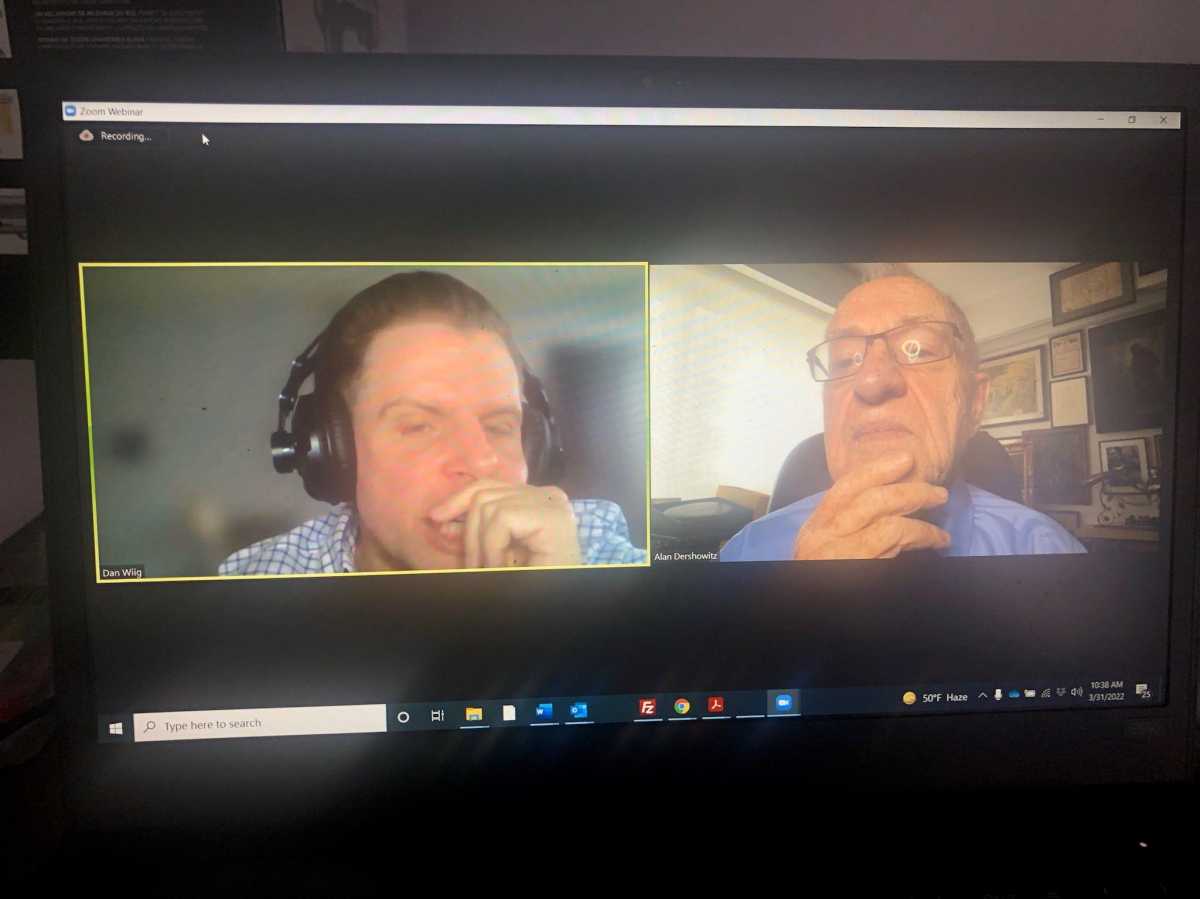
Manhattan District Attorney Alvin Bragg Jr. has been a guest as has Brooklyn District Attorney Eric Gonzalez and Alan Dershowitz.
“I reach out to people myself if I think it might be an interesting show,” Wiig said. “I go over what I want to talk about, but I don’t feed them questions.”
Gloria Allred, who has represented women in sexual discrimination and harassment cases, talked about her life, “what got her started, some of the cases she worked on,” Wiig said.
New York State Chief Judge Rowan D. Wilson discussed his vision for running the court system, and former Secretary of Homeland Security Jeh Johson discussed the U.S. Supreme Court decision regarding affirmative action.
“He’s popular not only with lawyers,” Dicharry said, “but with anyone interested in how the law interacts with the broader world of news, politics, and culture.”
Doing Requests
Magistrate Gary Stein appeared on the show after writing a book about a corrupt federal judge in the 1930s. Chad Peace, who runs the Independent Voter Project, advocating for independent voters to vote in primaries, as in California, also appeared.
Wiig last October on the 30th anniversary of the O.J. Simpson trial hosted a panel discussion, and did a show about Hong Kong political prisoner Jimmy Lai, focusing on freedom of speech and religion.
Most but not all guests are lawyers such as HR consultant Lauren McDonald, who discussed finding jobs.
Carol Swain, a woman of color who opposes DEI, talked about why she believes DEI is wrong.
“I got a lot of pushback on that. I got compliments on the way I questioned her,” Wiig said. “People who support DEI did not want to hear a different point of view.”
Former Manhattan District Attorney Cyrus Vance Jr. talked about regulating AI and entertainment lawyer Simon Pulman talked about the use of AI in Hollywood.
After Justice Ketanji Brown Jackson was nominated for the U.S. Supreme Court, he interviewed a federal judge, appointed by President Reagan, for whom she clerked. “He gave his insight about her and why he supported her,” Wiig said.
The next show to be released, this Friday, is with John Barrett, a St. John’s Law School professor, talking about the 1973 War Powers Act and lack of war declarations.
“The last time Congress declared war was during Worl War II,” he said regarding Bulgaria, Hungary, and Romania approved by Congress in 1942 after declarations against Germany, Italy and Japan.
They have “ever-greenish” episodes ready to roll along with plans for new ones. “Occasionally, a guest may want to listen to the raw audio before we drop it,” Wiig said. “They may want to make edits. They don’t like the way they said something. We would accommodate that.”