
“Having them understand where food comes from is essential because they’re the future,” she said.
Families cycled through stations hosted by local farmers, distributors, food nonprofits and environmental organizations. Experiential activities gave children the opportunity to engage firsthand with the organizations fueling a local, sustainable food system in Brooklyn.
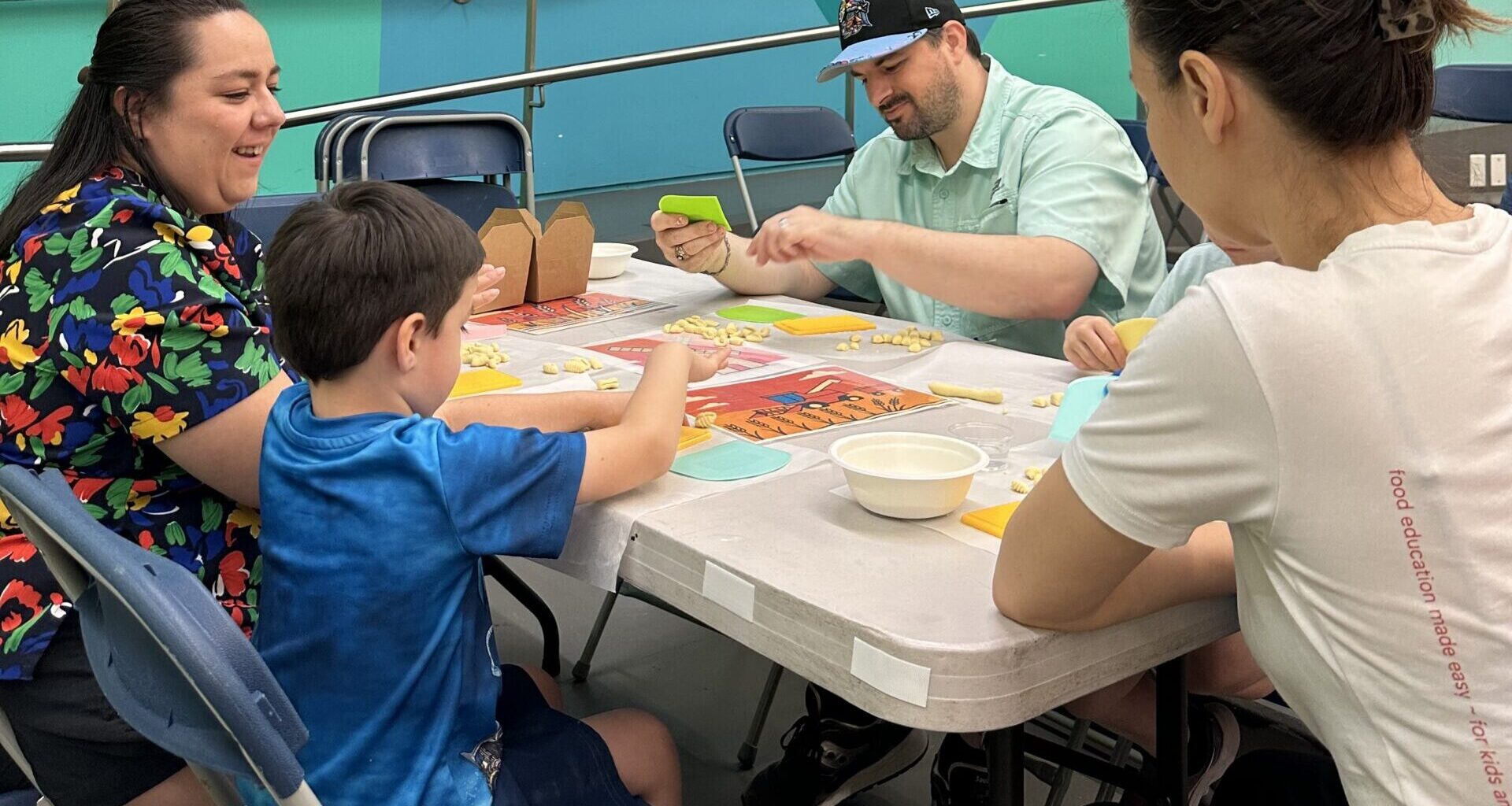
Oko Farms, an aquaponics farm in Brooklyn, led children through sensory explorations of various fruits and vegetables. With Pastable, a local food education nonprofit, participants made homemade cavatelli pasta while learning about the process of growing and harvesting wheat. The Brooklyn Botanic Garden helped attendees make natural paints from plants, Kamino del Sol led children in an herbal tea ceremony, and Black Girl Environmentalist taught children how to make batteries out of fruits and vegetables.
“I want children and families to get excited about food,” said Edwards. “I really want them to leave here making something, but, more importantly, understanding the beauty and the power of food as a learning tool and thinking about how they can play a role in it.”
At the station manned by bike-powered compost service BK ROT, Operations and Programs Manager Shanni Agagi showed a small child the end product of the composting process — what compost-lovers refer to as “black gold” — to the girl’s delight. Then the two looked at a bucket of food scraps together.
“It could be … garbage?” asked the child.
“It looks like garbage, right? But we can still use that to make soil,” Agagi explained.
“Soil?” the child asked.
“Yeah, compost!” responded Agagi.
The organization focuses on compost, but “it definitely ties into thinking about where your food comes from and where it’s going,” said Agagi, “Not ending the conversation when you’re finished eating, but rather continuing it. Getting them started young is how you create habits.”
Koron Smiley, a farm assistant with Red Hook Farms, helped participants plant their own basil plant to take home. Red Hook Farms, run by community organization Red Hook Initiative, operates two food justice-oriented urban farms.
“We try to just empower the youth to do all of these things, grow all of these vegetables and provide a contribution to their households,” Smiley told the Brooklyn Eagle.
One of the two farms is located in NYCHA’s Red Hook Houses, which is located in a food desert, meaning the area lacks affordable fresh produce. Some, like Jackson-Perez, prefer the term “food apartheid,” coined by Black farmer Karen Washington, which indicates that the lack of affordable fresh food in neighborhoods like Red Hook isn’t incidental but rather a systemic, discriminatory, policy-driven inequity, following lines of race and class.
“Here in central Brooklyn, it’s intentional to not have access to food. There aren’t many grocery stores. In those grocery stores, you cannot find local healthy food. They’re often coming from Big Agriculture organizations that aren’t the most nutritious,” said Jackson-Perez. “That’s why it’s important for central Brooklyn organizations such as Brooklyn Packers and Brooklyn Supported Agriculture to be a part of this conversation because our neighbors, our community, need it now more than ever.”
Brooklyn Supported Agriculture and Brooklyn Packers are in their 10th year in Brooklyn. The organization sources local produce from Black, queer and woman-led farms and sustainable producers and brings it to Brooklyn, hoping to build a more just and sustainable food system. BSA offers a sliding-scale-price Community Supported Agriculture program, where participants get a weekly bag of seasonal local produce, as well as sourcing produce for retailers through Brooklyn Packers.
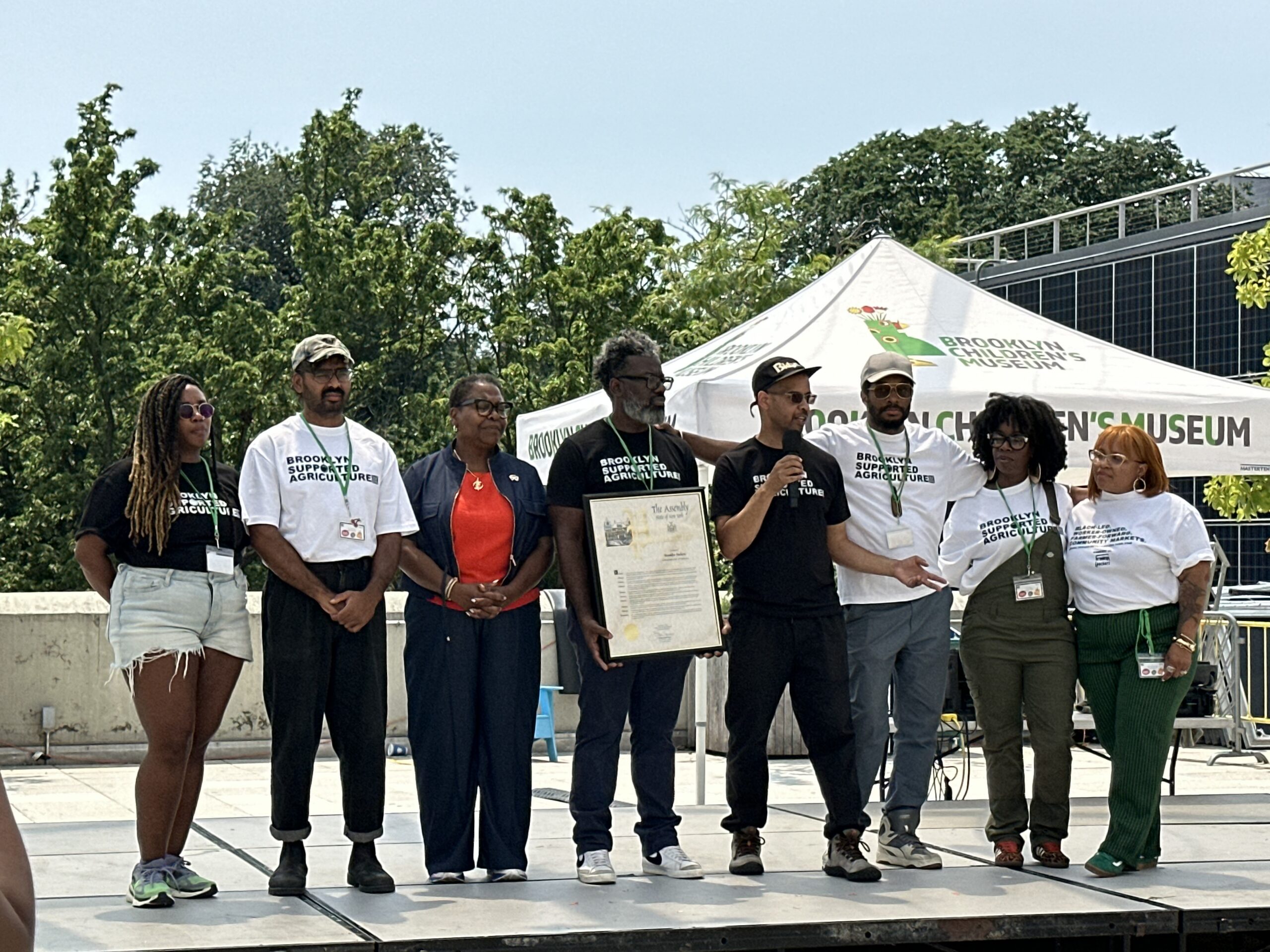 Members of Brooklyn Packers and Brooklyn Supported Agriculture, who partnered with BCM to host the Children’s Food Festival, accepting an honor from Assemblymember Stefani Zinerman. Photo: Brooklyn Eagle Staff
“Historically, agriculture has been underrepresented when it comes to people of color, especially when it comes to New York State,” said Mustapha Ra, a chef and market manager for Brooklyn Packers. “[We support] farmers that are supporting us. We want to build the land back.”
“We want to build a culture for food for tomorrow, not just taking everything for today,” he said, “Doing everything sustainably, ethically and the way food should be, with farmers first and a focus on making sure we have local access to food in our neighborhoods.”
“Brooklyn Packers’ work reflects the principles of food sovereignty, cooperative economics and racial justice by challenging inequities in the food system and ensuring that communities historically denied fresh, nutritious and affordable food are centered in solutions,” said Assemblymember Stefani Zinerman, who represents parts of Bedford-Stuyvesant and Crown Heights. Zinerman spoke at the event.
The importance of building a robust local food system was underscored by the cyclospora outbreak spreading across the United States, which some say has been worsened by the consolidation of the majority of the U.S. food supply into a few large producers. Organizers highlighted that local, small-scale agriculture is a safe alternative when grocery stores and big producers become unreliable.
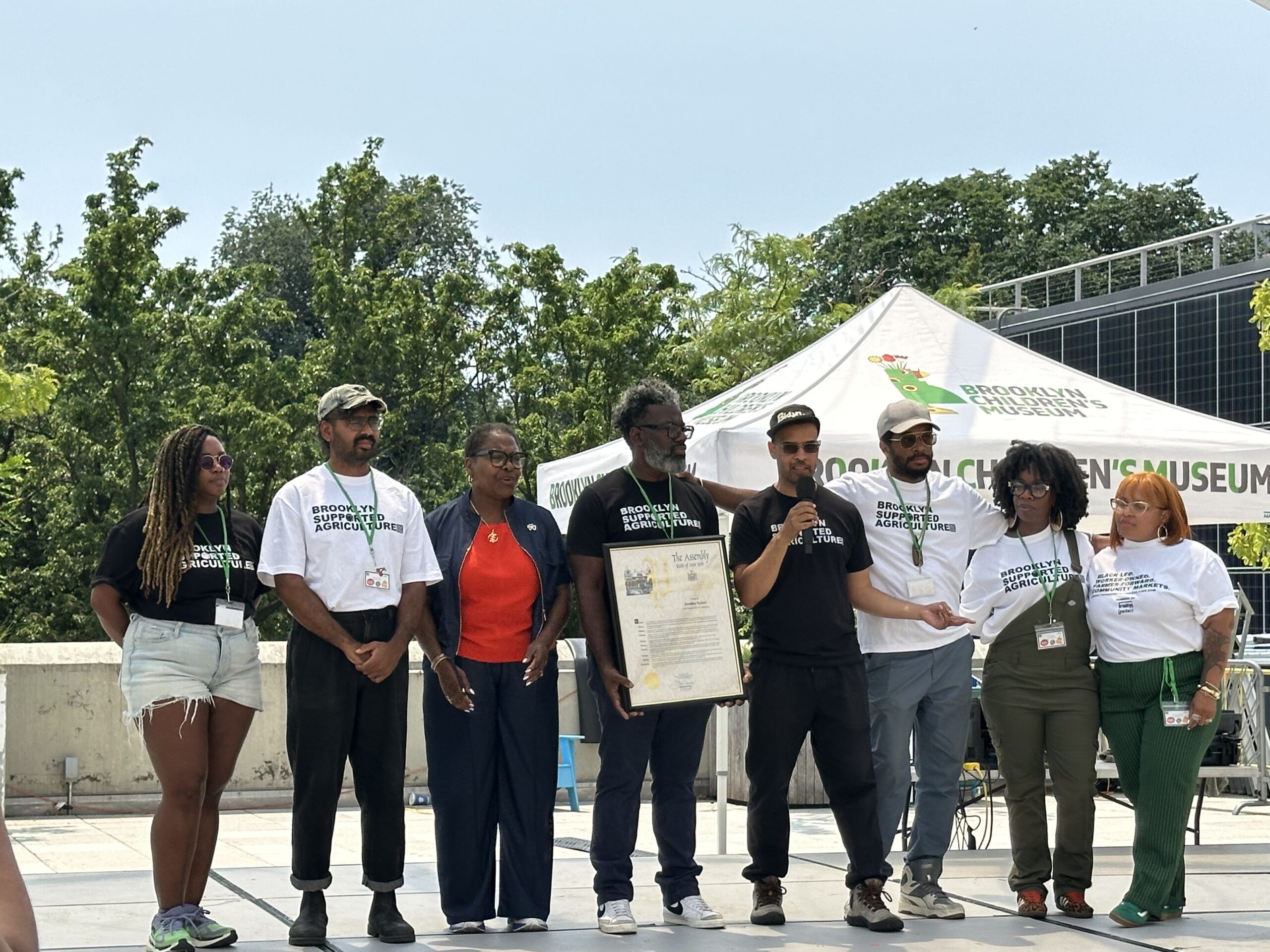 Members of Brooklyn Packers and Brooklyn Supported Agriculture, who partnered with BCM to host the Children’s Food Festival, accepting an honor from Assemblymember Stefani Zinerman. Photo: Brooklyn Eagle Staff
The BCM’s role isn’t to influence policy, said Edwards, but this festival is one way that they uplift organizations who advocate for a more sustainable and equitable food system in Brooklyn.
“We will be a platform to help those community partners gather and have an audience so that the constituents who come to our museum learn how they can be more civically engaged and fight for their own things,” he said. “That’s our biggest thing: It always goes back to learning through firsthand experiences for us.”
While the children attending the Children’s Food Festival may not yet understand the ins and outs of the U.S. food system, getting comfortable and having fun with food is the first step toward caring about it. If children know more about food, said Ra, it “lets them know where the access is and what they can do to improve it and what they can do to hopefully get into the food system.”
Organizers emphasized that the food and farming industry in the United States is in trouble, and they hope to educate the next generation to work toward a better system.
“Introducing children to local food systems is essential for their day-to-day and what they eat, how they eat, where it comes from, even encouraging parents to buy more locally or be involved in cooking in the kitchen,” said Jackson-Perez. “But also for the state of agriculture, it is unfortunately a dying industry. We need more tools and skills, and for our youth to feel a part of that system.”
Besides, it’s good fun. “Food is joy,” said Jackson-Perez.