
Migrants
Michael Rosenfeld Gallery
April 18–August 7, 2026
New York
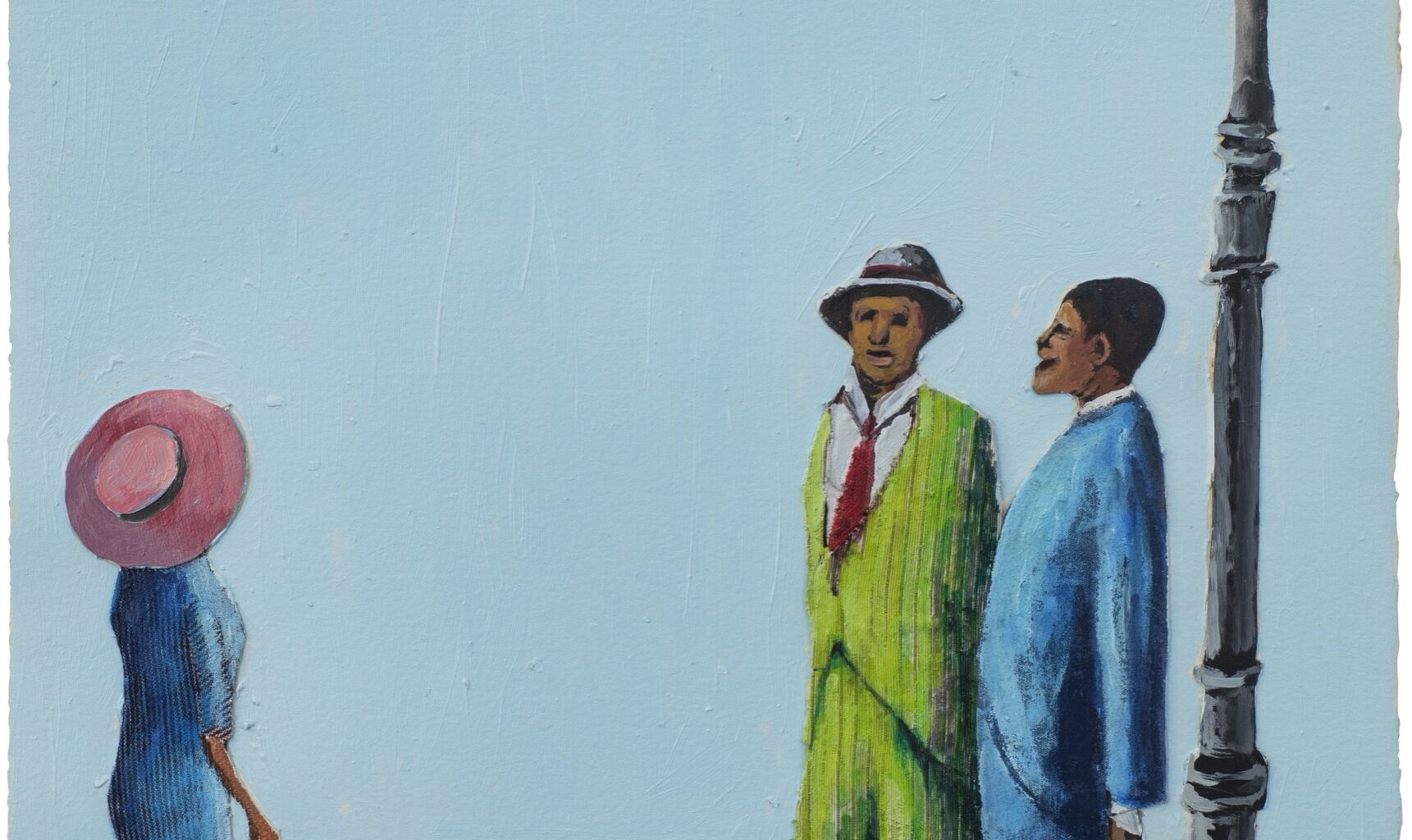
Benny Andrews’s “The Migrant Series”, completed between 2004 and the artist’s death in 2006, can be divided into a tripartite set: the migration undertaken by the Cherokee during the Trail of Tears in the 1830s and ’40s, the African-American Great Migration of 1910–70, and the California-bound American migrants of the Great Depression-era Dust Bowl. On the one hand, Andrews was galvanized by the realist tradition, the Harlem Renaissance, and the American gothic literature that he ardently read. Significantly, the project was also wrapped up in Andrews’s mixed heritage (Andrews was of African-American, Cherokee, and Scotch-Irish descent) and thus retains a biographical nature. Such is the case with much of Andrews’s oeuvre, which perennially found the artist recording history—past and present. The “Migrant” compositions, with works like Corner Greeters (2004), are optically delectable. Andrews chose to set the “Trail of Tears” subseries in unconfined and outstretched outdoor spaces, which have the effect of almost miniaturizing—and thereby depersonalizing—his subjects. Cast with overhanging blush-swept and lemon-glazed vapors, its blue skies almost swallow the grounded exile whole. Andrews’s fine pictorialism evidences that his concerns have as little to do with formalism as they do with pictorial delights. For however much balance and aesthetic merit the works enjoy, the paintings are, at their core, humanist reflections. Indeed, though Andrews consorted with Abstract Expressionists like Norman Lewis, he thoroughly resisted the spasmodic inadvertence of Action painting, instead preferring a more observational and quiet practice—one that was patient and studious, and anchored in preparative research rather than phenomenological or formalist contentions. With his “Migrant” series, Andrews achieves a significant feat in producing a series of excellently executed modernist history paintings that implicate the artist’s own autobiography while providing testimony to historical adversity.
Much of his work is investigatory and thematically circumscribed. His “Autobiographical Series” was prompted by a trip through his home state of Georgia in 1966, and is punctuated by homages to Civil Rights activists like John Lewis and W.W. Law. His mid-1990s “Revival Series” drawings were made from church services held at the Plainview Baptist Church near Madison, Georgia. Each series is quite original, with the artist adroitly shifting from what he deemed a Surrealism-endowed prismatic rendering of the Black experience. He once remarked that “Surrealism can get out of hand real fast, but then the Black experience is so ridiculous that Surrealism is the best way to express it.” However, he also commanded a more restrained style when depicting the faceless congregants in flattened silhouettes. Where subjects, motifs, and styles might vary, Andrews’s figurative-documentary approach frequently arcs towards a particularly expressive incarnation of social realism.
In an informative oral history interview from June 30, 1968, Andrews notes that, during the Depression, his family lost everything. His father, George (also known by his “Dot Man” sobriquet) was a sharecropper, who was later recognized as a talented self-taught painter and worked for the WPA. However, he hardly made any money. Andrews then recounts his childhood, during which his white grandfather spurned his African-American grandchildren, spoke to them “in the third-party,” and freely deployed racial slurs in their presence. These experiences impelled his interest in American race relations, which, in turn, informed his broader curiosity about not only the Great Migration but socioculturally relevant American migration waves more broadly. Thus, in June 2004 he trekked westward, traversing the landscape of the Dust Bowl; and then, almost one year later, the Trail of Tears. Andrews consulted archival annals and historical societies on his drives along Route 66, which stretches from Oklahoma to California and, subsequently, through the Carolinas and his native Georgia. Ultimately, however, the ensuing paintings became composites of amalgamated sites and historical figures. Recurrent leitmotifs include gangling, wary travelers and “Okie” families, sheathed in denim overalls and burlap layers. Some change tires, some plod beside tortuous train tracks, and others, as in the subjects peopling Migrant Camp (2004), huddle with their fellow man in threadbare Hooverville campsites that are bestrewn with improvised shanties and capped by rusted, corrugated steel lamina.
One can and ought to spend a significant amount of time parsing the details of Andrews’s modernist history paintings, for it is only through such patient viewing that one begins to appreciate Andrews’s schematic manipulation of collage surfaces. The forlorn, desert-strewn roamers are frequently cast beside their cargo-laden cars. Their hollow faces turn away from our gaze. They are enthralling enough, and convey the somber gravity of these scenes, which are deepened by Andrews’s masterful use of his “rough collage” technique. He began developing this approach in 1957, during his final year at the School of the Art Institute of Chicago (SAIC), where, after serving in the Korean War, Andrews enrolled through the GI Bill. It is significant that Andrews developed it while producing his Janitors at Rest (1957–58), which looked to the school’s custodial staff as a subject.