
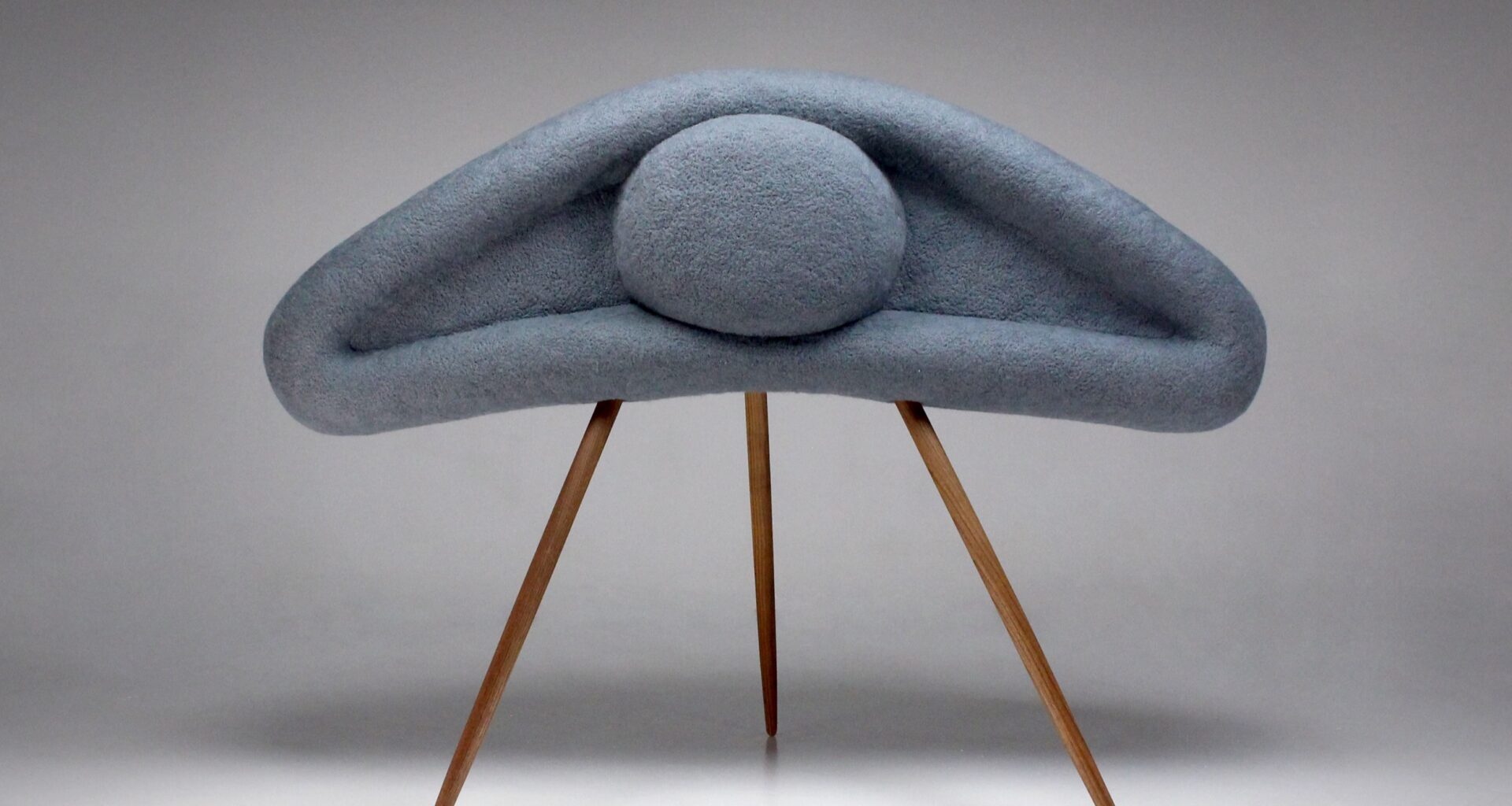
Shapeshifters, Sprites, and Spirits
Moody Center for the Arts at Rice University
May 29–August 15, 2026
Houston, TX
Witness a transcendental parade of anomalous, biomorphic forms; some appear familiar while others decidedly not, each one object, or perhaps an entity, with a rarified fit and finish, appropriate for the pristine space of the gallery. But what is being seen? Maybe a rite, a layover on a spiritual port of call, for this procession seems not entirely of this world. In each parade lies a performance, and in this light, the gallery is a stage. On the walls above these objects, fragments—perhaps the shadows of others—only partially seen, encircle and wrap the scene in an abstracted embrace.
This gathering of fantastic creatures is the work of Masako Miki; the felted wool sculptures that populate the scene are her signature depictions of the wide-ranging pantheon of yōkai, Japanese folkloric spirits. Miki takes inspiration from precepts of Shinto animism and the Night Parade of One Hundred Demons (Hyakki Yagyō), a medieval Japanese folktale where household castoffs are granted life and announce themselves to the world in a metaphysical parade. Miki reimagines yōkai through a contemporary visual vocabulary and in the process repurposes them, melding the past and the present to create not only a liminal space in the gallery—a transit point between worlds real, imagined, and the obscured area in between—but also proscenium, a place in which to tell stories, old and new.
Presented with the MassArt Art Museum exhibition Midnight March, Shapeshifters, Sprites, and Spirits offers a sunny counterpoint to its nocturnal peer, exploiting the airy windowed space of the Moody Center for the Arts at Rice University to offer a similarly otherworldly parade. Marching together, the sculptures read not quite as creatures, but life forces not entirely bound to this world; some are discarded objects (an umbrella, a sandal), while others are more directly sourced from nature (burdock root, or hinoki, oak, and pine trees—all “motifs,” as Miki describes them). Inhabiting a space between the spiritual and the physical, these objects reside in perpetual transit, present, but not entirely—solid yet weightless. In Miki’s cosmology, these beings retreat as they advance—literally and figuratively—telling and retelling their stories in the process, building and demolishing their own significance.
Miki’s sculptures populate their expansive soaring space as one would a stage, and paired with the accompanying vinyl wall works, they create an uncanny theater in the round, inviting a participatory attention from their viewers. As assembled by Associate Curator Claudia Mattos and Suzanne Deal Booth Executive Director Alison Weaver, the human scale of these sculptures creates a sense of shared intimacy with them; they appear as social creatures, sometimes congregating in groups, and seem to commiserate with one another, an impression heightened by the close viewing their placement invites. With this casual proximity, the gallery, at times, is reoriented into that of a showroom, a sensation aided by the pristine construction of each object, with every one possessing the well-turned finish of a piece of mid-century furniture. The supple roundness of Blissful One-Eyed Spirit (2018) summons a similar air of breezy contemporaneity offered in the honed surfaces of modern design, echoing the proportions of Eero Saarinen’s 1948 Womb Chair for Florence Knoll with a comparable aura of cosseting warmth. Likewise, Rising Prayer Beads (Pink) (2024), a stylization of the globular cascading flow of the titular beads, suggests a colorful tribute to Isamu Noguchi’s geometric washi paper “Akari” lanterns, softening the blunted edges of modernism but bearing the distinctive curvilinear traces of its influence.
The natural colludes and collides with the manufactured in the production of each of these works, and like all sculpture, they bear the embodied representational history of craft. In these woolen exteriors, fashioned by the repetitive pricks of a felting needle, is a visible lineage of labor, often missing in contemporary art making. In the vivid colors and laborious level of finish, the works strive not for naturalism, but a polished extrapolation of it. A streamlined mythology guides this representational revision, these legends seemingly tempered by the slipstream of modernity. Pine Tree from Ancient Time (2023) and Enchanted Pine Tree Reaching Clouds (2024) are both recognizably arboreal, but their forms have been smoothly tapered, and the foliage pruned into billowing sculpted volumes. One maintains its expected verdant green, while the other is a stark white, transforming it into its namesake. Are these yōkai bystanders or active participants in the triumphs and tragedies of humans? Both trees have eyes, and though mute, surely bear witness, observing, taking measures. History swells and flows around them, but if any verdicts are rendered, they are left unpronounced.