
Opacity
Photography fails repeatedly. This is clear in the glaring absences of Black and Brown documents held in institutional and canonical, historical white-centered photographic archives. The visible ‘thereness’ of past events narrates a version of history that denies the thereness of people who were present, but not made visible. Photography’s history is punctuated by these absences and perforated by omissions, felt in particular by those of us who do not see ourselves represented, especially when looking back.
The British artist and educator, Jermaine Francis, tackles so many things in his works, but one of them is time. He compounds time, working in an atemporal photographic in-between, to transform absence. In Francis’s works, the collective visual past, rooted in the archive, seeps into the visual present, confusing our understanding of what we see in the here and now, with the intrusions of ghosts, duendes and specters. There is a wider propensity in contemporary image-making towards “reclamation,” which I understand as a valid way of returning agency to subjects who have historically been misrepresented by the patriarchal, colonizing gaze. An act of photographic reclamation is an urgent, activist gesture, but in Francis’s case, it is also not straightforwardly humanist, nor does it provide a remedy. It makes a case for obscurity and uncertainty. Francis’s reclamation is more supernatural—riffing on Frederick Douglass’s belief in photographs as revenants, souls that have been muted, but are now brought back, given a voice.
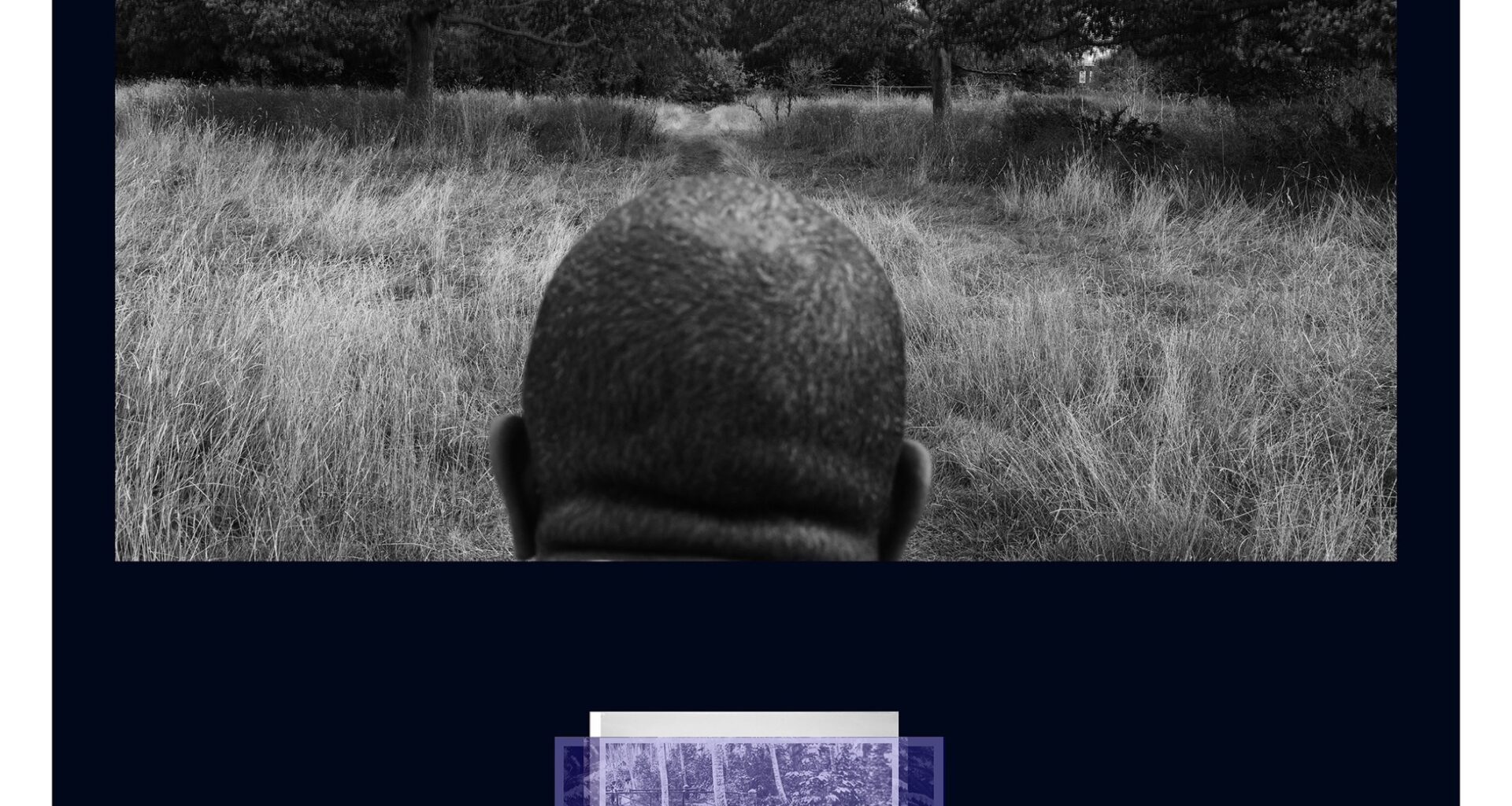
Many of Francis’s photo-montage pieces begin by combing through and cribbing from institutional British photographic archives made during the colonial era. He does so only to critique what is there and find what is missing, but to call on what lies dormant, at the edges of perceptionabsences we know are there. “A Pleasant Land, A History Deferred,” began with research into the The JCR Art Collection at Pembroke College, Oxford. Francis found very few photographs of Black people in the archive, and they were nameless and unidentified. The photographs, and their representation of their Black subjects, gave the appearance of “specters,” present but not fully seen or acknowledged. He remixes the found archival pictures—which he views as ahistorical objects—with larger-scale, cinematic portraits of present day, unnamed Black students at the college taken in Christ Church Meadow. The students’ images are partly concealed, but this time, the distance from the viewer is deliberate, indicating they are present but unable to be fixed by the viewer’s gaze. Francis shifts the idea of historical obscurity as a useful quality in the present day, the right to anonymity, pushing against reductionism. In the titles of these images, Francis refers to Samuel Johnson—an alumni of Pembroke College, a bastion of British culture, the creator of the first English dictionary, who was also an abolitionist and deeply critical of racial hierarchies. Johnson’s invisible, ghostly presence skews a singular sense of British history, a critical gaze from the past interwoven with the present.
Six photographic collages make up A Pleasant Land – The Muted Sounds of a Black Odyssey (2024): self portraits juxtaposed with archival photographs by A. Duperly & Son, the most successful commercial photography studio in Jamaica, established by Adolphe Duperly and continued by two Duperly generations afterwards. Adolphe Duperly was born in Paris and settled in Kingston in the 1830s, where the studio was established in 1840, the first photographic studio in Kingston. Francis selected images made between 1885 and1905. The archival pictures are digitally altered so that they are transparent, then overlaid with a blue-hued filter. The effect is again of a spectral presence that refutes the idea that we only see in the here and now, that subtly shifts us towards all the souls buried in that landscape. We never see Francis as a whole body, but a constant interruption into the frame, an ever-present yet undefined author-narrator of the image. Here, his bare foot stuck out in front of Marble Hill House, Twickenham. We look over the top of his head at Penn Wood, contemplating the view, beyond the body. We are seeing not what Francis sees, but closer to how he sees. At times he is present but out of place, positioned awkwardly against the background; at others he moves with gestures of ease, at home. These images gently redirect the gaze, using the language of the documentary photograph, away from what is only visible to some, towards a more ambiguous, unattainable space where the spectatorship and authorship flow into each other and expand out, like water spilling from a cup.
Francis actively reimagines the lines and frames of photography’s inherently documentary, single image, quality. He is simultaneously concerned with the conditions of spectatorship—by obfuscating and diverting the gaze physically from one perspective to multiple, he prompts sensorial shifts that mimic the sensations of being, the psyche in a flux state. Not everyone comes to a photograph in the same way, that not all eyes see the same things. Francis’s work posits the photograph not as a total rupture with reality, but as a gradual accumulation of it: layers of experiences that accumulate, and persistently remake who we are.
Francis’s work on obscurity and opacity relate to Rudolf Otto’s conditions of the “numinous” that percolating, transformative magic that emanates from a photograph—should give ourselves over to it. Edmund Burke believed a sublime state could be stirred up by fear, which relies on some kind of visual or sensory obscurity:
To make anything very terrible, obscurity seems in general to be necessary. When we know the full extent of any danger, when we can accustom our eyes to it, a great deal of the apprehension vanishes. Every one will be sensible of this, who considers how greatly night adds to our dread, in all cases of danger, and how much the notions of ghosts and goblins, of which none can form clear ideas, affect minds which give credit to the popular tales concerning such sorts of beings.
An important reference for Francis’s recent work is the ultimate painter of the sublime, J. M. W. Turner. Francis looks to Turner’s 1840 painting Slave Ship, thought to depict the British slave ship Zong and the 1781 massacre in which more than 130 African people were killed by being thrown overboard into the sea by the ship’s crew. Black hands reach up from the terrible waves; the sky is ablaze in fiery magentas and strident yellows, a sky that seems to be swallowed up too by the hellish scene in frenzied brushwork, an eviscerating, plangent cry. Though the slave trade in Britain had officially ended by the time the painting was first exhibited, it was part of an international abolitionist movement. In keeping with Edmund Burke’s theories of the sublime, Turner evokes the omnipotent power and wrath of nature, though the worst of the horror is kept just out of view. Ardently, we search for them in the cataclysmic scene; yet only small details emerge, chains, seagulls circling. The souls and the stories of the “dead and the dying” are subsumed by the painting as they were by the water.
The British photographer Ingrid Pollard, in her groundbreaking 1988 series “Pastoral Interlude,” works directly to debunk the enduring Romantic myth of the pastoral by reasserting the presence of Black bodies in the British landscape. In her version of the Black bucolic, a woman wearing a white hoodie and wellies pauses on a country path and surveys the rolling hills; a typical rückenfigur gesture used in painting to convey emotion, reflection, and an empowered connection between the subject and landscape, though conventionally throughout art history represented by a white male. A caption beneath the image seems to describe her thoughts as she looks out at this “pleasant land”: “carrying lost souls of brothers and sisters released over the ship side,” evoking the image of the Zong.
Connecting Turner and Burke’s ideas of “obscurity” to Édouard Glissant’s concept of the “right to opacity,” as a form of resistance against by the Imperialist Western gaze, “I want to explore this sense of ‘spatial opaqueness’ in photography, where the viewer’s eye finds it difficult to fixate on a singular point,” Francis explains. Francis leans into this aspect of opacity as a useful strategy, misunderstanding eschewing facile categorisation, ambiguity that “creates a disruption of decoding—a refusal of the passive absorption or scrutiny of the Black body.” Like Pollard, Francis finds the landscapes of Britain an important context for this spatial opaqueness to happen, haunted as they are by the “lost souls of brothers and sisters.”
Representation in the traditional western vernacular of figurative portraiture feel wearied and unsuited to the times in which we’re now living. I come to see a test exhibition of Francis’s new body of work near the canal in Westbourne Park. His ideas about opacity come fervently to the fore in the dwindling light of the late afternoon, the surfaces of his montages mounted on LED lightboxes leaning against the floor, both absorbing and reflecting the slivers of light and shadows, so that their surfaces glisten, animate and then at times, go dark. This spatial, temporal dialogue with the environment and the viewer’s body moves the work away from ideas of fixity. A photograph can materially, physically change with time and space, with bodies, the same way its meaning can shift and morph. “CMYK: A Visual Opacity,” folds documentary photographs of places very familiar to the artist, landscapes of the West Midlands, where he grew up in the 1980s a former coal-mining, working-class, majority white community, but by the 1980s, as the mines and old factories were closing down, a place of political unrest and cultural malaise. The pictorial planes of the West Midlands offer a kind of palimpsest, where busy dual carriageways and train tracks intersect with rural green spaces and cut past canals and manmade waterways. These post-industrial landscapes are a strange, dissonant mix between manmade manufacturing, chimneys and abandoned factories, and verdant fields regenerating with nature.
Francis refers to these images as ‘scenes’. The sites he photographed in the West Midlands are also, in some cases, places, where violent, racist crimes have taken place. But as in Francis’s other works, that is something that lurks unseen, embedded below the surface – we have to see beyond the image, a gaze refracted through layers of subjectivity, perspective and experience.
“CMYK” remixes the vernacular western codes of pastoral painting: a mise-en-scene of color, subject, and object to create what he calls a “syntax collision.” In these photographic scenes, filters of color, barely visible traces – auras – of figures, that remind me of the chemical vapors left in Victorian photographic processes. Francis sets up these ocular obstacles laid over each other, to prevent us from seeing anything clearly, forcing a separation between the visible and the visual, the seduction of the imaginary and the aesthetics of interpretation. The aesthetic plurality of these photo-based pieces is a gesture towards the confluence of contradictory emotions that is involved in interpreting what we see. Each scene emphasizes clashing perspectives, cut off, interrupted, transformed, edited—soliciting the tension between what is seen and what cannot be resolved simply by seeing or being seen. Being seen, after all, is not the same as being understood. Opacity and porosity are necessary: the ability to hold both beauty and violence, collective and personal knowledge, and not reach a definition or conclusion. I feel in Francis’s works I’m suspended in an everpresent state, where I feel comfortable with uncertainty, surrendering to the moment.
Magic
“A good image is truly magic,” Larry Sultan writes in Water Over Thunder. I think a photograph is closer to magic than it is to art. Reinstating a sense of wonder and awe feels essential in a good photograph, even more so today, where moments of magic are few and far between. In interviews, some of the world’s most feted photographers have admitted to me that the thing they consider makes a great photograph is unpredictable, and out of their control. The tussle between control and destiny is another way of seeing a photograph’s psychic space.
The proper magic of a photograph, I believe, cannot be engineered. Photographic magic appears by accident. Lee Miller, when developing prints for Man Ray in his Paris studio in 1929, accidentally exposed a print to light—the story goes that a rat ran over Miller’s foot in the dark, and instinctively she snapped on the light. As a result of this sudden exposure to the light mid-processing, a reversal of tones occurred, giving the nude female figure the effect of a halo around her form, so that it seems to melt and throb, almost to animate. Was the rat sent as divine intervention?
In 2014, Roberto Huarcaya was working in the Peruvian Amazon at night, with huge rolls of photosensitive paper, attempting the challenging feat of realizing a photogram of a fallen tree. His series returned to the Victorian idea of nature representing itself, with minimal human intervention, a way for the contested, endangered territory to express itself. While trying to expose the fallen tree, a tropical storm struck, and the paper was illuminated by lightning. The resulting giant images, up to thirty metres in length, are bright white flashes tearing across the black paper, gestures of the jungle made by the sky, are unintended collaborations with nature. A dazzling evocation of photography’s magic.
Photography’s mystic power has often been aligned with the occult, even considered dangerous, in many cultures. There’s something about the intervention of a camera into time and nature that is deified, and somehow capable of separating the soul from the body. Famously, Tȟašúŋke Witkó, one of the most prominent and respected leaders of the Oglala Sioux tribe of the Lakota Nation in the nineteenth century, comprehending the power his image would have in the hands of colonialists, refused to have his photograph taken for fear it would “shorten my life by taking from me my shadow.”
What if a photograph really could separate self from shadow? Some years ago I started to look at photographs by Vasantha Yogananthan. I saw recognized in his photographs a particular sense of longing I felt in myself. His warm, soft gaze on a distant land that somehow belongs to us, but has been wrenched from us. We share a similar diasporic experience, where everything – language, ritual, tradition, spirituality – has been erased by colonialism and assimilation. I feel we were born, like so many others like us in the diaspora, into an in-between world, where the connection to the “other” place of our heritage becomes distant, material and exists mostly in the imagination—stirred by a disheveled folder of old family photographs; batik prints on the wall, lamprais eaten at family gatherings, the smell of black pepper and cinnamon, the gold bangles and bare feet of my grandmother on the grass when she visited us. For Yogananthan, it was found in miniature paintings on the walls of the family home, or the stories of the Ramayana his father would retell. We construct ourselves around piecemeal stories and objects, hoping to gain a complete sense of our history out of blind spots. An explanation for our existence relies on continually blending fiction and reality. This other place of our origin—one that exists partly only in imagination—becomes more vivid than reality, as Yogananthan acknowledges in his work, to an extent romanticized too, by our diasporic gaze.
Yogananthan described to me an “unconscious pull” to South Asia. Not quite a return. He first visited Sri Lanka aged 16, due to the ongoing war. In his twenties, he made his first trips alone to India, then again to Sri Lanka. He found the myths and images of Ramayana he heard throughout his childhood were alive and well there.
Where I grew up, there’s a clear division, between things that are real, and things that are not—things are dreams, or they’re real. How people think in the west is very much tied to that division. When I travelled to India, I realised animals, humans and non-human beings are all tied together, there’s no limit to the connections between things.
Yogananthan, too, has re-adapted the vernacular of western documentary photography. The first pictures that deeply affected Yogananthan were photobooks by Chris Killip; later he moved to Paris and worked at a documentary photography agency, editing and sequencing pictures of Brazil, India, China, making them commercial and saleable to the press. After five years, he quit-but concedes that this time working with documentary photographs in this way informed and shaped his approach. But he became acutely attuned to the limitations and manipulations of the documentary genre.
Yoganathan’s works invite participation, in working against the traditional idea of the document, against reality, as we have come to understand it. A Myth of Two Souls is a sprawling, episodic work Yogananthan made between 2016 and 2021 during trips he took in India, Nepal, and Sri Lanka. Yogananthan’s images are inspired by his reading of the Ramayana, the epic narrating the life journey of Rama, the seventh incarnation of the god Vishnu. Images from the Ramayana pervade the rhythms and rituals of millions of Indians every day—Yogananthan’s project naturally became his personal way of relating to and retelling the Ramayana’s images and stories, as it continues to shape daily lives in the region and beyond. Looking in while looking out, he uses a mixture of documentary, street, portrait, landscape, and staged photography, edited into loosely narrative sequences, then organized into seven photobooks, each representing a chapter of the Ramayana.
“Photography has that power to deal with that specific space that is neither real nor fiction, and that is the most interesting space to work with,” Yogananthan tells me during a phone conversation. In his photographs, you’re never quite sure if what you are looking at is real or not, but slowly the photographs erode the idea that distinctions of that kind are important. We need to rely on other senses to complete the images, to look into ourselves, too. Magic finds its way into the familiar and the mundane. Yogananthan’s dizzyingly rich, prismatic colors transport us to impossibly resplendent forests with lilac and vermillion trees, (the artist’s version of the sacred forest, Dandaka, to which he devotes a chapter of his photobook, A Myth of Two Souls), shimmering waterfalls, strangely empty streets clouded with smoke. A female figure lies across the road; a horse leaps out of a lake, a bird soars against an ecstatic sky. Yogananthan draws out symbolic moments where magic becomes real, and reality appears to be miraculous. Absence coalesces in these images, intense expressions of liminality, a feeling of neither here nor there, neither one thing nor another, neither fully accepted or alienated. As diasporic people, we are adept at code-switching and navigating contradictory ways of seeing the world—yet rather than contradict each other, in Yogananthan’s work, the documentary and the choreographed images work symbiotically, a metaphor for the duality of the soul, the rational and the non-rational state. They gently offer a mutual critique: the documentary grounds the story in the urgency and veracity of lived experience, and stops the mythological becoming too stepped in romanticism, while the choreographed, invented photographs, soliciting symbolism, do not claim neutrality or objectivity, and insist on the precarity of perception, pushing away from any notion of centrality.
Yogananthan describes the intentional, slow process of making these photographs: always using wide- and medium-format cameras, incorporating techniques such as hand-painting his photographs to alter their color, or add details that obscure or emphasize the photograph’s psychic space. These elements have a decorative charm, but they are important conceptually—there is no singular authority or meaning. Myths themselves function this way—ancient and present, porous and permeable through time and place, subject to reinterpretation, to be retold, and with each orator, to be changed a little, adding a scratch to the surface, a daub, a mark, of their own psyche.
A painter, Yogananthan explained to me, starts with nothing—for a photographer, it is the opposite: you start with the entire world and must carve from it some purpose, something new to say. His photographs come, he adds, from a confounding experience of ‘everything at once’. Whenever he tried to bend the world to the image he wanted to create, he deemed it a failure. He speaks instead of the need for a photograph to “vibrate with life,” He recalls working in a hazy state of almost aimless wandering and really allowing reality to perforate without the influence of the controlling, rational, subjective mind: “it is very hard to be open to the world.” There is a sense that images must come to the artist, not that the world is there for the taking.
I saw some of the works from A Myth of Two Souls presented in an exhibition, Crossings, at the Rijksmuseum, Amsterdam in the summer of 2025. The Rijksmuseum holds a substantial photography collection, including a little known archive of 1,200 nineteenth-century photographs taken in India, Pakistan, Bangladesh, Myanmar, Singapore, Sri Lanka, Nepal, Bhutan, and Tibet, mostly by European photographers for European and American audiences. The photographs were taken during a time of British colonial rule across most of the region, at a time when photography was intertwined with the colonial mindset. Some of the photographs on display from this archive, such as those by Joseph Lawton, were made directly for the British administration. They were used to objectify and study, and to uphold the values of the colonial regime, serving the foreign fantasy of the region, of a perfumed place of ancient religions, ruins, rites, and intoxicating tropical nature. Despite the violence of forced labor, unrest. and uprising happening across the region at the time, the photographs insist on another point of view.
I stopped at an albumen silver print of the English photographer, Charles T. Scowen, a close-up view of the blossom of a Liberica coffee bush, taken in Sri Lanka, dated between 1876–93. Scowen had arrived in Sri Lanka, (then known as Ceylon, the British colonial name for the island) in 1873 and set up one of the first commercial photography studios in Kandy in 1876, where he specialized in flower and plant studies. The works Scowen and his team produced were mostly for tourists but also commerce and trade. Coffee production was a major industry in Sri Lanka. The Dutch colonialists experimented with it in the eighteenth century but the British—who took control of the island in 1815—exploded the industry, making Sri Lanka one of the world’s leading coffee producing countries by the 1860s, alongside Brazil and Indonesia. In the 1830s, after the abolition of slavery, many plantations relied on indentured labor of Indian Tamils, with violent, harsh conditions. Nature, however, had other plans. In 1869 a fungal disease nicknamed “Devastating Emily” decimated coffee plantations. When this photograph was taken, therefore, the coffee industry was already in decline in Sri Lanka, and photographing the plant has a different resonance. I see in Scowen’s representation of the coffee plant a symbol of resilience and beauty, retribution and defiance, nature’s defeat of man’s greed. In the pretty, star-shaped, flowers contrasting with the dark tones of the evanescent berries and thick leaves, you cannot help but see astonishment and appreciation, too.
Works by Scowen, as well as others, were presented with a selection of photographs from Yogananthan’s A Myth of Two Souls. While I found the exhibition didn’t entirely succeed, it seemed to inadvertently validate something else shared between the historic works and Yogananthan’s—the presence of magic, ancient echoes calling to one another across the century. The Buddha of Polonnaruwa, photographed by Lawton in the 1800s, a giant monument lying on its side, as if toppled by protest or felled like a tree, or maybe simply sleeping peacefully. There are portals everywhere, if you know where to look for them. The fallen Buddha in my mind beckons to Yogananthan’s image of a streetside barbershop, the tools neatly set up but abandoned, silent, as swirling clouds of mist stir up an atmosphere of intrigue. A voluminous curtain billows out in front of a secret door, an ordinary street scene into which Yogananthan imbues something mystical. Vapors wrap their way around both these images of myth, ritual, loss and transformation—and in all of them, the abiding presence of magic. As I try to hold onto what it is I feel in these images, meaning evaporates like the mist into sensation.
Healing
Much has been written about the relationship between death and photography. John Berger saw the photograph’s expired moment as a “flirting with death” [John Berger, an “The Uses of Photography”, 1978]. For Barthes, every photograph contains a past moment, and therefore evokes a feeling of absence. The photographed, too, undergoes a “micro-death,” the notion of being translated from active, living, subject in the present to a passive object, a memento mori. I regularly revisit the time-bending tributes to humanity of Roy DeCarava, who said his photographs “present a moment so profoundly that it becomes an eternity.” In that eternity is also a feeling of eternal loss, eternal grief, I think. A photograph can never reconcile the absence with its proof of presence. I think of photographs as the “thresholes” the poet Lara Mimosa Montes imagines—holes, rather than holds, because we fall into them, we disappear through the door. A photograph wants to hold on to something it ultimately has to let go. “What is grief, if not love preserving?” Montes writes. The same could be said of the photograph’s paradoxical nature. A melancholy kind of fragment, a keepsake for the soul.
Burke’s idea of the sublime to me is not so far removed from Barthes’s idea of the punctum—an idea that has been incredibly influential in our understanding of photography and its indescribable power. Barthes posited that a photograph, if effective, contains a small detail that pierces the viewer—this wounding effect is what moves us when we look at it. Whereas the sublime involves an element of intentionality, the punctum, according to Barthes, is not intended—it occurs by accident. Still, for both theorists, the idea of pain is present—without this pain, we cannot transcend the image or reach this temporary heightened or epiphanic state. Grace Ndiritu’s practice suggests that pain can be transformative, and death, even the death in a photograph, is not final. And it has the potential to heal.
Ndiritu’s multidisciplinary work is concerned with the reanimation and transformation of the energy of art objects. She combines esoteric, animistic and shamanic practices with art making. Photography has a central place in her practice: she often mines documentary photography from museum and institutional archives to transform photographs into participatory objects where the life they once held is reanimated. She has remixed and reconfigured existing collections of photography into constellations that re-interpret their history and create new, cosmic associations between works. The removal of captions and labels demarcating the importance of the work or its author facilitates this freer relationship between the museum goer and the photograph. For Ndiritu, “what appears in the microcosm of the photograph is a reflection of what occurs in the macrocosm of the universe,” and this is what she hopes to unveil.
Ndiritu has another motive in activating a photograph. Her 2022 Healing Pavilion at the Wellcome Collection in London is an example of her radical take on photography’s otherworldly power. Ndiritu created two large-scale tapestries, Repair (1915) and Restitution (1973) from archival photographs from two museum collections. By transforming the scale, texture and medium of the original images, she changes our response to them—the tapestries were intended to evoke those found in Buddhist temples, and their scale they hold the space in an entirely different way. Still, at the center of our understanding of these two works is an event that did occur, a microcosm that represents a wider collective violence.
The earlier image of the two was taken in 1915 and belongs to the Wellcome Collection’s archive. It depicts staff members of the Wellcome Historical Medical Museum posing with human remains, including skulls. The remains originated from the Global South and were displayed in the gallery where the photograph is taken, the Hall of Primitive Medicine. The second work referenced a similar 1973 photograph from the Ethnologisches Museum collection in Berlin, in which museum staff pose informally, sitting on and leaning against the Mandu Yenu royal throne, from the Kingdom of Bamum, Cameroon. The intricately designed carved timber throne, adorned with precious glass beads and replete with symbolic figures, was sought after by the German colonial administration, and was reportedly handed over to Wilhelm II in 1908 by King Ibrahim Njoya and has remained in the Ethnologisches collection ever since.
The focus of both photographs is collective colonial violence, evinced in the impervious, irreverent, and mocking interactions between the staff and the collection objects they are to care for. The effect is disturbing. But Ndiritu is not only concerned with exposing the colonial violence on which many museum collections were built and that remains at the heart of the politics of ethnographic display. Transforming the photographs into another kind of object, she emphasizes their materiality, too. The photograph is an object that becomes a relic too. By bringing that relic back to life and releasing the photograph from its past, Ndiritu sees an opportunity for—as the works’ titles suggest—repair and restitution. To communicate with the people in the image, to forge a conversation with the past, since it holds the future too. Trapped spirits are released from the photograph.
Ndiritu’s radical approach to the nature of photographs, at least until recently, has been widely ridiculed and rejected by the establishment, but I see affinities in this approach in many working with the medium now – the desire to use photography in a spiritual way, to cleanse the past, to transcend the boundaries of what we perceive to be real, and as part of a process of healing for historic injustices and pain.
Ghosts
My pain has led me
Somewhere love can
Can never reach
My fear never leaves;
I have learnt to dance with it.
—Poulomi Basu, EcdySis
The word “appear” stems from the Latin appārēre, “to come into sight,” the adjective derived from it, “apparent” meaning “easily or clearly seen.” When something appears, it becomes visible, yet the noun form, “apparition,” etymologically linked to “appear” and adopted in the fifteenth century, shifts the idea of what is “easily seen” to something that is only visible to some—a sudden spectral image, a supernatural, precarious and perhaps terrifying manifestation that only “appears” to a particular person or group. Implicit in the English language is an idea of the subjectivity of sight, but also that sight has a supernatural quality about it.
In the nineteenth century, when the Spiritualism and occultism movements were prominent, many were seeking proof of the existence of the afterlife. Photography provided a solution. Spirit photographers captured the faintly imprinted images of deceased loved ones, portrayed in the vicinity of the clearer image of their living relative—with tricks of the camera, thanks to the new technology of glass plate negatives, that could be reused to create multiple exposures. Spirit photography was a big business in the late nineteenth century, but not without compunction; the American photographer William Mumler, famed for creating an image of Mary Todd Lincoln with the spirit of her assassinated husband, the late President Abraham Lincoln, wound up in court, accused of fraud. Similarly, the hugely popular 1870s spirit photographer Édouard Isidore Buguet, was the target of a police sting operation in Paris, which revealed his multiple exposure methods, and spent a year in jail for fraud.
Regardless of the possibly exploitative intentions of these Victorian photographers, many still wanted to believe in spirit photography, much in the same way we are convinced by AI and computer generated images today; the belief itself is what is real—the willingness to believe in invisible forces, greater than us and beyond comprehension and sight.
“Ghosts live inside us, and dance in our shadows,” artist Poulomi Basu told me, during a recent conversation on the phone. I feel Basu works more like a medium than an artist, listening to and channeling spirits of unseen forces through her body, translating visions into the visible, apparitions into appearance, pain into power. She is a spirit photographer for today, in a way; someone who directs us towards the truth of what we want to believe in. Basu says that she works between “the seen and the felt.”
“A photograph exists in me as the idea of thinking and knowing we are all connected, in some strange and abstract plane—someone has been here and there. A photograph can take us to those realms. It is a very fertile, expanded space,” she explains. Documentary photography, indexical and evidential, is interpreted by Basu an elastic form of rational expression, which she suffuses with non-Western ontological ideas. She cites the Sanskrit maxim: “Yatha Pinde, Tatha Brahmande, Yatha Brahmande, Tatha Pinde, Yat Pinde, Tat Brahmande” [all that is outside you is within you]. This fundamental non-dualistic Vedic principle suggests that the “Pinde”—the body, the individual—is of the same substance as the infinite “Brahmande,” the macrocosm, the universe. Basu departs from this belief that the cosmic is reflected in the body, and the body is reflected in the cosmos. This is a guiding principle in her work.
Basu takes a hybrid approach to photography, using different photographic techniques and styles voraciously and viscerally, to create amorphous forms and non-linear narratives. Her groundbreaking, influential photobook, Centralia, for example, blends conventional documentary forms, such as war reportage, thermal imaging, crime scene depictions, portraiture, and eye witness accounts, layered with sourced and found imagery; CGI; and staged, cinematic tableau, drawing on literature, speculative fiction, and body horror.
In Centralia, the decomposition and decay of the body is linked to transformation or chaos in the world. Centralia is an urgent activist, social documentary work, focused on the violent, unreported struggle for land and rights of the indigenous People’s Liberation Guerrilla Army against the Indian state government in Central India, with particular attention to the position of female fighters embroiled in the brutal war in these burning, dystopian landscapes. Following loosely the stories of survivors of this ongoing unseen war, the work’s aim is to link extractive mining and environmental destruction in the region to systemic, political violence and the proliferation of traditions and myths that upholds and reinforces it.
Yet after working closely with marginalized communities, Basu realized she needed to find a new language within the extractive, colonial practice of documentary photography that could transmit a physical sense of burning, extraction and violence. Images of ecological disaster and collapse are constantly reframed through brutality against bodies and individuals—Pinde and Brahmande. Burning mines and scorched, scarred earth are made to look like infected, bloody tissue and open wounds; the landscape as a body. Bodies, meanwhile, become landscapes, the human form is destabilized, erased, blurred into toxic clouds of smoke, hazy atmospheres. Disaster infects the flesh, and Basu makes you feel it.
Destabilizing the viewer’s sense of time, space, and perspective of the situation, expanding the documentary into speculative territory, Basu links the earth’s vulnerability to the vulnerability of women’s bodies, making climate catastrophe visceral. Her new speculative docu-fiction work – officially published in September – builds on the new language in photography Basu created in Centralia. I experience a perplexing, panicked, hot rush of emotions and sensations I got as I turn the pages of ECDYSIS. The book moves at pace between digital art, poetry, forensic, found and new photography dovetailing several long-term projects of Basu’s activist-centered work around stories of female survival. I am engulfed in dark landscapes lit by fire; I shiver in huts with women, as they clutch their children close. A panther stares at me, eyes aglow and glaring. I feel hunted. Crisis here feels close, the magnitude of our existential threat is as clear as the lightning that tears across the sky. The pages scream, bleed. It all vibrates with so much anger, and so much life.
ECDYSIS is a part fictional response to the physical, emotional and social trauma women suffer at the hands of the patriarchy, evolving from the 2013 work Blood Speaks, about the Nepalese practice of chaupaid, the exile of menstruating and bleeding post-partum women, Basu’s work with Water Aid, and into the creation of Maya, Basu’s menstruating graphic novel superhero, and the protagonist of a VR work, Maya. ECDYSIS moves from inside women’s bodies to the edges of nature. Where women’s blood is widely perceived in culture as shameful, subjected to control and forced to be private and hidden, here it pours across pages, fierce, unapologetic, like lava, searing pulses. Moving between Pinde and Brahmande, landscapes and portraits, abstractions and figurations, the images are bathed in a deliciously strange crimson glow, the color of the womb, and the center of the earth. This full physical immersion in the work is key to her non-rational practice, guided by emotion, and merging faith, ritual, and religion with the ancestral, ancient knowledge held in her own body. “I have always felt the spiritual resides in the body, in many ways.” Her process often involves breathwork—±coming into the body, she enters a flow state—many of her ideas for images come from the manifestations that evolve from this dream-like meditative space. “The subconscious borrows from the real, so why close that down? I want to use an artistic way of thinking to bridge that gap between the two.”
The unseen is always lurking, haunting—Basu’s motifs of shadows, forests, the nocturnal, and the celestial allude to this interest in the psychic and the transcendent visual realms, to situate the viewer in the expansiveness of the unknown. Figures who appear to float also recur—an allusion to the artist’s out-of-body experience of fear and anxiety. Taking photography into the shadows and the darkness, rather than using it to illuminate, Basu suggests the apparitions are where truth lies. Not everything is legible. Basu wants her work to be understood through the body, not the intellect. That is where real action lies. In her work we are held in a state of being rudely awakened and alive.
Zombies
One day in 1936, a woman stumbled barefoot, dressed in torn rags, into a village in Haiti. Her appearance was, according to accounts, terrible to behold—her eyes seemed touched by death, and she had lost her eyelashes. She dragged a lame leg. She was Felicia Felix-Mentor and she had died, according to locals, twenty-nine years ago, buried in 1907.
The American writer and anthropologist Zora Neale Hurston was in Haiti at the time and heard about Felix-Mentor’s return. Keen to see the zombified woman for herself, she traveled to the hospital Felix-Mentor had been taken to and photographed her hurriedly. In her book, Tell My Horse, Neale Hurston describes what she saw: “the broken remnant, relic, or refuse of Felicia Felix-Mentor in a hospital yard.” Hurston’s photograph, taken quickly as the woman appears to advance towards the photographer, shows a subject larger than the photographer, unsmiling, so she appears to be looming, staggering, still wearing her ragged clothing. The photograph appeared in LIFE magazine in 1937. Felix-Mentor—or whoever the woman really was—became Haiti’s most famous zombie. This photograph, to me, represents the way a photograph becomes not only what the individual viewer wants it to be, but how it is transformed by collective will and imagination.
Zombies, like Felix-Mentor, were not seen as the terrifying monsters they became in the western imagination—for Haitians, Zombiism was emblematic of resistance, of the struggle for freedom and autonomy. It is possible Felicia herself had been drugged and subsequently enslaved, risen from the death imposed by colonialism.
Caroline Douville reinvigorates Neale Hurston’s photograph of Felicia in her work, Réunion (2024). Douville paints Neale Hurston’s LIFE magazine image of Felix-Mentor’s figure with an airbrush in black and white, the effect of an X-ray, in turn the effect of revealing something hidden beneath. Douville also includes thumbnail references to the original photograph. ‘This is the only zombie every photographed’ the caption read when the image was printed. The accompanying article refers to her return, “naked and demented”. Douville, and Neale Hurston, see the woman differently.
Douville’s work, I later read, stems from playing games like Minecraft as a child where the zombie figure is a recurrent part of the narrative. As a child, Douville was unaware of the Haiti origins of zombies, the embodiment of the liminal, the unsettled or unconscious state. Douville returns to these origins as a form of critique of the way dominant cultures co-opt and erase folklore, ritual, and practices of indigenous cultures. Long before they were commercialized by Western horror films and gaming, zombies were symbolic figures in Vodou. In folklore in the nineteenth century, following the brutal French colonial rule of Haiti, zombies were mindless, soulless beings, brought back to life by drugs administered by a bokor—a Haitian sorcerer—and made to work as slaves in their somnolescent state. They represented the collective fear of indentured labor, the collective trauma of forced labor, and the role of storytelling, magic, and tradition to respond to colonial oppression and its violence, to transform it.
This is how Douville works with the archival: she transforms the oppression and violence of the colonizing camera and reinstates a sense of the unknown. She works with historical photographs documenting communal and Vodou rituals, found in anthropological and colonial archives, and turns them into acrylic and oil transfers on canvas, in deep, supernatural purple and green, mounted in frames fashioned with copper pipers and metal sheets. The fusion of contrasting materials and techniques—photography into painting, handmade and industrial—reflects the tensions that course vividly through her work, modest in scale but utterly alive.
In “Haiti December 24th 1945”, Douville reclaims an image from a Dailymail article about zombies, belonging to the Michael Ochs Archives/Getty Images archive, taken by the American photographer Earl Leaf, more commonly known for his celebrity photography. The image depicts a mambo (Voodoo priestess) at a Voodoo ceremony. “I found this whole situation intriguing, the date, the location, the people and I thought, maybe this guy was simply on vacation and assisting some kind of artificial ceremony concocted for tourists…” Douville explained in an email. Reframing the image in green plays with the western codes of gaming and horror, supernatural visual tropes and cliches; the sculptural metal frame encasing the image evokes a kind of time machine-like structure, a gateway to another realm. The metalwork Douville introduces also recalls the industrial pipes of abandoned factories and warehouses, sites of manual labor where horror films and games are often staged – liminal, transitional spaces charged with anxiety, suggestive of decay, rust and collapse.
In another image, “Primogéniture II”, Douville transforms an archival photograph of the funeral of the late Haitian president, Papa Doc François Duvalier. Using painting and color as a filter to re-see images of the past and re-interpret them the original image “seems like it could come straight from a vampire or Zombie movie but it’s a real event”, Douville explains, in an email. At the end of the coffin, we see Jean-Claude Duvalier, Duvalier’s son – then 19 years old and about to become president for the rest of his life. Funerals represent another liminal space, here profoundly so: the end of one life, transitioning to the other realm, transforming another’s existence in the moment of death.
The documentary photograph in Douville’s work is treated as a revenant too. Reanimated, undead—summoned up and revived to finish what they started. Not to resolve the past but to continue it into the present. Is the past ever really behind us? The photograph is not only a self-contained ahistorical object, it is a forced encounter between the time of the photograph and the time of looking. Douville’s photographs have an unresolved, unseen trauma that has not been properly acknowledged. A certain pain emanates from them, zombies returning to the land from which they were exiled.
Dreams
In my dream I swim with fish in the ocean. There is no land around me. In my dream, my sister has twins. My sister and her husband couldn’t conceive a child, but they cared for me as their own. In my dreaming bed, I am pregnant. I lie in the dark and think about how to tell my family. I am a middle-aged man in a hospital delivery suite. My belly button opens and I give birth to a fist. I am dining with my aunt and mother when I feel stones and sand in my mouth. I look up and see them turning into statues. My grandmother is lying in bed. As I go closer, I see that she is losing body parts. I am scared and try to put the parts back into place.
— One Hundred and Twenty Minutes
We spend six years, of an average life, dreaming. Every person, regardless of their reality, spends 120 minutes dreaming, every night, whether we remember our dreams or not.
I learned this when, one Autumn day, I wandered through a beautiful old townhouse in Bristol. The artist Amak Mahmoodian had staged her multidisciplinary project, One Hundred and Twenty Minutes) there, as part of the Bristol Photo Festival in 2024. The title of the work, One Hundred and Twenty Minutes, reflects the time we spend in this visual world of dreams every night.
The exhibition was a space for experiencing dreams and active dreaming. It represented a long-term collaborative project, made with sixteen displaced people from fourteen different countries, all living in exile in the UK—like Mahmoodian herself, who has been unable to return to her birthplace, Iran since 2010. Working closely with her collaborators, adopting methods from automatism, they spoke of their recurrent dreams, and Mahmoodian worked like a medium, to turn their dreams from notes and sketches made while listening into poems and pictures, Polaroid photographs as well as staged analogue works.
The images she created are delicate and brooding, careful not to slide into sentimentality, edged with melancholy. The image-making was a process of deconstructing identity and exile through dreams, then reconstructing these deeply personal journeys.
Five of the photographs are shot in color; eleven in crepuscular black and white, true to the color the dreams were experienced in. The project was later presented in part at the Photographer’s Gallery in London, one of the four shortlisted works for the Deutsche Börse Photography Foundation Prize 2026. In London, the works were hung in an undulating line along the wall—to mimic the flow of dreams. In the photographs, each individual dream becomes part of a larger, universal story. No time or place is identifiable in the photographs.
The photographs in the project repeatedly return to physical thresholds: the sea, the meeting point between land and water. Hands, where the outer edges of the body make contact with the world. Beds, the place where consciousness meets the unconscious, where we dream. Windows and mirrors evoke this inward-outward state. A door stands in a forest in winter, leading nowhere. A larger-than-life scale photograph of a belly button, surrounded by puckered skin, the anchor to the maternal, to history – the point from which we are untethered, separated from our beginnings and released into the world as a solitary being. All of these images of thresholds are also circular and inconclusive, like dreams. They work against the linear time typically found in a photograph, where time is concluded, sealed off and finite.
Photographs fail. They fail when they impose the violence of a single interpretation on their subject. Dreams are ambiguous and transportive—you can return to places and people you can no longer be with, for two hours every night. Does that make them less real? Dreams become sites of encounter where the pasts can be reconciled, where connections can be felt, and where the pain of exile is articulated not just as absence, but as a shared human condition. Centering the dreams of these individuals rather than the painful facts of their exile subverts the conventions of social documentary and activist photography. Their displacement is not offered as spectacle, but as part of an immaterial, human narrative that binds us all.
In the logic and language of dreams we are between worlds—as we are in a photographa the threshold between the material and the psychic worlds. In the lingering shadows and splintered, symbolic visions Mahmoodian evokes, we understand more deeply who we are. One Hundred and Twenty Minutes explores the idea that the unseen is not necessarily invisible—it simply lies beyond our habitual ways of seeing. To photograph the psychic seen, in Mahmoodian’s case, to photograph dreams, is to propose a new paradigm for making, looking at, and thinking through photographs.
Freedom
When you see, the act of seeing has no form–what you see sometimes has form and sometimes doesn’t. The act of seeing is ineffable. And sometimes what is seen is also ineffable. And that’s how it is with a certain kind of thinking-feeling that I’ll call “freedom” to give it a name. Real freedom–as an act of perception–has no form.
— Clarice Lispector, Água Viva
What am I getting at? In all the time I have spent walking alongside photographs, looking, feeling, I feel as soon as I get close to something like their meaning, it slips away in an instant. It is impossible to hold in language, or maybe we don’t yet have a language for this kind of photography – maybe we don’t need one. The stupefying beauty of these works is in a way indescribable and ungraspable. To photograph the psychic seen is an act of recognition and acknowledgement, a reminder that things exist that we cannot see, hold or contain. The place all of these photographs of the psychic seen lead me to is to do with freedom. Freedom in these photographs looks like being comfortable with incomprehension and uncertainty. The deepest forms of seeing may begin where certainty ends. Photography can still do something new, it can reach other visual realms that are beyond control and, at times, even beyond thought. It means embracing a world where the boundaries of time and space between us are no longer important. And perhaps there is a suggestion too that freedom is not found in seeing more clearly, but in surrendering to all that refuses to be seen. They ask nothing more of us than our willingness to dwell, even briefly, in the vastness of what cannot be seen.