
by Michelle Mullen
For years, paraprofessionals watched as colleagues left the profession, picked up second and third jobs to cover their bills and wondered whether they could afford to stay in the work they loved. Now, after a year-long legislative battle, they’re finally set to get a pay boost, but Mayor Zohran Mamdani has yet to sign it into law.
Paraprofessionals, often called paras, work alongside teachers to provide critical individualized support for students with disabilities and other specialized needs. Their wide range of responsibilities span from academic support to assisting with communication, mobility and behavioral crises, ensuring a safe learning environment.
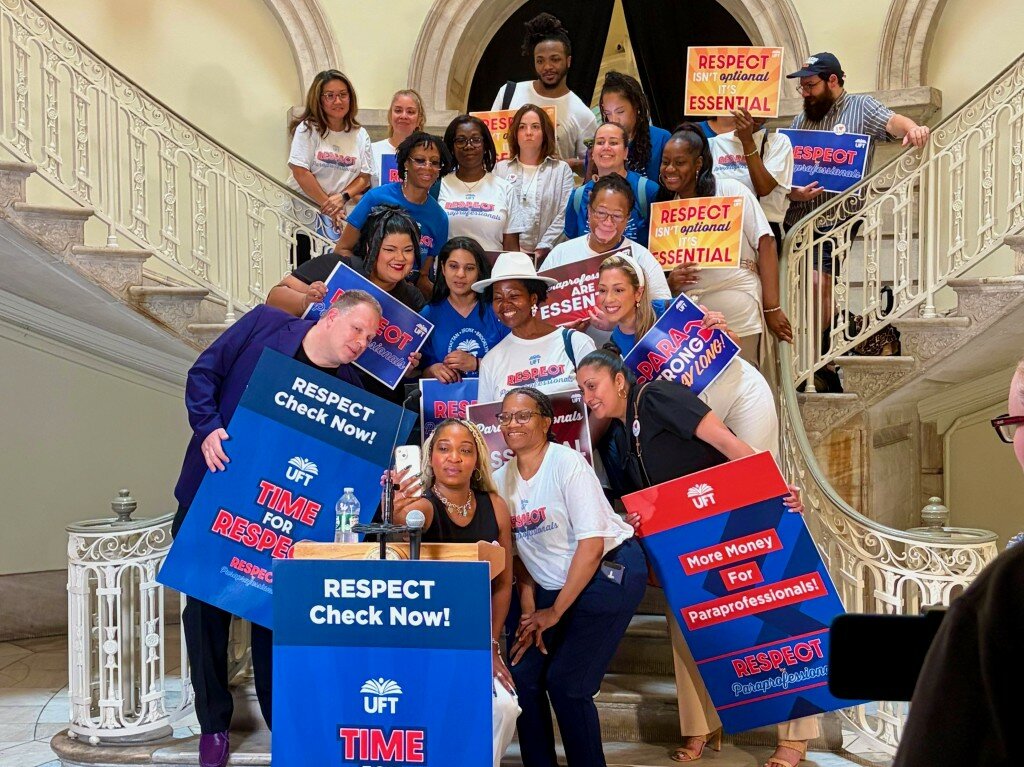
On July 16, the New York City Council voted 49-0 to approve the “Respect Check,” legislation that will give roughly 26,000 department of education paraprofessionals a total of $10,000 in four quarterly payments of $2,500 during the 2026-27 school year. Despite the unanimous vote, Mayor Mamdani has signaled he may not sign the bill, arguing it conflicts with the Taylor Law — a state statute that reserves public employee pay decisions for collective bargaining rather than legislative action.
The one-time payment would cost the city about $244 million and is meant to stabilize a workforce where salaries start at roughly $32,000 a year, while the city and the United Federation of Teachers continue contract negotiations.
The legislation aims to address decades of widening pay disparities within the DOE. While salaries increased across the school system, paraprofessionals saw smaller gains than many other employees. Between 2005 and 2025, starting paraprofessional salaries rose by about $12,000, while the city’s highest-paid principals saw their pay climb by $87,000 over the same span, according to DOE salary schedules.
For Jenny Ramos, an educational paraprofessional of more than eight years at Bronx High School of Law and Finance, the vote landed as a relief after years of financial uncertainty.
“I’ve contemplated leaving this line of work quite a few times, I mean it,” Ramos said. “I’ve been at work crying over how hard life is, because I can never cover all my bills.”
A single mother of three making $44,000 a year, the 38-year-old said she recently drove her son to college, but couldn’t afford a laptop for him. Instead, he walks to the campus library to get his schoolwork done. For necessities, such as toiletries, she scrounged up what she could from home for him to use at school.
“As a mom, you don’t have to give them luxury, but you have to give them what they need,” she said. “He needs that, and I cannot provide it.”
The legislation grew out of a staffing crisis the city has faced for years. The department of education has publicly acknowledged around 1,600 vacant paraprofessional positions, but the United Federation of Teachers said it believes the real number is far higher.
Every vacancy represents a student who may not be getting a service they are legally entitled to, said Michael Mulgrew, the union’s president.
The department of education did not respond to a request for comment before press time.
New York City Council member Carmen De La Rosa, the bill’s lead sponsor, said the issue first came into focus for her during oversight hearings on the Carter cases — special education lawsuits filed by parents whose children were not getting mandated services.
The Carter cases take their name from Florence County School District Four v. Carter, a 1993 U.S. Supreme Court ruling that gave parents the right to sue when a school district fails to provide legally required special education services. Under that decision, the city must reimburse families who win for private school tuition or outside services.
According to the New York City Office of Administrative Trials and Hearings, filings rose from more than 14,000 due process complaints in the 2020-21 school year to more than 21,000 in 2022-23.
“The salaries were too low — $32,000 as the starting salary, and after 10, 15 years, they were still making less than $60,000 a year,” she said. “In a city as expensive as ours, people weren’t signing up to be paras, and those that were saw it as a temporary move and were leaving the profession at a time where the need is ever growing.”
The bill was first introduced during the previous council term but never got a floor vote; then-Speaker Adrienne Adams declined to bring it forward, according to Mulgrew, who said advancing the bill became a priority when Julie Menin became speaker this year.
Mulgrew said the union had already tried twice to raise paraprofessional pay through collective bargaining, instead resorting to asking other union titles to give up portions of their own raises to help close the gap.
A 2024 union membership survey counted nearly 1,900 vacancies before the DOE later put the real figure closer to 3,000, according to Mulgrew, and he said the staffing gap has left students without services while exposing the city to a growing pile of lawsuits.
Council member Eric Dinowitz, who chairs the city council’s education committee, said the payment would be “a bridge, but not a permanent fix.”
The immediate goal, he said, is to retain experienced paraprofessionals while broader contract talks continue, especially as schools struggle to support students with disabilities and English language learners.
Despite the council’s unanimous vote, the bill’s future is uncertain. New York’s Taylor Law generally requires that public employee wages and benefits be set through collective bargaining rather than legislation — a distinction Mamdani’s administration says the council’s bill fails to respect.
“Every day, paraprofessionals ensure that our most vulnerable students get the support and care they deserve in our public schools… I have been clear that questions of compensation are best resolved through the collective bargaining process that respects workers and their unions,” Mayor Mamdani said in a statement to the Press.
His administration, Mamdani said, is reviewing the final language and working to determine the appropriate next steps.
In the meantime, Ramos said she is currently the only permanent paraprofessional at her high school, and although she is assigned to specific students, she ends up helping many more because there are not enough adults to go around.
“It’s very upsetting to see,” she said. “There are kids where little things just don’t click sometimes, and it’s unfair to watch them go through their upperclassmen years struggling because they don’t have that extra help.”
At P.S. 24 in Riverdale, Vivi Polanco said low pay discourages people from ever making the leap from substitute to permanent paraprofessional like she did.
Before becoming a paraprofessional, Polanco left a higher-paying job at Citibank for the classroom after her daughter was diagnosed with ADHD, trading income for a schedule that let her be present at home. The trade-off still costs her, she said.
She still works at an after-school program every day to make ends meet, and her husband works multiple jobs as well, she said.
“Even as a para, we have a second job,” she said. “We have a family to feed, we have bills to pay.”
As the future of the Respect Check remains uncertain, De La Rosa said the bill was never meant to replace collective bargaining.
“We’re using this bill as a motivation to say this is a workforce in crisis,” she said. “But in the meantime, for the paras coming back to work in September, this is an encouragement to say: we see you.”
For Ramos and Polanco, the vote was a milestone, but they say there is still a long way to go for a salary that lets the people who support the city’s most vulnerable students stay in the job without falling behind on their own.
Keywords
NYC paraprofessionals,
Respect Check,
Zohran Mamdani,
New York City Council,
paraprofessional pay,
DOE paraprofessionals,
United Federation of Teachers,
special education,
NYC schools,
Carmen De La Rosa