
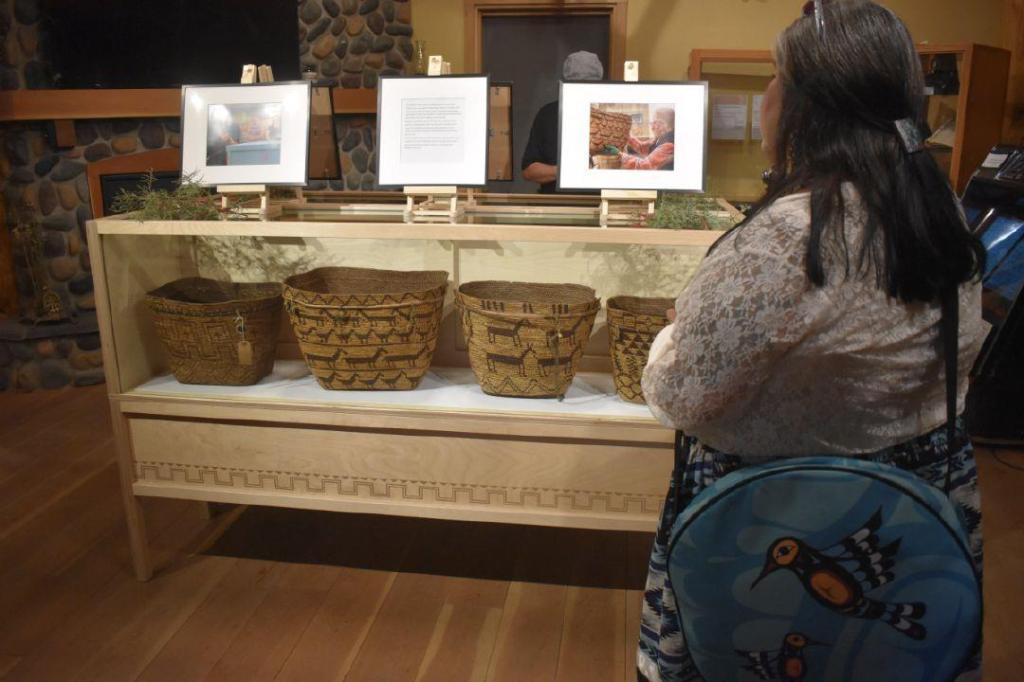
Friday was an exciting and powerful day for many at the Museum of the Cariboo Chilcotin in Williams Lake where intricately woven Tsilhqot’in baskets are now on display.
A grand opening was held July 31 to celebrate two exhibits – qatŝ’ay (coiled spruce root baskets) returned to the Tsilhqot’in Nation from a museum in Brooklyn, New York, and a collaborative exhibition, Nexwenen Nataghelʔilh – Bringing Them Back to Our Land, that celebrates the Tsilhqot’in Nation’s first major museum repatriation.
“This day is important to have our children, youth and Elders here,” said Xeni Gwet’in Nits’ilʔin (Chief) Roger William.
Eight of the nine qatŝ’ay from the Brooklyn Museum are nestled in a glass display case on the main floor after arriving on July 10 and being smudged, in addition to song and prayer, following a long journey from New York.
The other is placed on the ground with a sign asking people not to touch.
Each of the unique baskets are made for a specific purpose and show designs that mark family connections and other aspects of identity. Some are so tightly woven they could even hold water, noted Tsilhqot’in National Government (TNG) executive director Jenny Philbrick adding some have bears or different flowers.
One of the youngest baskets is believed to have a church, beaver and porcupine on it.
“Our great-grandparents have probably made these, touched these. Our spirits have been put into them,” Philbrick said. “A lot of the baskets have people’s hair put into them, so they’re very personal.”
Philbrick added the baskets were not just used for storing or picking but were placed on burial sites, where they were taken by many non-Tsilhqot’in people. In the past hundreds of qatŝ’ay and other Tsilhqot’in objects were taken from Tsilhqot’in territory often being traded or sold to private collectors across Canada and the U.S.
The return of the qatŝ’ay from the Brooklyn Museum results from a Tsilhqot’in delegation that attended in spring 2023 the United Nations Permanent Forum on Indigenous Issues. While in New York, the delegation was able to view ten baskets which were reportedly collected from Tsilhqot’in people during an expedition along the Fraser River and had been housed at the museum since 1905.
At Friday’s grand opening TNG cultural heritage coordinator Shane Doddridge noted how a graduate student assisted them with a rationale to the museum for their return as rules in the U.S. are quite different, with objects having to meet a specific criteria.
Coordination and logistics of their return with American and Canadian customs and border services were further led by TNG archivist Samantha Lee.
Doddridge said legislation prevented them from bringing home one of the baskets from the Brooklyn Museum with migratory bird feathers.
“We brought these ones home,” Doddridge added of the nine baskets. “And it just happened to coincide with when we’re bringing up our beautiful exhibit celebrating repatriation at the Museum in Vancouver.”
Before arriving at the Museum of the Cariboo Chilcotin, Nexwenen Nataghelʔilh was previously on display for the past year at the Museum of Vancouver and developed in close collaboration as part of a broader exhibition, The Work of Repair: Redress and Repatriation at the Museum of Vancouver.
It invites visitors to witness museum repatriation in action, following the return of over 60 Tŝilhqot’in ancestral belongings from the Musuem of Vancouver in February 2024 including qatŝ’ay, tŝi-bis (obsidian) stone tools, and a variety of other cultural objects which were held in museums or private collections for over a century, largely out of public view.
Also included in the exhibit inspired by the repatriation of qatŝ’ay from the Museum of Vancouver is beadwork by contemporary Tsilhqot’in artists.
“It will be here for another year, so we encourage everyone to check it out,” Doddridge said, adding after Williams Lake will be the Quesnel Museum and University of Northern British Columbia in Prince George.
At the Friday, July 31 celebration opening prayer was provided by the Tsilhqot’in Women’s Council followed by drum and song that William said was about a warrior and hunter who lost his sight.
The hunter and warrior came upon a lake and was frustrated, angry and scared. A loon that watched the hunter and warrior gave his sight back in exchange for the beautiful necklace he wore.
“This whole exhibit that we share here in the City of Williams Lake and the Museum of the Cariboo Chilcotin is like getting our sight back,” William said, noting the Tsilhqot’in craftsmanship put into past and present items.
“Our ancestors are also coming back,” Tl’etinqox Nits’ilʔin (Chief) Dale Hance said adding the importance of preserving the baskets. “It’s a part of who we are.”
Yunesit’in Nits’ilʔin Chief Lennon Solomon said in a time where many struggle to find their identity, the artifacts will help them remember who they are, where they come from and where they are headed.
“I think it goes a long way into remembering how the Tsilhqot’in are – a warrior nation and how we survived being almost taken off the map. These artifacts are proof that we’re still here and we have a lot of work ahead of us.”
Repatriation according to the TNG is hope for a brighter future for future generations, with Philbrick adding she believes the qatŝ’ay will evoke positive emotion for many.
She recalled how her 88-year-old grandmother spoke of how kids would pick roots that would be soaked in water by her own grandmother and weaved into baskets for them.
President of the Museum of the Cariboo Chilcotin, Amber Nehring said the museum is humbled to host the exhibit, describing it as a very deep honour.
A week earlier Doddridge noted how the TNG celebrated a victory against mining at Teztan Biny (Fish Lake) that was a more than 30 year battle, a similar time frame for Aboriginal Title that was achieved in June 2014.
“There’s so many battles it’s hard to also focus on other important cultural work, so with some of these repatriations we really see an inspiration and it’s lifting up all people,” Doddridge said.
To date, more than 300 Tsilhqot’in belongings have been identified in at least 20 museums around the world, the TNG notes.