
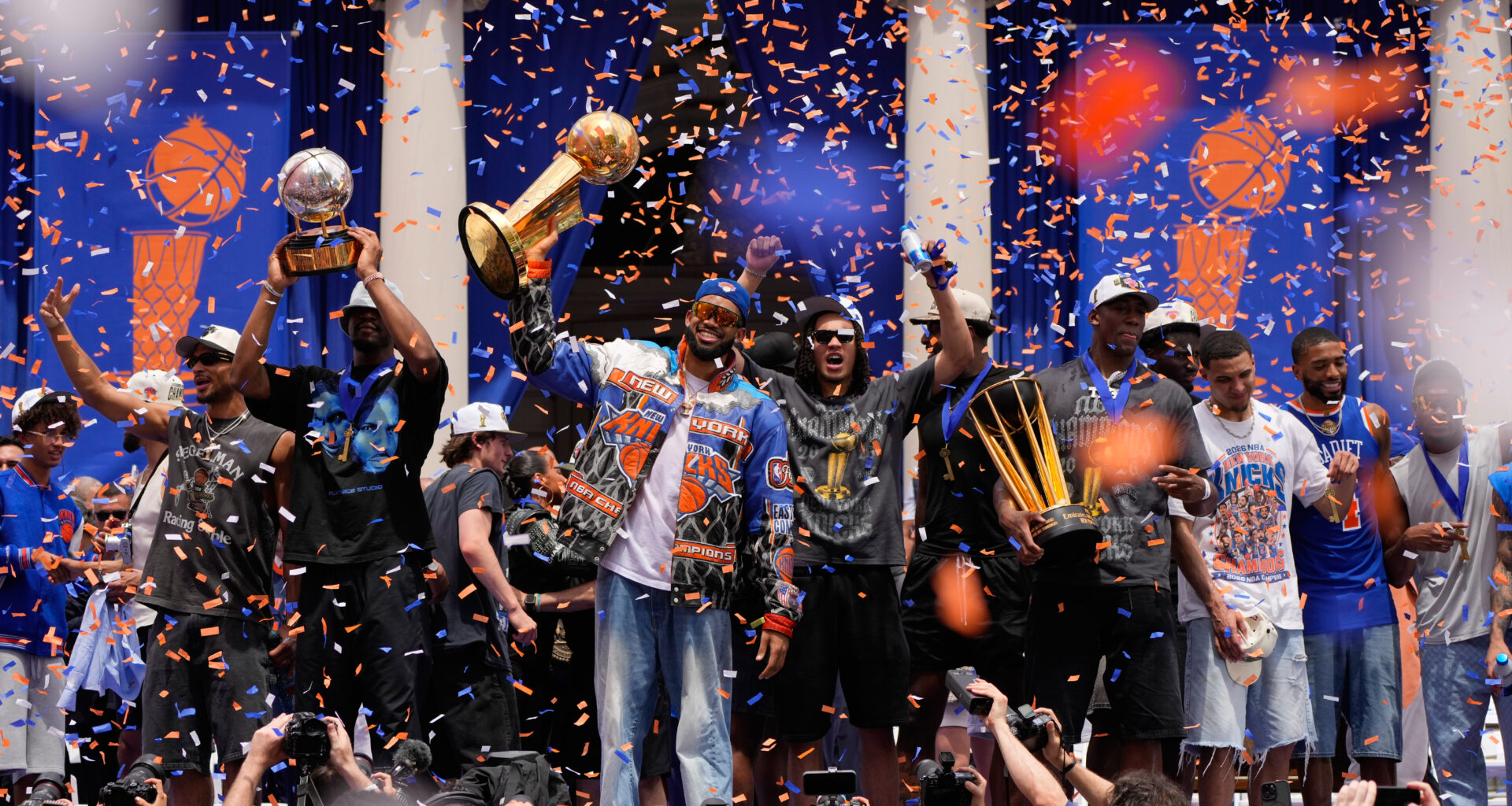
Was it all a dream? The Knicks’ epic playoff run on top of the global love fest that is the World Cup, all on the heels of a mayoral campaign that leaned into the magic of New York.
For the last several months, New Yorkers were dapping each other up in the grocery, traveling to neighborhoods never before visited, getting chills watching Brazilian fans samba dancing to Tartan Army bagpipes, and nodding heads watching Shakira during the World Cup Final at … the library?
In likely and unlikely places across the city — bars, parks, museums, vacant lots, buses — New Yorkers came together and reported a feeling they couldn’t quite describe, something like awe.
“Awe is a lightning bolt that marks in memory those moments when the doors of perception are cleansed, and we see with startling clarity what is truly important in life,” says clinical psychologist David Elkins.
The awe we experienced impacted our minds and our bodies — it changed us physiologically. Our vagus nerve was activated, which calmed our nervous system and opened us up to selflessness, empathy, and connection.
If we can measure awe, we can understand it — and make more of it. We aren’t dependent on the basketball gods or FIFA overlords to feel that we belong to each other and to the city.
Last fall, our collective of urban planners set out to measure awe. Decades of working in neighborhoods across the city taught us there’s wonder all around us — the trick was to capture and make sense of it.
We asked thousands of New Yorkers to share their awe stories — a time when the city knocked them off their feet. Often, they recalled the everyday: strangers trapped on the subway singing songs, a spontaneous memorial for a beloved neighbor at the local bodega. Their stories fed a data analysis that outlines the what, why, and where of NYC awe.
Armed with data detailing what moves and connects us, we can craft legislation, make investments, and design programs that reflect what we hold dear. Our policy aspirations can include immediate impact and enduring connection, increased wellbeing, and inspired action.
A summer like this hints at the possibility of more. It encourages a shift from a flat politics of gap-filling to a multi-dimensional politics of connection. Because whether it’s the threat of climate change, increasing inequality, or the loneliness epidemic, “survival is, in fact,” as Palestinian scholar Edward Said noted, “about the connection between things.”
Examples of awe-inspired governance abound: New Zealand’s well-being economy considers dignity, cultural preservation, and ecological limits alongside income; a commission in Wales incorporates an assessment of impact on future generations in its decision-making; and Bhutan measures gross domestic happiness alongside gross national product.
Government must take into account our full selves. We are people who need affordable housing, living wage jobs, great schools, and safe neighborhoods. We’re also people who love our families, care for our neighbors, and seek a connection to something larger than ourselves.
Systematically gathering qualitative data that paints a more complete picture will redefine how we measure success. That will lead to shifts in fundamental systems — our data infrastructure, decision-making, economy.
The good news is, we don’t have to wait another 53 years for the gift of belonging. By understanding the “it” behind the awe, we can create the conditions for the kind of connection that will make a better city and, ultimately, ensure our survival.
MacLean is a founding member of the urban planning collective, Team Wonder. Previously, she created and led the first-ever NYC Office of Engagement and ran the national community planning nonprofit, Hester Street.