
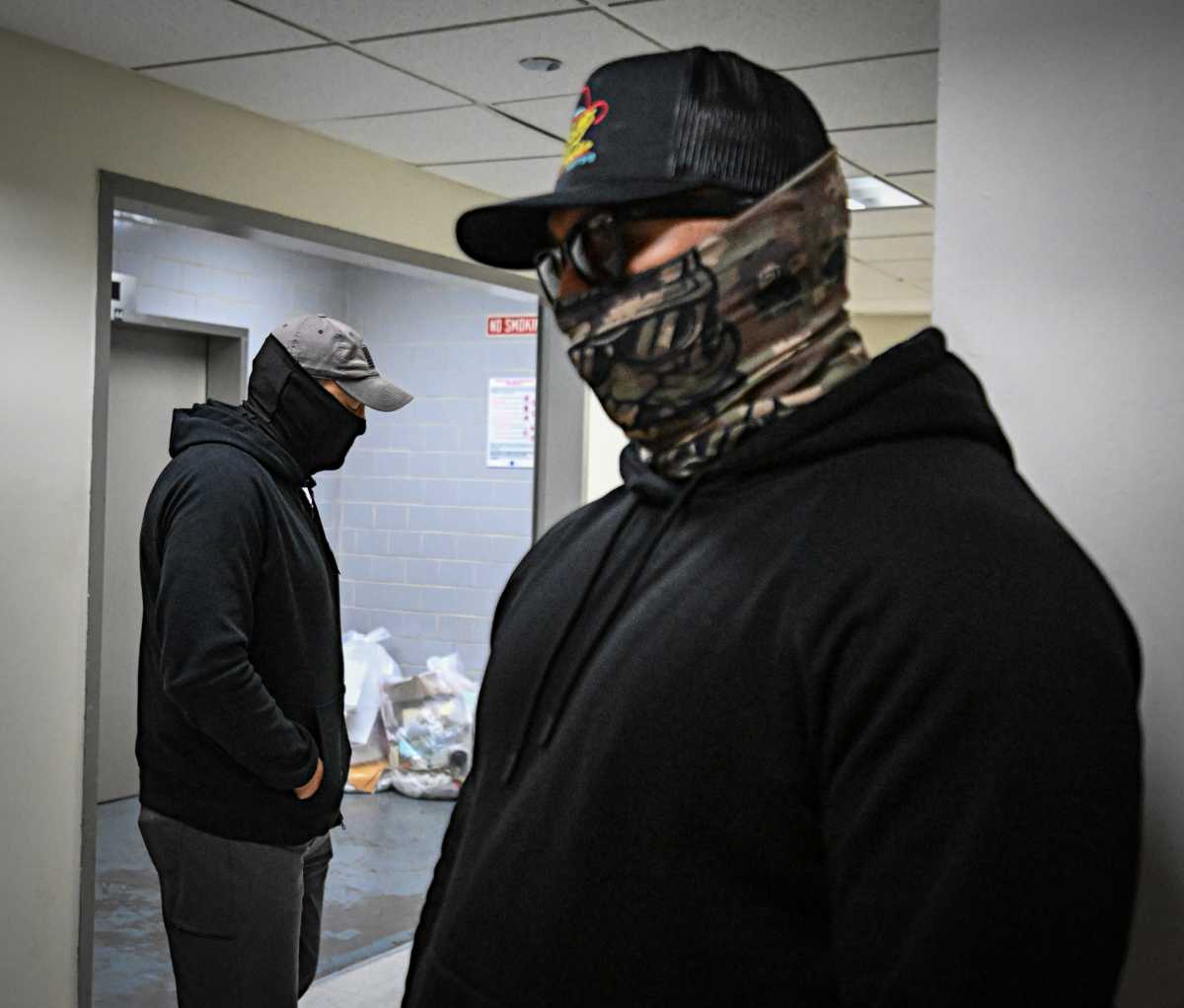
A federal judge has blocked a New York law banning Immigration and Customs Enforcement (ICE) agents from wearing masks while on duty in the state, saying the law is likely an impermissible regulation of federal activity.
The decision comes after the federal government sued to stop the New York law, which went into effect in late June and was intended to prevent ICE agents from conducting masked kidnappings of people across the state. Elected officials who passed the law argued officers were emboldened to pick people up with little to no justification because they were hiding their faces, and in court, attorneys argued the state was allowed to pass the law because it’s within New York’s “police powers” to pass laws that are within the state’s best interest.
U.S. District Judge Mae D’Agostino, an Obama appointee, said it was “besides the point” that preventing federal officers from wearing masks in New York is within the state’s jurisdiction and would prevent dangerous situations because the state can’t tell the federal government how to do its job, the upstate judge wrote late Monday.
“The Supreme Court has clearly held that the United States may perform its functions without conforming to the police regulations of a state,” D’Agostino wrote. “Although the Federal Government is limited in the number of its powers, states cannot exclude it from the exercise of any authority conferred upon it by the Constitution [or] obstruct its authorized officers against its will.”
The federal government is allowed to do what it needs to carry out its “necessary functions” (here, immigration enforcement via the longstanding Immigration and Nationality Act) without obstruction from the states, D’Agostino wrote in her 51-page decision.
That means that because the federal government has decided ICE officers need to wear masks to carry out the federal Immigration and Nationality Act, the judge said that New York cannot do anything about it: “Settled law establishes that federal, not state, authorities make the policies that animate the enforcement of federal immigration laws,” and the feds say they need masks.
“States have no power … to impede, burden, or in any manner control, the operations of the constitutional laws enacted by Congress to carry into execution the powers vested in the general government,” the judge wrote. “The intergovernmental immunity doctrine ‘generally immunizes the Federal Government from state laws that either (1) ‘directly regulate’ or (2) ‘discriminate against it.’”
The federal Department of Justice commended D’Agostino’s decision and said the department is “focused on law and order, public safety.”
New York Attorney General Letitia James, who is defending the state law in the case, said her office stands “firm in our belief that masked agents do not make New York safer.” She said her team is reviewing “all legal options” to enforce the mask ban against ICE agents.
Similar laws banning ICE agents from wearing masks have not fared well across the country. Previously, a federal California district court judge ruled the law was unconstitutional because it exempted state police, and a local judge in Philadelphia blocked a city law also attempting to unmask ICE agents.
Monday’s decision in New York is a preliminary one in a case brought by the federal government against a package of laws the state passed in an attempt to stymie ICE picking people up with little or no justification and taking them to reportedly horrific detention centers, such as New Jersey’s Delaney Hall, where someone died this weekend.
The federal government had also asked D’Agostino to also block local laws preventing city and state police from working with or taking orders from ICE and barring local agencies, governments and facilities, like jails and schools, from engaging in contracts with ICE. The judge declined to do so.
She said those laws were likely permissible because a state’s choice not to voluntarily cooperate with immigration enforcement does not prevent the federal government from doing it itself. Unlike the mask ban, these laws do not stop the feds from doing what they say they need to and can do themselves, so they don’t run afoul of the federal government’s immunity from state law.
“While [these] agreements may facilitate the federal government’s enforcement of immigration laws, and perhaps, the federal government may in fact benefit from such assistance from local authorities, a state law that prohibits localities from entering into such agreements does not create any obstacle to that enforcement,” the judge wrote. “New York is not bound by that hope or expectation.”
D’Agostino added that it would make “no sense” to hold that a federal law based on state cooperation prevents a state law from withholding that cooperation.
Any contract ICE has with local agencies must be terminated by Aug. 25, and no new contract will be permitted past that date.
The DOJ didn’t comment on that part of the ruling, but Jame’s office commended it, saying those bans will keep communities safe.
“Local law enforcement should be focused on local matters, and New York taxpayers should not have to foot the bill for any collaboration with ICE,” James said.
Those laws will remain in effect as the case proceeds, whereas the mask ban will not be enforced as the lawsuit moves forward. A more permanent decision on both the laws preventing ICE from entering into contracts with state facilities and wearing masks in New York is expected to come from D’Agostino in the following months.