
Works on Paper 2011–2026
Rodder
June 25–August 12, 2026
New York
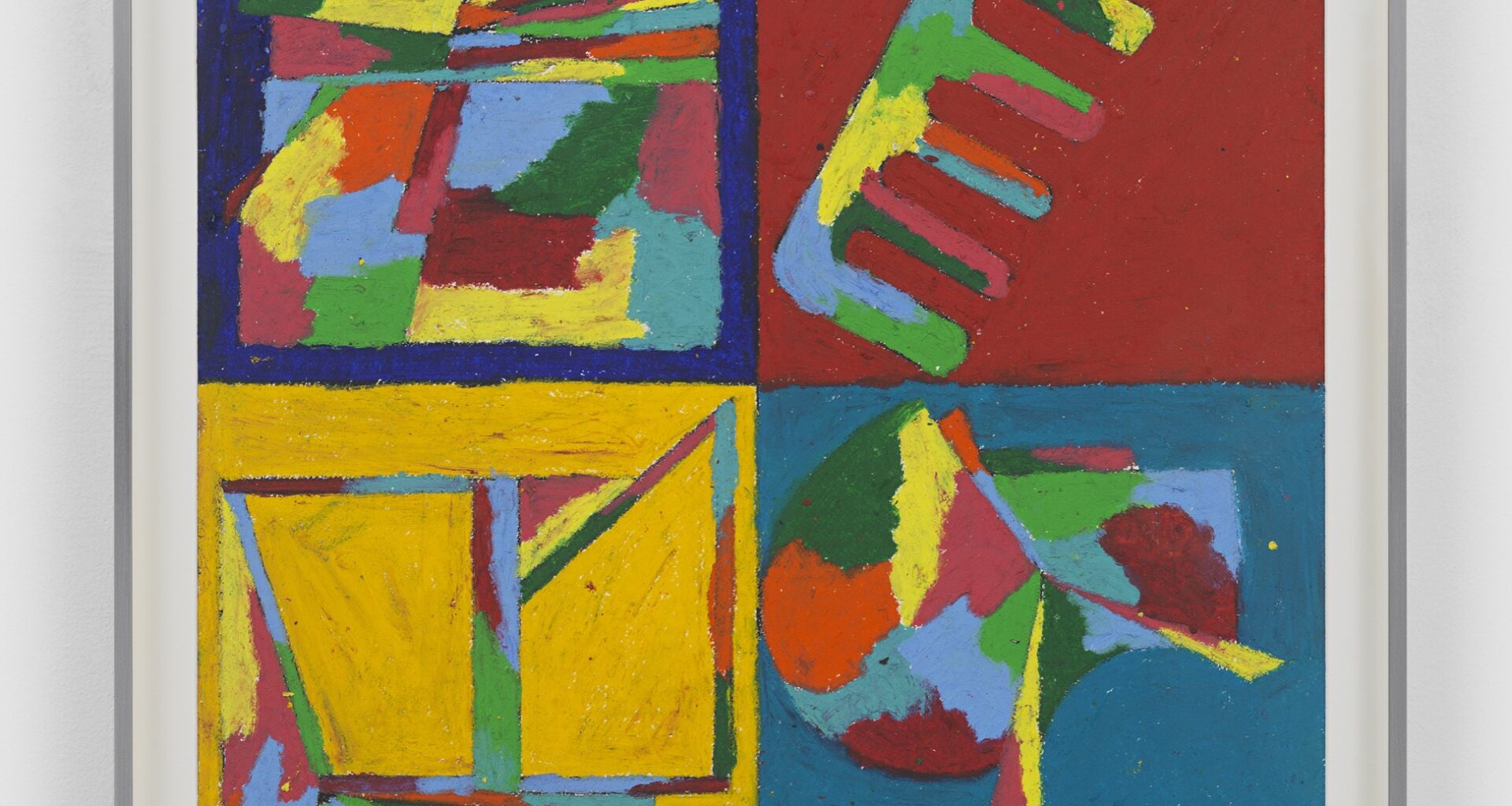
Works on Paper 2011–2026, Wyatt Kahn’s second exhibition at Rodder, is a sprawling fifteen year survey that includes drawings, watercolors, and prints. The variety of work offers a simple but important reminder: that artistic evolution does not have to be linear, and the important moments in the studio may not remain entirely present once the artworks enter the public eye. While many of the works in the exhibition have served as studies of large scale paintings or sculptures, a number of the works on view were studies for works that Kahn later chose to not produce.
Still Life (2017), a graphite and correction fluid drawing, welcomes viewers into the exhibition. It is an appropriate starting point for engaging Kahn’s drawing practice. Still Life combines multiple elements of Kahn’s visual language, depicting a scene of hard-edged geometric shapes scattered alongside domestic personal items from the artist’s life: a lightbulb, a landline telephone, a pair of glasses on a desk, a potted plant. The construction of the shapes suggest a Cubist influence, while the hand and foot seem to be drawn from Philip Guston’s late figurative vocabulary. Each object is connected, and amidst the dense black backdrop, they implant themselves into Kahn’s artistic universe. These items and shapes re-appear in various drawings as Kahn playfully engages ideas about composition, gesture, material, and color.
To the right of Still Life on an adjacent wall is one of the oldest works in the exhibition, Untitled 29 (2011), a work on paper that consists entirely of masking tape, graph paper, grey paper, and handwritten alphabetical and numeric codes. It is a literal blueprint for one of his multi-panel relief works, revealing to viewers the meticulous math behind his canvas puzzles, showing how he calculates joints and panel seams before the physical process begins.
Further into the exhibition, three sketches of Kahn’s new vinyl works hang in conversation with a recent lithograph. The sketch for Construction (after László Moholy-Nagy) 4th sketch (2026) pales in comparison to the original 2025 work, which was far larger while retaining a feeling of laboriousness through the repeated application of colored oil bars that were absent from original. The rigid, sharp structure that was present in the vinyl softens here, perhaps due to the homemade paper the oil bars are drawn onto. The sketch reflects none of the opacity of its namesake. What is left in its wake is a beautiful deliberation into the relationship between color and form, as green lines are laid down next to, and on top of, maroons, grays, and whites. The adjacent work, Construction after Konstruktion (2026) is a twelve-color lithograph. Retaining the distinctive rigidity of the presumed wooden stretcher made for Konstruktion, the coils and inlaid shapes within the work are much more discernible than when applied with an oil stick, as Kahn’s exploration of tactile depth provides the work with a sense of finality fitting of an actual transparent painting. Kahn refers to a number of these sketches as “posthumous”—as though he is trying to figure out if he can unlock something different within the same structure through a multitude of mediums. The idea of a posthumous work can also be understood as a subtle acknowledgement of the complexity of transforming a work on paper into a standalone 3D object. Over the past fifteen years, not every drawing has successfully transitioned to a painting or sculpture, and there is a beauty to that, as Kahn reveals himself to be both a craftsman and an architect, continuously testing ideas while acknowledging that failure is equally crucial as success when constructing an artistic methodology.