
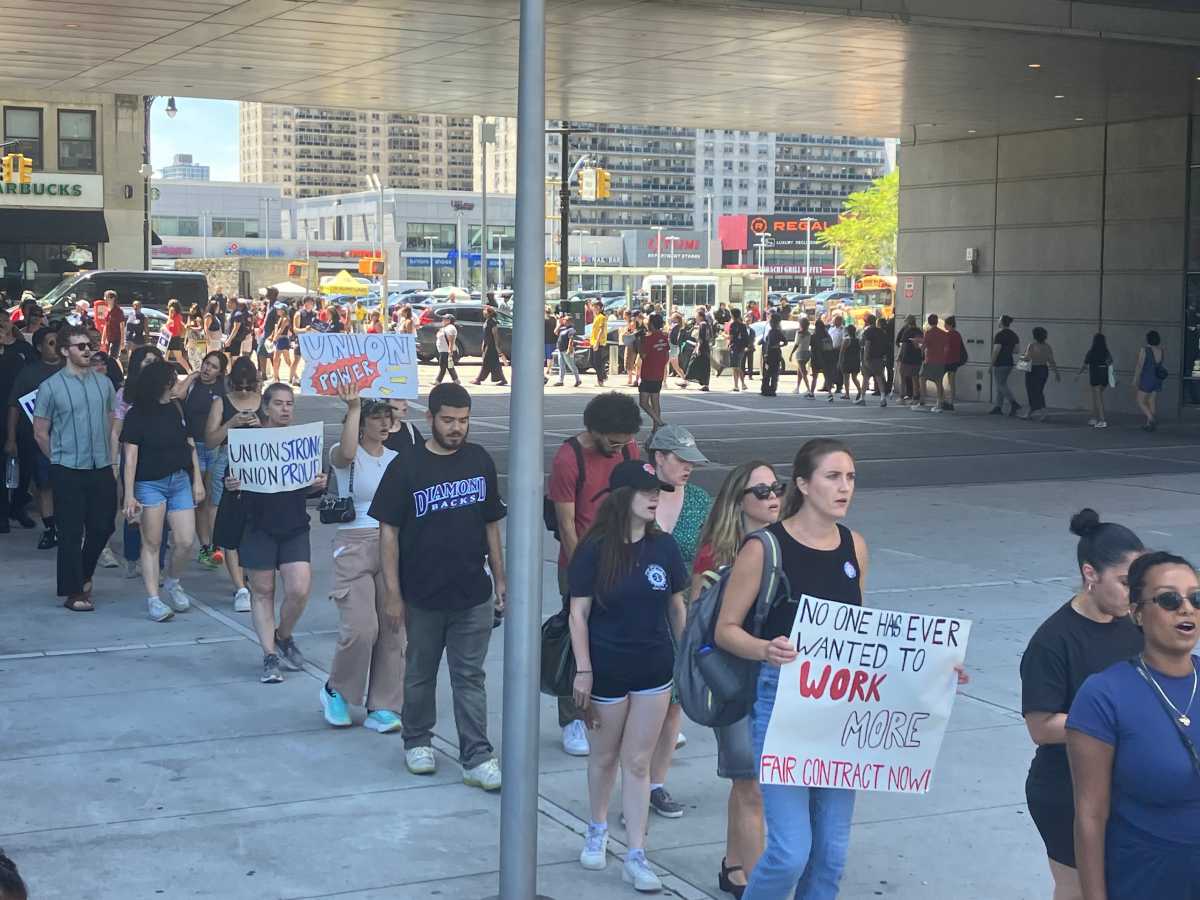
Bronx courts are feeling the impact of the borough’s over 300 public defense attorneys and legal professionals out on strike for ten days, both the union that launched the work stoppage and legal experts say.
The Bronx Defender Services union says that if management does not meet their demands soon so they can get back to work, a backlog could quickly build in the criminal, immigration and family courts they represent people in, as they do not believe any substantive work is occurring on the thousands of cases they collectively manage.
“Substantive work is not being done on cases,” said Bronx Defenders criminal defense attorney Conrad Blackburn. “And, if a case is in a trial posture and a trial should be starting soon, that could cause a delay in the trial. If there’s an issue with a client’s detention status, and an argument needs to be made about why the client should be released, that could be delayed.”
Attorneys say their supervisors are stepping in to triage their cases while they’ve walked off the job, but it’s “not humanly possible” for that group of roughly 50 to 60 people to do the work of the nearly 180 striking attorneys, many of whom are frequently handling between 50 and 100 cases at a time.
They told amNewYork they believe their supervisors are dividing the floors of court buildings between themselves and trying to appear on each scheduled hearing simply to ask for an adjournment until the attorneys actually equipped to handle the cases are back on the job.
“We get a lot of mixed signals about how things are going,” said Blackburn. “If you ask some people, they’ll say it’s a well-oiled machine, and supervisors are standing on cases and adjourning cases out. If you ask other people, they’ll say things are going kind of poorly, especially for our clients in arraignments, because clients are trying to figure out who their attorney is going to be.”
Bronx Defenders Executive Director Juval Scott said in a Wednesday statement that the organization was “committed to reaching an agreement that raises compensation across every staff role and strengthens our ability to provide the best defense possible for the people of the Bronx” and hoped to reach a resolution soon.
She added that the organization was still “fully operational” and providing the Bronx community with legal representation.
How are cases being handled amid the Bronx Defenders strike?
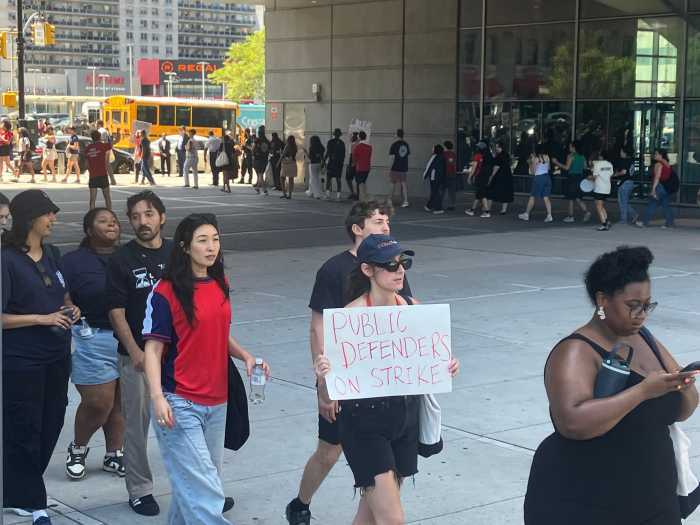 Bronx Defenders picket outside the Bronx Hall of Justice Tuesday.
Blackburn said he is concerned there simply are not enough attorneys to handle the number of cases and arraignments the Bronx Defenders are tasked with managing each day, which he thinks could result in a court backlog and create anxiety for people looking for legal help or the attorney they’ve come to trust.
“I’m sure it’s a very anxiety-producing experience coming to court and be like, ‘Who’s my attorney today? Does this person know about my case? Is this person going to fight for me?’” Blackburn said.
Blackburn spoke with amNewYork on Tuesday as hundreds of Bronx Defenders legal professionals picketed outside the Bronx Hall of Justice, where he and dozens of his colleagues represent hundreds each day.
New York Law School professor Andrew Scherer said the strike was “certainly slowing things down” in the courts — an opinion informed by his time serving as a public interest law policy director at the school and his past life leading a similar legal services nonprofit, New York Legal Services.
“The cases just have to be postponed until there are attorneys available,” Scherer said. “The other legal services providers are all generally up to working up to capacity, so it’s not likely that the other providers are going to be able to pick up the slack.”
All of this, the union says, shows how critically important their work is and demonstrates that it’s in their management’s best interest to work with them to get a contract so everyone can get back to work.
“Just as a matter of numbers, it’s simply not possible for middle management to even come close to replicating the quality of representation we’re able to offer when we’re at work,” said Bronx Defenders immigration attorney Jessica Coffrin-St. Julien. “Management’s not really prepared to move cases forward if their adjournment request is denied.”
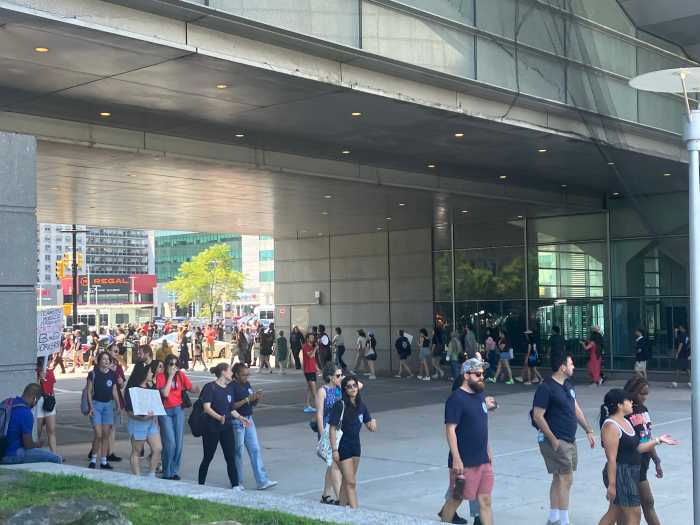 Hundreds of striking legal professionals picket outside their typical place of work.Photo by Isabella Gallo
The union says they’re still at odds with management over salaries, an ask for a 3% annual cost-of-living wage increase, a desire to keep attorney salaries “tethered” to social worker salaries so they’d get joint pay increases and hybrid work policies.
Attorneys said it pains them to be on strike and away from their clients, attorneys say. However, they feel like there’s no choice but to hold the line to get a contract that will allow them to support and take care of themselves while working the difficult and draining public defense job.
“I think it weighs heavily on every member knowing that the people we represent are not being as well served as they deserve to be during this time,” said Coffrin-St. Julien. “No one takes striking lightly. I think it’s fair to say no one wants to be on strike. It’s something we were forced into.”
Clients caught in the middle
The Bronx Defenders represent people who otherwise couldn’t afford legal representation. That makes it even more important, Scherer said, for the attorneys to get the type of contract they feel will support them well enough to allow them to do their job well and stay at the firm long enough to build institutional knowledge.
“This is incredibly important work,” Scherer said. “People should get compensated well enough for it so that they can make a career out of it, so they can have experience, and build on their experience, and stay. If you don’t pay people enough, you don’t compensate them enough, then they’re going to leave.”
“If there’s too much turnover, if people can’t find a way to make a career out of this and aren’t able to stay in these positions over the years, that’s not good for people who need representation,” he added.
It’s public defenders, Scherer said, who, in his opinion, do the most important work in the legal system – much more important than other attorneys paid much more. It’s in society’s best interest to recognize their work should be well paid, just like how judges, government attorneys and private attorneys are well paid, he said.
And, while adjourning cases and not having any substantive work done on them hurts defendants, it also makes it difficult for prosecutors to do their jobs. Those on the other side of the courtroom can feel like justice is being delayed, crime victim advocate Bishop Boyde Singletary said.
He told amNewYork he’s seen a number of cases – possibly dozens – adjourned related to alleged victims he supports in the past week, including the case of Christopher Joseph, accused of stabbing Kaitlynn Berman 22 times – meaning Berman’s alleged attacker remains on the streets. That’s stressful for the people he works with, Singletary said.
The court system has previously said it remains operational as the strike continues on, but did not respond to amNewYork’s request for comments this week on how the lack of public defenders is impacting it. The Mamdani administration has said the mayor believes it’s “critical” that an agreement is reached quickly.
On Monday, attorneys said they were frustrated that they had barely met with management at the bargaining table since walking off the job. Since then, however, Bronx Defenders management has upped its availability, and the two parties bargained for over seven hours Tuesday. They sat down again at 1 p.m. Wednesday.
The union says it’s also frustrated with how its management has been handling cases in its absence. Attorneys told amNewYork that their management essentially forced one immigration attorney to cross the picket line Tuesday. Had that attorney not appeared in court, they said, her client may have gone without representation and been deported, a situation the union accuses their management of manufacturing.
Bronx Defenders is the final public defense firm on strike after a string of contract negotiations at firms across the boroughs broke down and landed nearly one thousand public defenders on strike over the past two weeks.
Brooklyn Defender Services was the first to reach a tentative agreement, ending a six day strike on July 21. Neighborhood Defender Services ended their 11-day strike late Monday, saying they’d finally reached a contract with salary and cost-of-living raises and preserved their no-cost healthcare.