
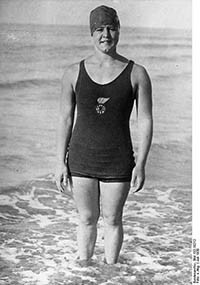
Gertrude Ederle, “World’s Greatest Woman Swimmer.”
The Queens Gazette printed an article on July 24, 2024, focusing on Gertrude Ederle in 1924. Some early paragraphs are repeated here. 1926 would prove to be Gertrude’s triumphal year.
One hundred years ago.
Born on October 23, 1905, and raised in the west 60s in Manhattan, Gertrude Ederle learned to swim at the family summer cottage in Highlands, New Jersey. Her father, Henry, was a butcher and provisioner at their family shop on Amsterdam Avenue. Gertrude lived much of her later life in Flushing, Queens. Her life links to Queens are many. She died in Wyckoff, New Jersey, in November 2003, at age 98, and is buried in Woodlawn Cemetery in the Bronx.
Gertrude started swimming at a young age, setting her first records at age 12. From the early 1920s Gertrude began to set and amass numerous national and world records in swimming distances from 100 to 800 meters. In 1922, one fine afternoon at Brighton Beach, Brooklyn, Miss Ederle broke seven swimming records for various championship events. From 1921 to 1925, Gertrude held 29 official world and U.S. swimming records.
Miss Ederle stepped into the international spotlight as an eighteen-year old United States Olympic swimmer, at the 1924 Paris, France Olympic Games. Gertrude won two Bronze Medals (3rd place) in the Women’s 100-meter, and then the 400-meter freestyle races, both individual events. As a member of the 4X100 Meter freestyle relay team, Gertrude Ederle became an Olympic Gold Medalist. Gertrude wasn’t as successful as she had hoped to be at the 1924 Paris Olympics, yet a gold and two bronze medals were quite the haul for the 18-year-old New Yorker. Miss Ederle had bigger fish to fry as she went professional and set her focus upon distance swimming.
A highly motivated swimmer destined for aqua-glory, Gertrude attempted distances even the best swimmers would not wish to swim. In 1925, she swam from the Battery in lower Manhattan south through the narrows separating Brooklyn and Staten Island, to Sandy Hook, New Jersey. Some sources say her over-seven-hour swim was only 16 miles, another stating it was a 21-mile swim. The distances sometimes varied based upon the tides, currents, and wind, which sometimes caused a swimmer to actually swim farther than the officially listed distance. This was a common occurrence. All these years later, this epic marathon swim, officially mapped at 17.5 miles, is called the “Ederle Swim,” hosted annually by NYC Swim.
Many saw this swim as a precursor to a future attempt at swimming across the English Channel, completed by only five men. That same summer of 1925, on August 18th, Gertrude attempted and failed to swim across the English Channel. She fired her trainer after the failed attempt, some speculating that her trainer sabotaged her near successful crossing effort.
After training for a year and swimming to increase stamina and distance, she set off from Cap Gris-Nez, France, where her 21-mile swim was truly arduous as currents, tides, and time were factors in keeping her from the accepting shores of England. Gertrude Ederle became the first woman to swim across the English Channel on August 6, 1926. Her epic swim took 14 hours and 34 minutes, as her “21-mile” crossing became the equivalent of a 35-mile swim, due to stormy conditions taking her off course. She made landfall at Kingsdown, Kent. Determination, indeed.
New York City, Gertrude’s hometown, regaled her with a ticker tape parade down the “Canyon of Heroes” on Broadway, in lower Manhattan, on August 27, 1926.
This writer has a personal family link to the Ederle family. My father, born in 1926 on the Upper West Side of Manhattan, lived above the Ederle Butcher Shop at 66th Street and Amsterdam Avenue. Gertrude’s parents, Henry and Gertrud, owned and ran the butcher shop. My Dad would tell a story that his mother, my Grandma, observing from a second-floor window, would put him outside the butcher shop in a stroller, and allowed him to gladly accept a piece of meat or bread in which to nibble on. They were poor prior to the Great Depression, beginning in 1929. Things like that happened, back then. Additionally, the press nicknamed Gertrude “Trudy,” yet, according to my Dad, family and friends called her “Gertie.”
Gertrude’s many, many hours in the water exasperated the onset of deafness as it would burden her terrifically in her later years. She would teach deaf children to swim through the Lexington School for the Deaf in Manhattan, the school now located in East Elmhurst, Queens.
Gertrude Ederle would, in later life, swim at the Aquacade on Meadow Lake at the 1939-1940 New York World’s Fair. Her name is honored at that site by the Gertrude Ederle Terrace and Café, by a NYC Parks Dept. recreation center and playground on West 60th Street in Manhattan, and by a park in Highlands, New Jersey. Nicknamed “Gertie,” “Trudy,” and “The Queen of the Waves,” Gertrude Ederle would go on to be called, by then President Calvin Coolidge, “America’s Best Girl.”
There are a fair number of books written about Gertrude Ederle’s youth, swimming career, and later life. I recommend the excellent 2024 movie, “Young Woman and the Sea,” subtitled: “How Trudy Ederle Conquered the English Channel and Inspired the World,” based upon the 2009 book by Glenn Stout.
For journalists, writers, and historians, anniversary years celebrate great human achievements and horrific world events. Perhaps another writer can expand upon these words in 25 or 50 years when we have cause to mention Gertrude’s amazing 1926 feat once again.
Gertrude Ederle, a New York woman through and through, is best remembered for her swimming across the English Channel in 1926. We celebrate her here today, 100 years later. On August 6, 1926, as Gertrude waded into the cold French ocean surf, the gutsy American announced, “England or drown is my motto.”