
The tour came little more than a month after Mamdani and the City Council adopted a budget that held the NYPD’s authorized uniformed headcount flat at 35,000 and dropped a previously proposed increase of 580 officers.
Police unions have warned that officers are overstretched, while Mamdani has sought to broaden the city’s public safety strategy through a new Office of Community Safety focused on violence prevention, mental health services and neighborhood partnerships.
National Night Out — an annual series of community events intended to strengthen relationships between police and residents — brought those approaches together. Mamdani credited officers for the city’s falling violence numbers while emphasizing the community ties at the center of his emerging safety agenda.
Mamdani received warm receptions at the Brooklyn and Manhattan events that amNewYork attended. The reception was somewhat different on Staten Island, where video showed several people booing as the mayor took the stage. Mamdani spoke for roughly 30 seconds before quickly exiting the stage.
Staten Island was the only borough Mamdani lost in last year’s election. He received 23.1% of the borough’s vote, compared with 55.2% for Andrew Cuomo and 21.2% for Curtis Sliwa. The video from his Tuesday evening stop in Richmond County was posted by United Zionists, a pro-Israel group that has repeatedly criticized and protested Mamdani.
Mamdani hears appeals for more cops in East Harlem
 East Harlem residents crowd around Mayor Zohran Mamdani for selfies and handshakes as he leaves the 23rd Precinct’s National Night Out event on Tuesday, Aug. 4, 2026.Photo by Lloyd Mitchell
At the 23rd Precinct’s celebration in East Harlem, Mamdani thanked officers for helping deliver what he described as historic levels of public safety.
“I want to say thank you to every man and woman who is serving the NYPD, both in this neighborhood and precinct and across the five boroughs,” Mamdani told the crowd.
The mayor described National Night Out as an opportunity to build a bridge between law enforcement and the communities officers serve.
“We know that the stronger that bridge is, the safer that community is,” he said.
Tisch credited the declines to “focused, precision policing” and deploying officers “where and when they are needed most.”
“None of this happens by accident,” the top cop said. “It is a direct result of your NYPD cops, the very best in the business, getting out there and doing the work.”
Manhattan Borough President Brad Hoylman-Sigal called Mamdani and Tisch “a perfect pairing,” adding that while crime was down in Manhattan, “fun is definitely up.”
The NYPD said Monday that the city recorded 381 shooting incidents through July, down from 412 during the same period last year. The department reported 149 murders, below the previous seven-month low of 174 recorded in 2017. Overall major crime fell 12.7% in July.
The broader crime picture was mixed. Transit crime rose 1% through July and more than 10% during the month. Reported hate crimes increased 9.4% year to date, while rape reports were up 3.6%, an increase police partly attributed to a broadened legal definition of the crime.
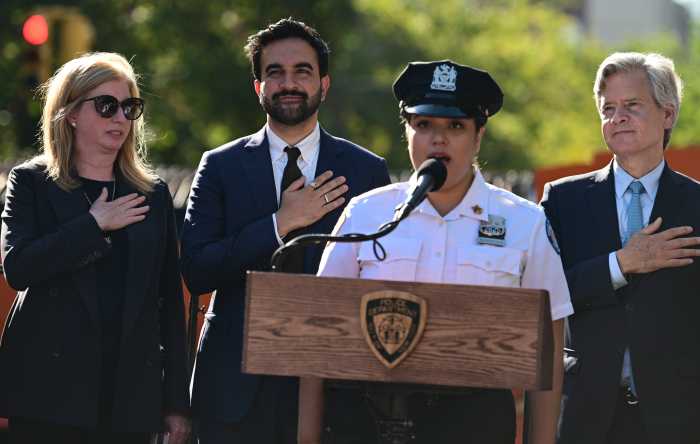 Mayor Zohran Mamdani, Police Commissioner Jessica Tisch and Manhattan Borough President Brad Hoylman-SigalPhoto by Lloyd Mitchell
 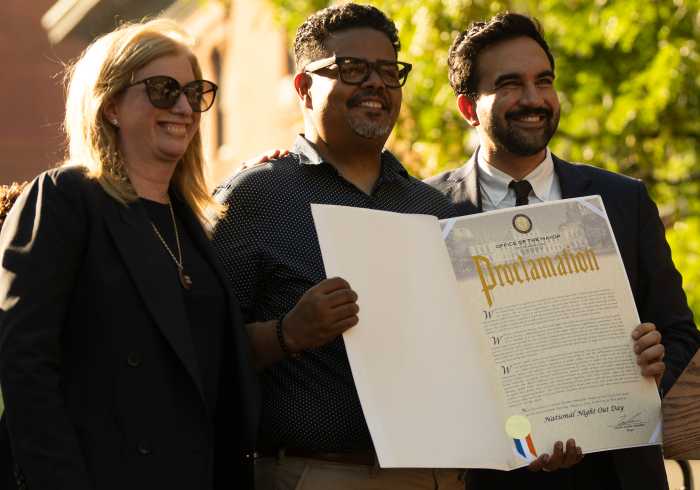 The Rev. Felipe Ayala, president of the 23rd Precinct Community Council, receives a proclamation from Mayor Zohran Mamdani. Photo by Lloyd Mitchell
Rev. Felipe Ayala, president of the 23rd Precinct Community Council and one of the neighborhood leaders Mamdani honored with a proclamation, praised the precinct’s community policing work but said East Harlem still needs more officers, particularly during evening hours.
Ayala said current officers were working longer hours and residents wanted a greater police presence.
Ayala did not directly criticize Mamdani’s budget decision or call for the abandoned 580-officer expansion to be revived. His comments nevertheless echoed concerns raised by police unions that attrition and long hours are increasing the burden on the officers who remain.
Mamdani said that when the budget was adopted, he and Tisch had found ways to keep the NYPD at its “originally authorized” headcount while meeting the city’s crime-fighting needs. The department said it could police effectively with the staffing level funded in the budget.
The decision was praised by Council progressives and police reform advocates, who argued that additional money should instead support housing, mental health care, substance use treatment and economic stability. Police unions and Council Speaker Julie Menin opposed the move. Menin said the city needed more officers because of terrorism threats, felony assaults, rape and subway crime.
The Police Benevolent Association has also tied staffing and retention concerns to its push for a new contract. The union’s previous agreement expired Aug. 1, 2025, and the PBA has argued that lower pay compared with other law enforcement agencies is contributing to officer departures.
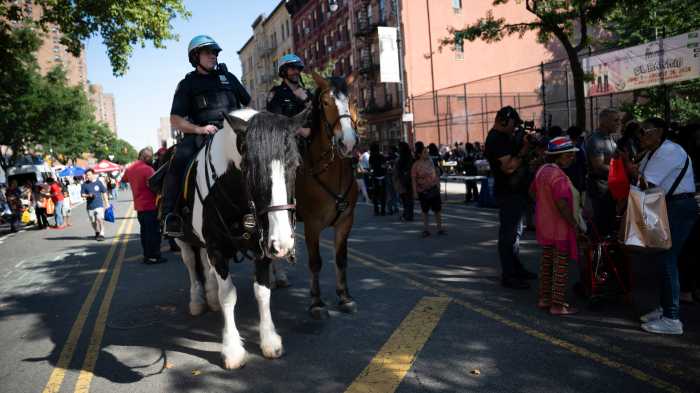 NYPD mounted officers move through the crowd as residents gather for the 23rd Precinct’s National Night Out block party in East HarlemPhoto by Lloyd Mitchell
 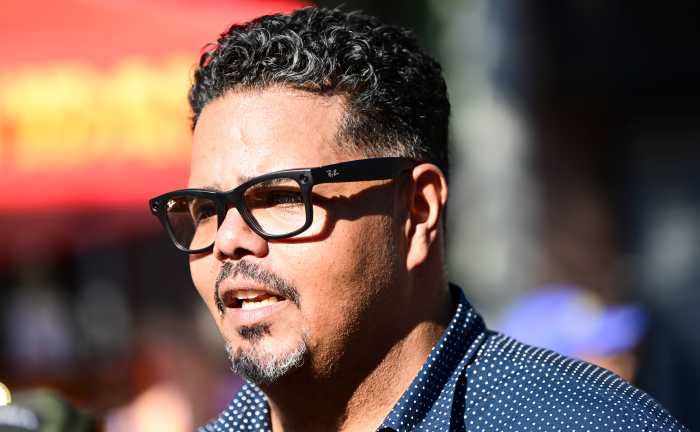 Rev. Felipe Ayala, president of the 23rd Precinct Community Council, speaks with amNewYork during the precinct’s National Night Out event in East Harlem on Tuesday, Aug. 4, 2026.Photo by Lloyd Mitchell
Ayala said the 23rd Precinct’s community-policing approach had remained consistent through changes in mayoral administrations and headcount. He said precinct leaders instruct officers to greet and speak with residents rather than treat the neighborhood solely as a place to patrol.
“Our tone is community first,” Ayala said.
He said he distrusted police when he was younger but now works with officers “hand in hand almost every day.” Ayala said neighborhood voices and officers working the streets should both help shape Mamdani’s developing safety strategy.
But for the 23rd Precinct, he said, the immediate need was straightforward.
“The more we can get, the better,” he said of additional officers.
Office of Community Safety
Mayor Mamdani created the Mayor’s Office of Community Safety in March as an initial step toward the full city department he promised during his campaign.
The office coordinates programs related to gun violence prevention, community mental health, crime victims, domestic and gender-based violence and hate crimes. Its summer strategy calls for expanded violence interruption outreach during evenings and weekends, youth employment programs and a 72-hour response protocol following shootings.
The strategy also specifically lists National Night Out as part of the office’s effort to strengthen relationships among residents, community organizations and government agencies.
City & State reported last week that the office had also coordinated neighborhood canvassing and support for victims’ families after recent shootings, while directing new funding toward violence interruption programs, hospital-based interventions and mobile response teams.
Mamdani did not mention the office by name at the Brooklyn or Manhattan stops that amNewYork attended, but his emphasis on cooperation among officers, residents and community groups mirrored the approach laid out in its summer plan, which acknowledges that the administration is still developing a broader vision for the office.
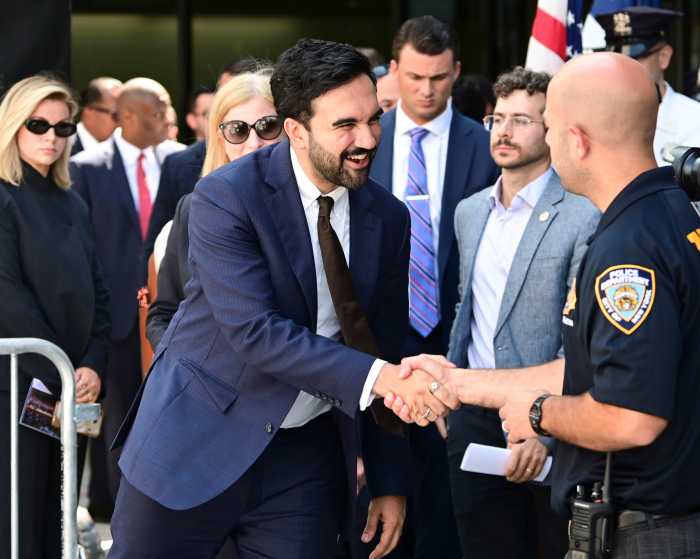 Mamdani arrives at Restoration Plaza for the 79th Precinct’s National Night OutPhoto by Lloyd Mitchell
Earlier Tuesday, Mamdani opened his tour at Restoration Plaza in Bedford-Stuyvesant alongside Tisch, House Minority Leader Hakeem Jeffries and Brooklyn District Attorney Eric Gonzalez.
Mamdani again said public safety depended on stronger ties between police and residents. He and Tisch presented a proclamation to Dr. Kim Best, the longtime president of the 79th Precinct Community Council.
House Minority Leader Hakeem Jeffries, who has frequently clashed politically with the Democratic Socialists of America, nonetheless praised Mamdani’s partnership with Tisch.
“I think the results under the mayor’s leadership and partnership with Jessica Tisch and the NYPD strongly speak for themselves,” Jeffries told amNewYork.
Asked whether Tisch should remain commissioner for the rest of Mamdani’s term, Jeffries said she was doing “a tremendous job.” He said he did not know enough about Mamdani’s proposed Department of Community Safety to assess it, but pointed to the latest crime figures: “The results speak for themselves right now.”
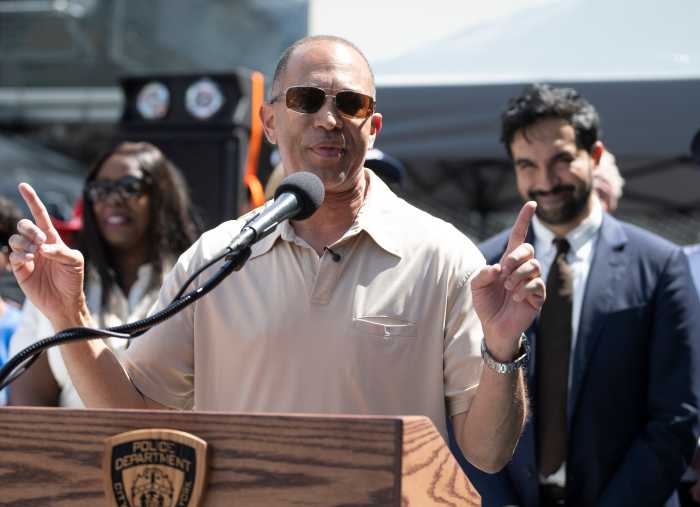 House Minority Leader Hakeem Jeffries speaks during the 79th Precinct’s National Night Out event at Restoration Plaza in Bed-Stuy. Photo by Lloyd Mitchell
  No bad blood? Mayor Zohran Mamdani and House Minority Leader Hakeem Jeffries embrace during the 79th Precinct’s National Night Out event. Photo by Lloyd Mitchell
The praise followed a politically complicated year between the two Democrats. Last month, Mamdani and Jeffries backed opposing candidates in congressional primaries that pitted the House Democratic leader’s incumbent allies against challengers supported by the mayor – including one backed by NYC-DSA.
Mamdani did, however, help head off a DSA challenge to Jeffries. As mayor-elect, Mamdani urged NYC-DSA not to endorse Council Member Chi Ossé’s prospective primary challenge to Jeffries, and the group narrowly voted against doing so.
Kim Best, president of the 79th Precinct Community Council, said she was proud to receive her first proclamation from Mamdani, despite saying she had received more than 600 awards. Best said she had noticed positive changes in the neighborhood and on the subway and argued that training, education and greater community involvement should be central to the city’s public-safety strategy.
Asked what the city needed more of, Best replied: “They need more people like me.”