
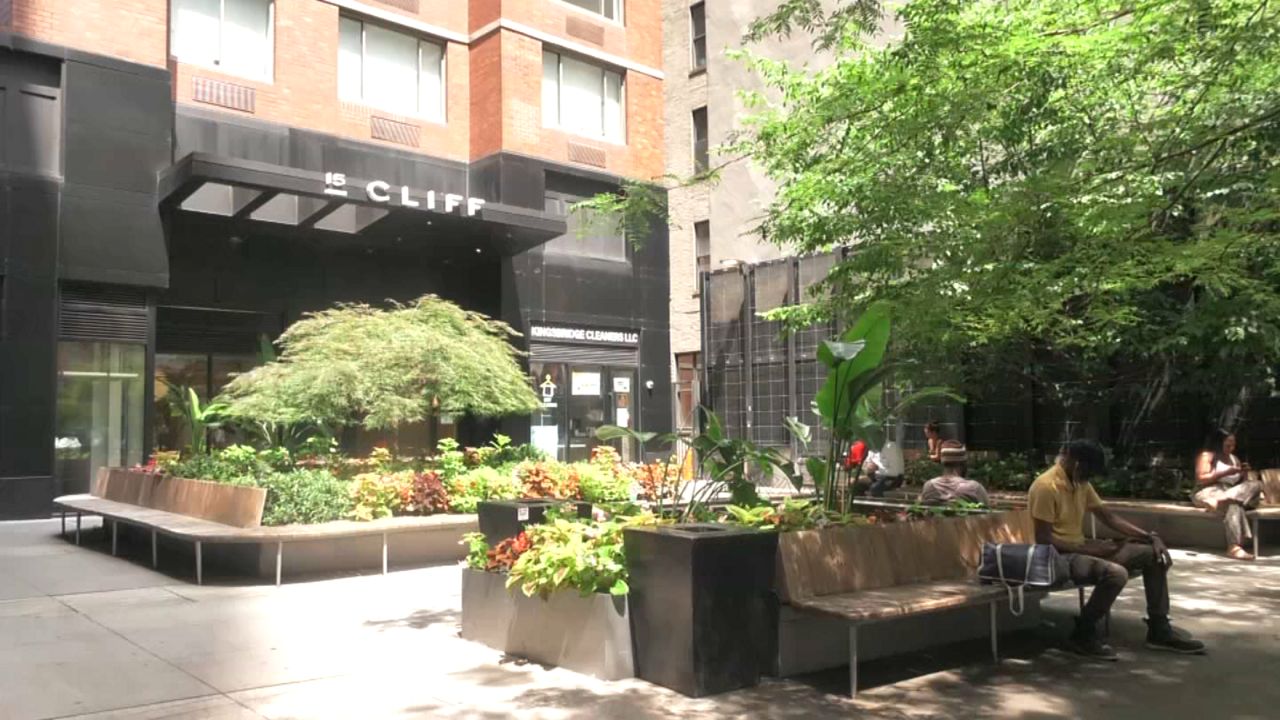
In a city where every square foot comes at a premium, some of New York’s most valuable public space is hiding in plain sight.
“The POPS in our city is so important for the economic stability of our neighborhood. And they’re important for the people who live and work here,” open-space advocate Wayde Rafnel said.
That was the focus of a walking tour through Lower Manhattan on Thursday. Open-space advocates like Rafnel and the buildings commissioner were examining Privately Owned Public Spaces, or POPS, and whether New Yorkers are getting the access they were promised.
The spaces may look like a perk. They’re actually part of the deal dating back to 1961, allowing developers to build bigger buildings in exchange for creating and maintaining space anyone can use.
“They can be atriums, they can be inside, they can be outside. The one we’re in right now has a piano in it,” tour guide Jess Joseph said.
One of the best-known and most controversial is Zuccotti Park. The privately owned public plaza became the center of Occupy Wall Street in 2011, putting the tension between private control and public access on international display.
“It’s increasingly difficult to create new open space, so POPS are the primary way to create open space for New Yorkers in dense areas of our city,” Kathy Park Price, the director of advocacy and policy at New Yorkers for Park, said.
But Rafnel said that public bargaining can break down when people try to use the space.
“They told me no one was allowed to sit there. And then I started documenting them bullying normal folks, older folks, all kinds of folks out of there,” he said.
Rafnel’s video shows people questioned, confronted or told to leave have drawn millions of views. Then the tour reached its final stop. And the concern Rafnel had documented online played out in front of the city official responsible for enforcing the rules.
“The building manager here came up to me and she said, ‘You guys really shouldn’t be doing this.’ And when I said, ‘What is it?,’ she really couldn’t answer that,” Joseph said.
The group was inside 180 Maiden Lane, an atrium marked open to the public.
Buildings Commissioner Ahmed Tigani spoke privately to come to a resolution with the manager.
“Luckily, we were able to resolve that through a conversation with both sides, but this is just a really good reminder that we have to continue the education with property owners about what rights people have who can use the space,” Tigani said.
The exchange exposing the larger concern: some New Yorkers don’t know these places exist, and some property managers may not fully understand the public’s rights inside them. According to the DOB, its first proactive inspection cycle in 2017 found 57% of POPS out of compliance.
“In cycle two, it dropped down to 20% non-compliance, and in cycle three, 15% non-compliance,” Tigani said.
DOB also investigates complaints. Owners who don’t correct violations can face penalties of $5,000 to $25,000.
“If we don’t maintain the public space, we violate the trust, and we can’t continue using these great tools that allow both parties to win,” Tigani said.
The tour group will now recommend ways to make pops easier to recognize, leaving less room for confusion over who can use them.
Rafnel said he hopes that the next time someone stops to enjoy one of these spaces, the only question is where to sit.
“You’ve got to stand up for what you believe in,” Rafnel said.