
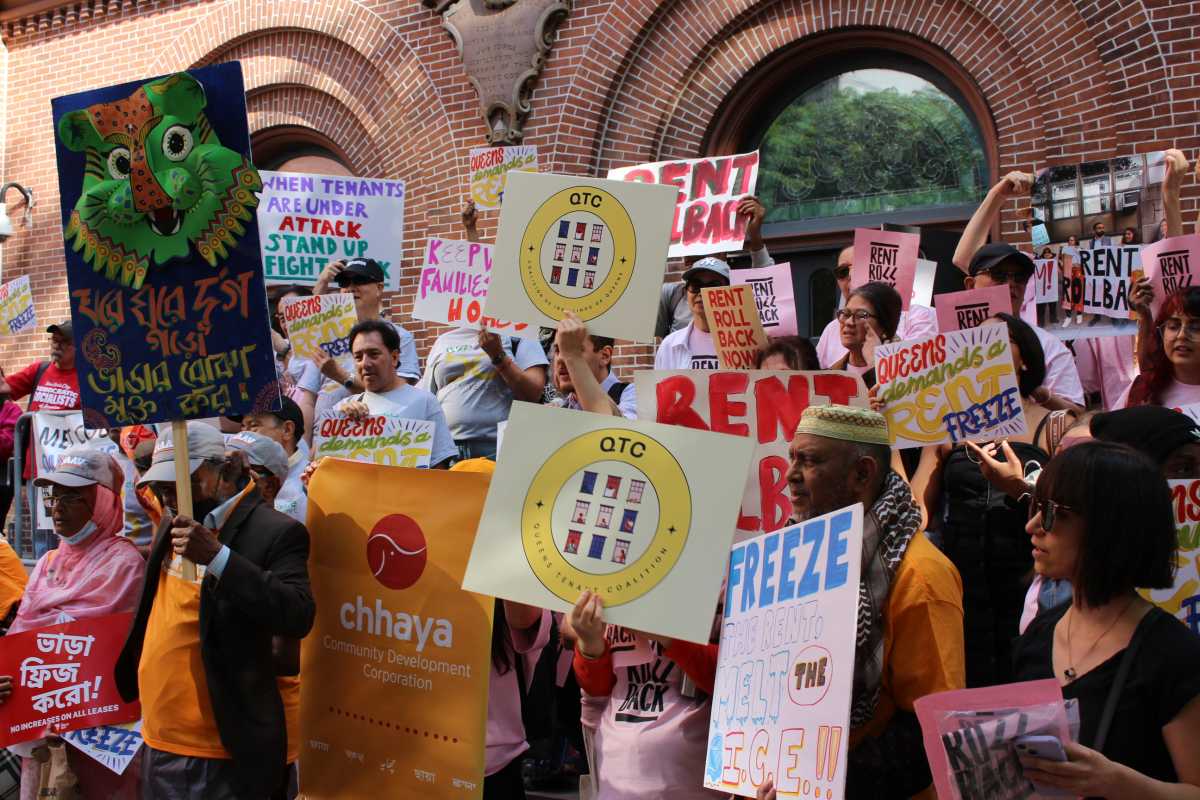
The rent freeze applies to over one million rent-stabilized apartments with one- and two-year leases, along with exemptions for seniors and disabled tenants.
Landlords argued that Mayor Zohran Mamdani stacked the RGB board with members in favor of the rent freeze. The lawsuit alleges the freeze was a political attack, and the RGB stepped out of its sphere of influence to allow the mayor to control it.
“This was a sham process with a predetermined outcome that Mayor Mamdani dictated by fiat,” said Randy Mastro, co-chair of the Securities and Complex Litigation practice at Dechert LLC, who filed the petition on behalf of the property owners. “That is not the way government decisions by independent boards are supposed to be made, and we have therefore now had to bring this Article 78 proceeding as a check on the Mayor’s abuse of power.”
However, it was reported in an article on Nonprofit Quarterly that the sole member of the RGB who voted against the rent freeze, Eric Adams’ appointee Arpit Gupta, dismissed any such political interference.
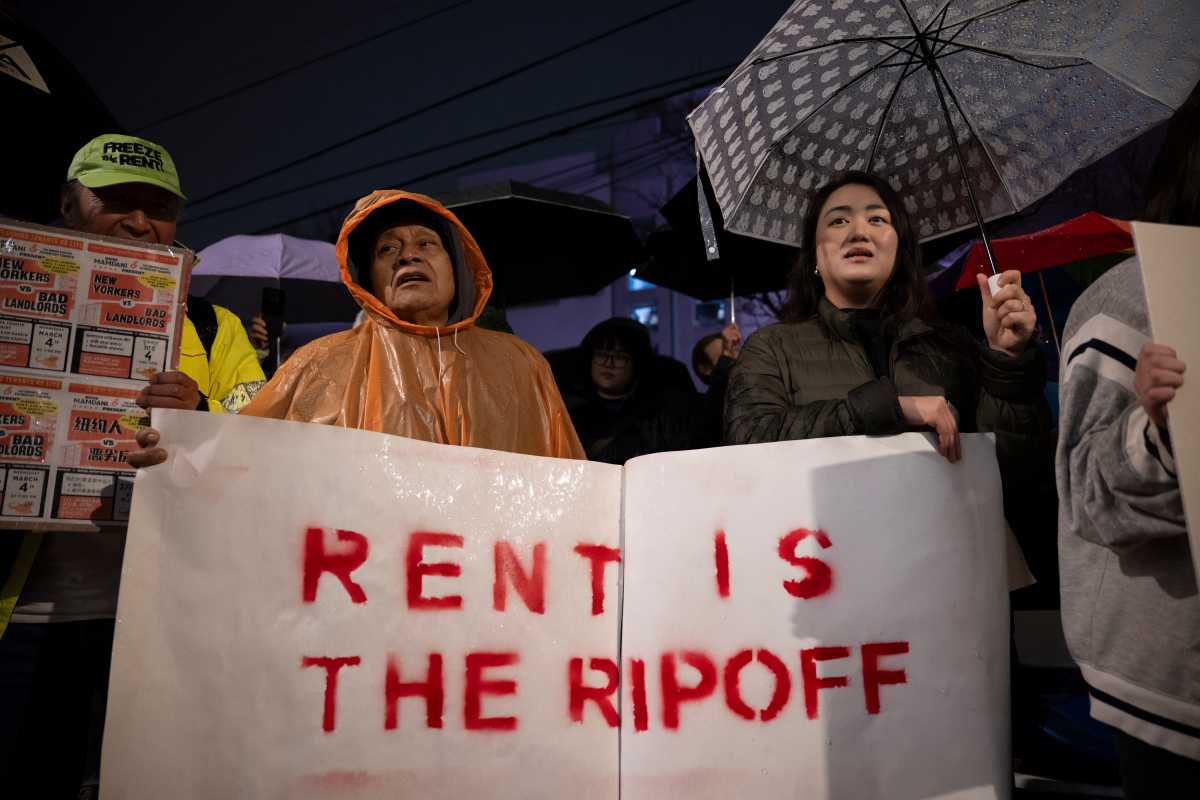 Over 200 tenants from Queens and across New York City attended the second installment of the Rental Ripoff hearings, hosted by the Office of Mayor Zohran Mamdani, at the Academy of American Studies in Long Island City on March 5.Photo by Lloyd Mitchell
Rent freezes and rollbacks have long been advocated for by tenants’ rights groups and legal teams that represent them, who cite dire increases in rent that are slowly pricing them out of the city they have lived in their entire lives.
Renters make up nearly 70% of NYC residents, roughly 44% of which are rent-stabilized.
Rent at those stabilized units went up 6% over the past year, following increases of 12% and 10% in the previous two years. Overall, net operating income growth rose more than 30% over the past 3 years.
Nonetheless, wages have not risen in proportion to the cost of housing. A 2024 report by Zillow MediaRoom showed that despite a 30% increase in rent, wages have only grown 20.2%.
Even with rising housing costs, many tenants said they live in deplorable conditions — mold, rats, defective appliances, broken elevators, lack of accessibility, malfunctioning intercom systems and more — all while getting harassed by their landlords who they said nickel and dime them for repairs that do not meet their needs or warrant such costs.
While many of the tenants said they were not surprised by the lawsuit, they emphasized that the RGB’s decision reflected the needs of the tenants after years of ignoring their concerns and siding with the landlords.
Timothy Collins, former executive director of the RGB from 1987 to 1994, who later became a tenant attorney, stated back in 2016 that he believed “the RGB has been giving owners unwarranted increases for decades, in part because it uses a flawed methodology that overestimates their operating costs.”
Maksim Wynn, the RGB’s current landlord representative, also released a statement on June 25 stating that the rent freeze is actually in the interest of the landlords. While a rent increase sounds like it would boost short-term revenue, he explained, it would instead lead to a loss of revenue because it would price out tenants and lead to costly evictions and long-term vacancies.
Landlords argue rent freeze is ‘illegal’
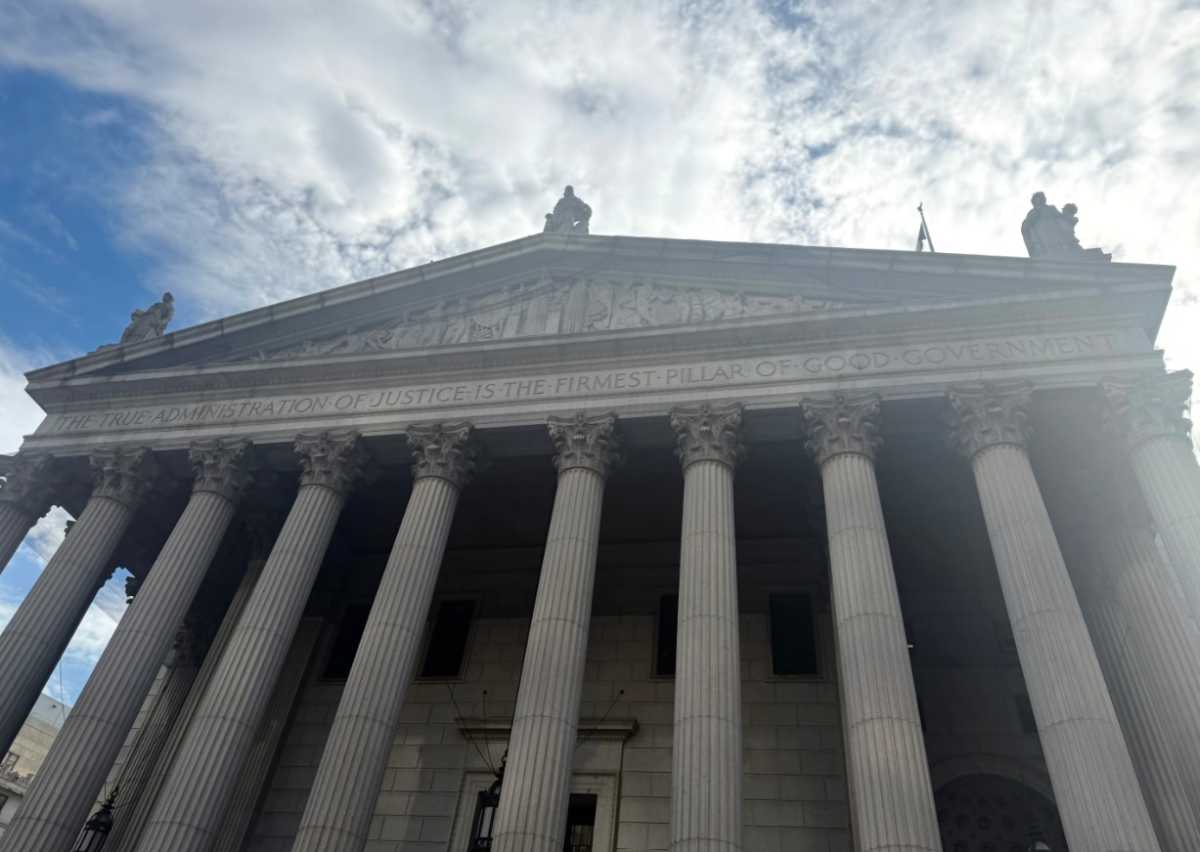 New York City Supreme Court in Manhattan.Photo by Renee DeLorenzo
According to a petition filed by the landlords, they allege the RGB “failed to consider current economic conditions of the residential real estate industry, including operating costs, real estate taxes, financing costs and vacancy rates, manipulated its own data and rendered a decision its own research did not support.”
In the petition, Mastro argued that property owners were continuing to struggle with “skyrocketing costs,” and alleged the RGB’s decision was “irrational” and “illegal.”
Mastro referenced the Rental Ripoff hearings conducted under the guidance of Mamdani in the months leading up to the decision, as well as a special briefing given by the Mayor’s Office to the RGB about the “true cost of living,” arguing that it led the rent board to “manipulate its own data, intentionally underestimating operating costs and intentionally overstating income of landlords.”
One of the plaintiffs — Violet Zharku, who reportedly owns and operates three fully rent-stabilized apartments in buildings in Woodside, Astoria and Flushing with her family members — argued the RGB’s decision left small property owners like her to absorb increasing costs.
“Freezing the rent does not freeze my mortgage, property taxes, insurance, water and sewer bills, utility costs or the cost of repairs,” Zharku said. “Those expenses continue to rise every year while our rental income does not.”
While she said her family is proud of the “safe and affordable housing” they provide for dozens of New York City families, they can no longer sustain their buildings under these conditions and said they have “no choice” but to sell their buildings.
Current court documents only include the landlord’s arguments against the rent freeze and, as of Tuesday, the RGB’s request to change the venue of the case from Staten Island to Manhattan.
Responsive papers from the RGB in support of the rent freeze are due on Aug. 14, and the first oral arguments in the case are scheduled for Aug. 2. If the court agrees to change venue on Aug. 21, then arguments will likely not go forward that same day.
There is the possibility of an appeal, the Urban Justice Center noted, which would delay any final outcome. As of now, though, the rent freeze remains valid and must be adhered to by all landlords with rent stabilized tenants.
“Ultimately, the validity of the RBG rent freeze is up to the courts to determine,” said Valerie Smosna, supervising attorney at the UJC. “But we know the RGB process involved many public hearings, that were accessible to both landlords and tenants, and considered substantial data before arriving at a decision, as they have done in prior years. And that includes prior years where a rent freeze was the outcome… Just because landlords are disappointed with the outcome, it doesn’t mean the RBG’s orders should be overturned.”
The true consequences of rising rent
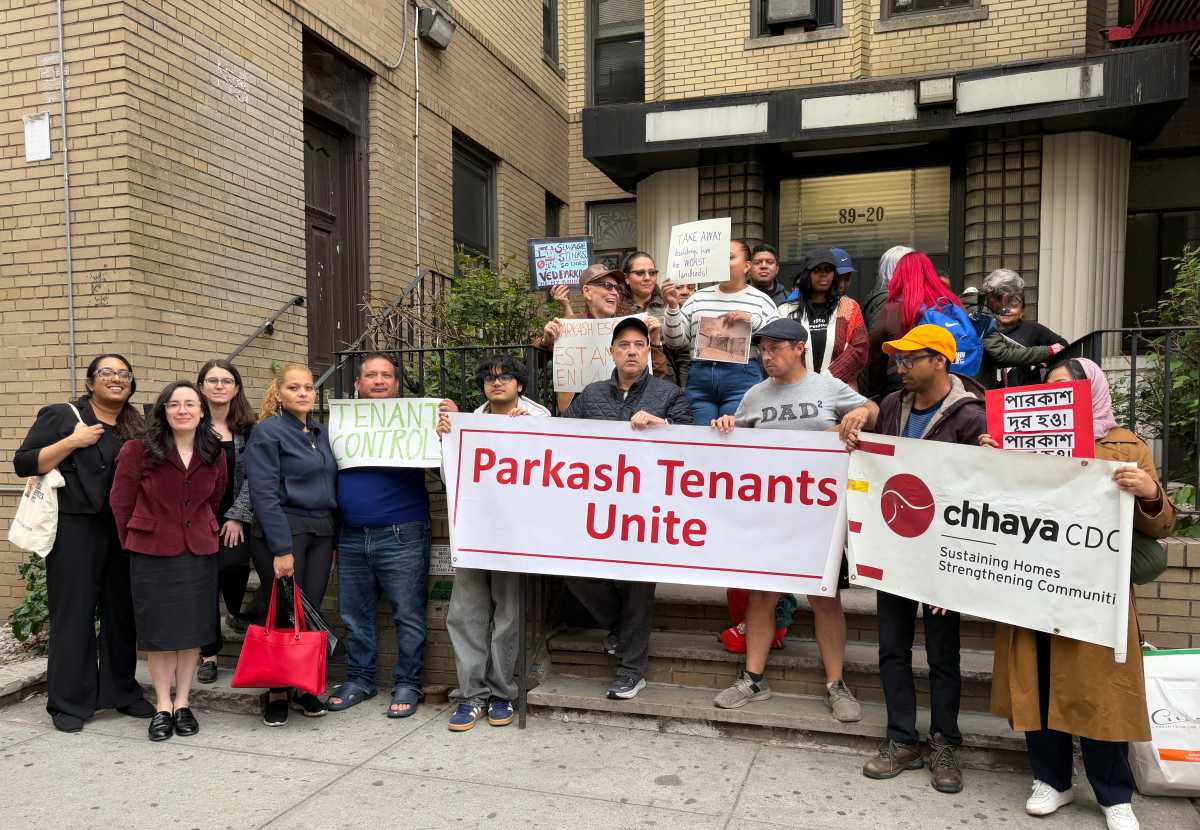 Parkash tenants of 89-20 161st St. in Jamaica rallied on May 14 to demand ownership of the building be stripped from negligent landlord Ved Parkash and be given to a city-approved buyer after decades of suffering inhumane and dangerous living conditions.Photo by Renee DeLorenzo
Kasey McNaughton, the director of organizing for the Youth Alliance for Housing, and a renter in Astoria for nearly six years, said she was “not shocked” by the lawsuit, noting that real estate lobbyists have utilized lawsuits as a public relations tactic for years.
However, she emphasized that despite landlords’ accusations that the appointees were politically motivated, they are all required to abide by the same rules and consider the same data — all of which point to the same thing. “Tenants are in crisis and real estate profits are continuing to rise,” she said.
The more rent rises, she continued, the more pressure there is on tenants to make “impossible” decisions at the end of each month, choosing between paying for rent, groceries or medications.
“It causes mental health crises and physical crises in the body,” she said. “People work themselves to death in this city, all to make rent at the beginning of the month. It’s like sitting between a rock and a hard place every single month, being told to pick up another job and work harder, all to siphon money from your employer into the hands of your landlord.”
According to data from the 2024 American Community Survey, 51.6% of NYC renter households pay 30% or more of their income toward rent, including 28.8% that pay 50% or more.
“Every time rent increases, more tenants are evicted,” McNaughton said. “It causes a more violent system to erupt, which doesn’t help anyone in New York.”
Many evicted tenants end up “couch-surfing” to retain shelter, although there’s constant uncertainty where their next move will take them. Others end up sleeping in their cars. Some end up in shelters, although many of them are already at capacity and cannot sustain a long-term population increase.
Coalition for the Homeless reported that more than 350,000 people were without homes in NYC in June 2026. Over 154,000 NYC school children experienced homelessness in the 2024-25 school year — that’s one in eight of them.
Queens tenants are on the brink of crisis
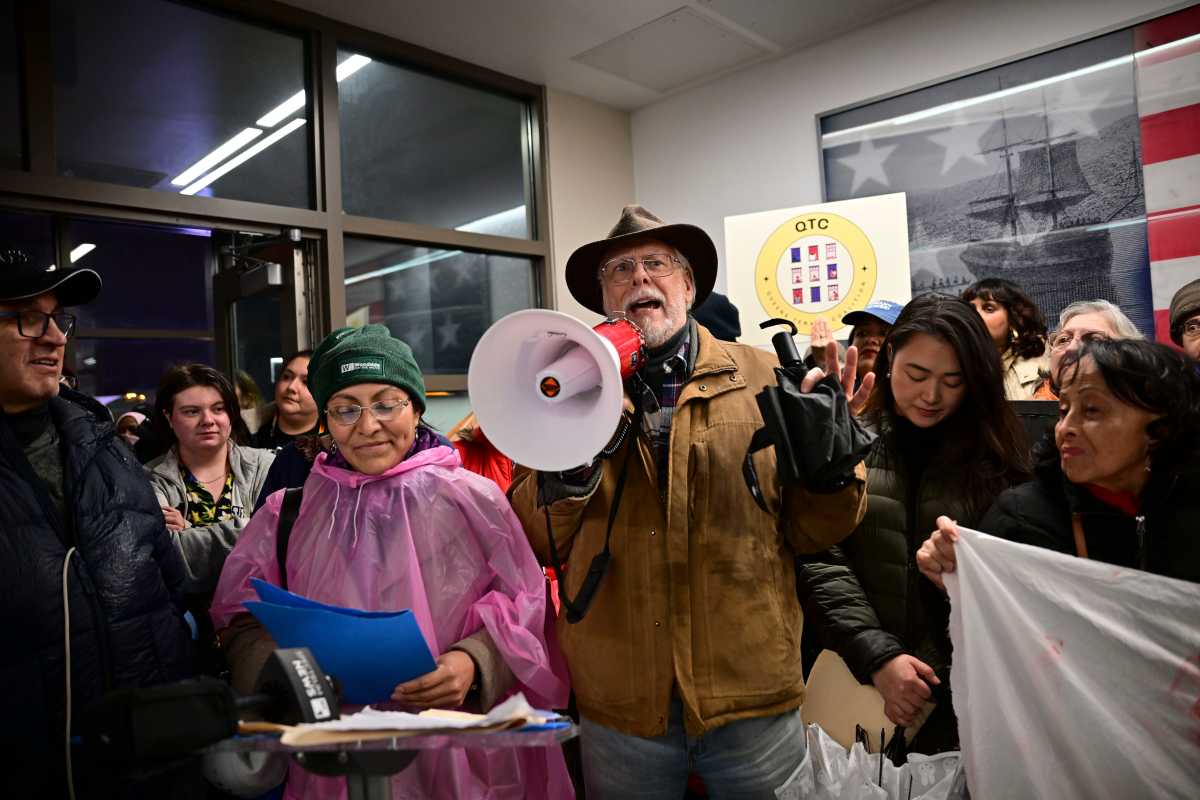 Protesters gathered in the lobby of the Academy of American Studies in Long Island City for the Queens Rental Ripoff hearing on March 5 before security forced them outside.Photo by Lloyd Mitchell
Doug Ostling, a rent-stabilized tenant at a building owned by Zara Realty in Flushing, said as a senior living on a fixed income, affordability has become his primary concern. He has lived in the building for over 50 years, he explained, and has watched his rent climb from around $400 per month to nearly $1,400 per month. With the addition of a recent Major Capital Improvement (MCI) rental hike for building-wide upgrades, he said it will soon be closer to $1,700.
“I’ve lived here all my life, but it’s getting to a point where it’s impossible to continue living here,” he said. “I don’t know how long I can hold on.”
He explained that factors such as inflation have driven up costs for basic necessities, such as groceries. And, he continued, as he gets older and more frequently needs to see doctors, medical and pharmaceutical costs place even more pressure on his fixed budget.
Regardless of Ostling’s financial situation at his current building — more than 40% of his income goes toward rent — he said there was no way he could find a “remotely comparable” price for another apartment.
“There’s no real backup plan,” Ostling stressed. “I’m close to being priced out.”
Zara Realty has recently been under fire for charging illegal fees, with Ostling even claiming that the landlord has charged $400 for a key to the building the tenants already pay rent at.
Attorney General Letitia James and RuthAnne Visnauskas, commissioner of New York State Homes and Community Renewal (HCR), even filed a lawsuit against Zara Realty for “repeatedly violating rent stabilization laws and overcharging rent-stabilized tenants” in Jamaica and Elmhurst.
The intercom system doesn’t work, Ostling also claimed, meaning deliveries from Uber or DoorDash can’t make it into the building and forces tenants, including seniors and disabled renters, to find a way down the 6-story building to collect their deliveries in the lobby.
Ostling’s son, who died four years ago of multiple sclerosis, could not enter the building due to a lack of wheelchair accessibility. Ostling stated that multiple times, he requested access to a separate entrance on the side of the building that had a ramp used by maintenance workers, but the landlords never approved it.
“That is the kind of mentality tenants are dealing with in New York,” he said. “They’re just so callous and, frankly, they don’t care. They just care about profit.”
As of press time, Zara Realty did not respond to QNS’s request for comment.
Fear among the next generation of renters
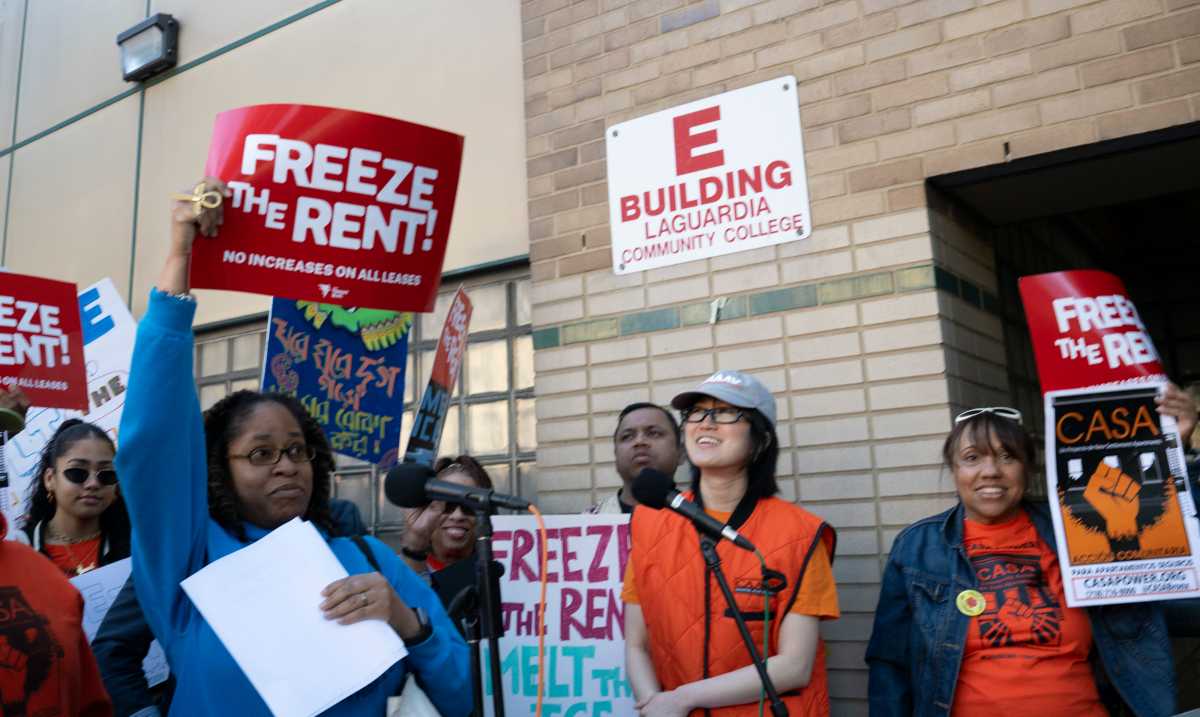 Residents protested to freeze the rent outside LaGuardia Community College.Photo by Lloyd Mitchell
Wena Teng, a lifelong tenant in Flushing who recently moved to Chinatown for the duration of her graduate studies, said the landlords’ lawsuit was surprising to her.
“The Rent Guidelines Board is responding to years of organizing,” she said. “This organizing itself is a response to the fact that landlords are extracting money from their tenants and are not facing a financial crisis, as they believe they are.”
She said the lawsuit communicates to New Yorkers that there’s something “wrong” about the rent freeze, despite the reality that landlords are not suffering the way tenants are.
“Tenants aren’t even necessarily against landlords,” she explained. “We’re against a housing crisis and historical patterns against renters.”
Teng stressed how important the rent freeze is.
As a recent grad now continuing her studies, and struggling to find her way through the housing market, Teng said she worries about her future. “I don’t think this affordability crisis we have in this economy is something I want to inherit,” she said.
She now organizes with Youth Alliance for Housing, which helped advocate for the rent freeze.
“I was really happy to see that happen because a lot of the data was pointing to the fact that we needed it,” she said. “Rent stabilized tenants really struggle to make ends meet. Being able to see that go into effect after years of organizing is really meaningful.”
She also pointed to stigmas that suggest low-income and rent-stabilized New Yorkers are simply not working hard enough, emphasizing that this is not the case and instead blaming it on factors outside of their control. “The cost of living in New York is just too high,” she said.
Tenants say the rent freeze doesn’t go far enough
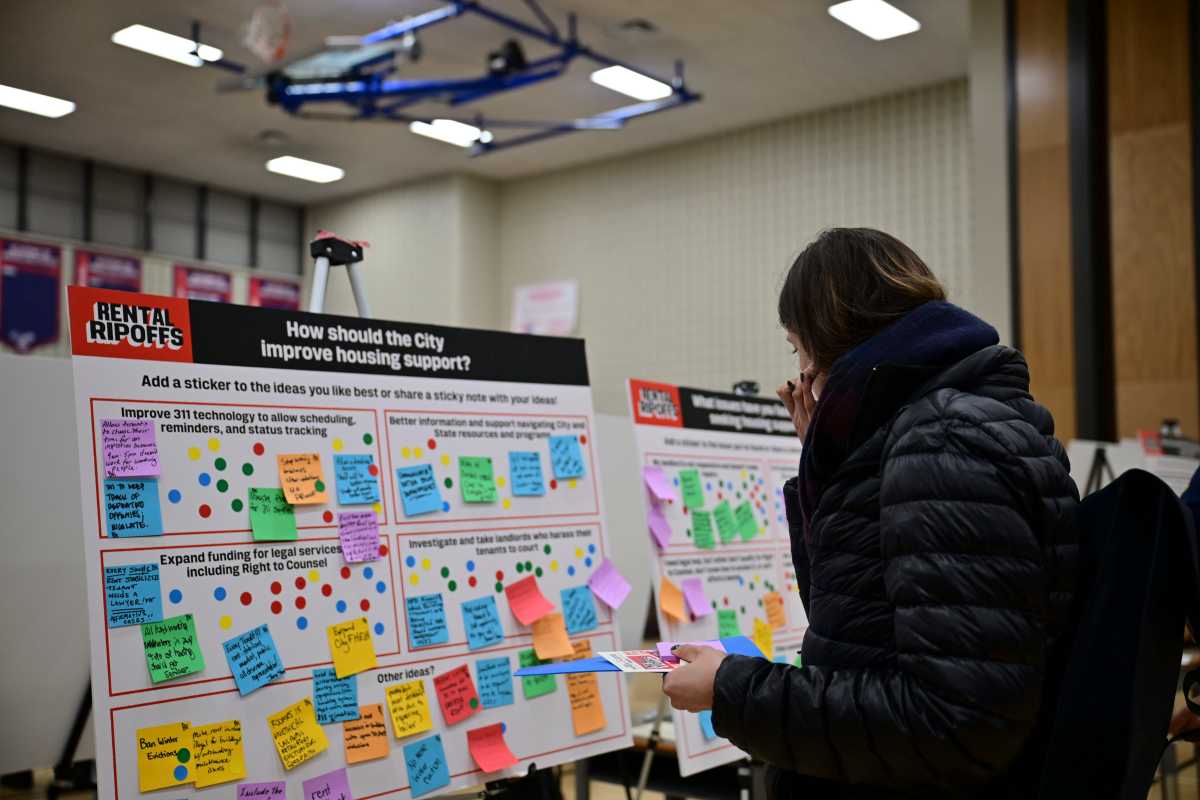 Attendees of the March 5 Queens Rental Ripoff hearing had an opportunity to share thoughts, ideas, concerns and suggestions on large boards set up throughout the gymnasium.Photo by Lloyd Mitchell
While the rent freeze is a great first step toward achieving justice for renters, tenants said it’s not enough and argued a rent rollback was in order.
“It doesn’t address the main problem that the rent is already too high as it is,” Ostling said. “What we really need is a rent rollback.”
Tenant organizers in Queens said they believed the real crux of the problem is that large, powerful landlords keep buying up all the properties in the city, charging exorbitant rates, regularly evicting tenants and then selling the properties for a high profit.
They alleged this “divide and conquer” strategy is practiced by many large landlords, who comprise most of the landlords in NYC. They demanded the practice be stopped and addressed through systemic change.
When housing is treated as a commodity, organizers argued, it dehumanizes tenants who rely on rent-stabilization to survive.
“We are focusing on transforming our housing system to one that is more equitable and focuses on the decommodification of housing,” McNaughton said of the work at Youth Alliance for Housing. “Rather, we push toward a future where housing can be a public good.”
Teng also said the rent freeze is the “bare minimum.” She said it’s essential tenants organize and nonprofits be allowed to take advantage of the Community Opportunity to Purchase Act (COPA), which protects the right of first offer or refusal to buy multi-family residential buildings when put up for sale.
“It takes an organized body of tenants, allies and the youth to be able to make New York City a city that is affordable again,” she said. “I’m just trying to find my new home and role in the city.”
“We need some relief,” Ostling added. “Frankly, we’re losing a lot of good, lifelong New Yorkers. I love the city, and I would hate to have to move somewhere else because I couldn’t afford it anymore… Tenants need to unite.”