
Rail: Yet your work never feels despairing. Even when it addresses histories of violence or ecological fragility, there remains an extraordinary sense of vitality. The landscapes are dense, alive, and almost excessive in their abundance. Is that optimism or simply observation?
Zerbini: I think it’s observation. Nature is not static. It’s constantly transforming itself. Even in difficult conditions, life continues to invent new forms. What interests me is precisely that complexity. When you enter a forest, you realize that nothing exists in isolation. Every plant, every insect, every organism is connected to countless others. It’s an incredibly sophisticated system. Perhaps that’s why I keep returning to nature. It constantly reminds me that the world is larger, more complex and more mysterious than our explanations of it. Painting becomes a way of staying close to that mystery.
Rail: The word observation keeps returning throughout our conversation. You’ve used it to describe history, storytelling, painting and now ecology. It almost sounds less like a method than a philosophy.
Zerbini: Maybe it is. I don’t begin with answers, I begin by looking. Whether I’m painting a historical event, a landscape, a plant, or an abstract form, I’m trying to understand something. Observation is a way of paying attention. And when you pay attention, you begin to notice relationships that weren’t visible before. That’s true in history. It’s true in nature. It’s true in painting. For me, all these things are connected.
Rail: Which perhaps brings us naturally to the monotypes. They seem to represent a shift from observing nature to actively collaborating with it.
Zerbini: Precisely.
Rail: I’ve heard that your studio is surrounded by dense vegetation and that the monotypes emerged through direct engagement with plants, often in consultation with botanists and other specialists. Could you tell me how that process began?
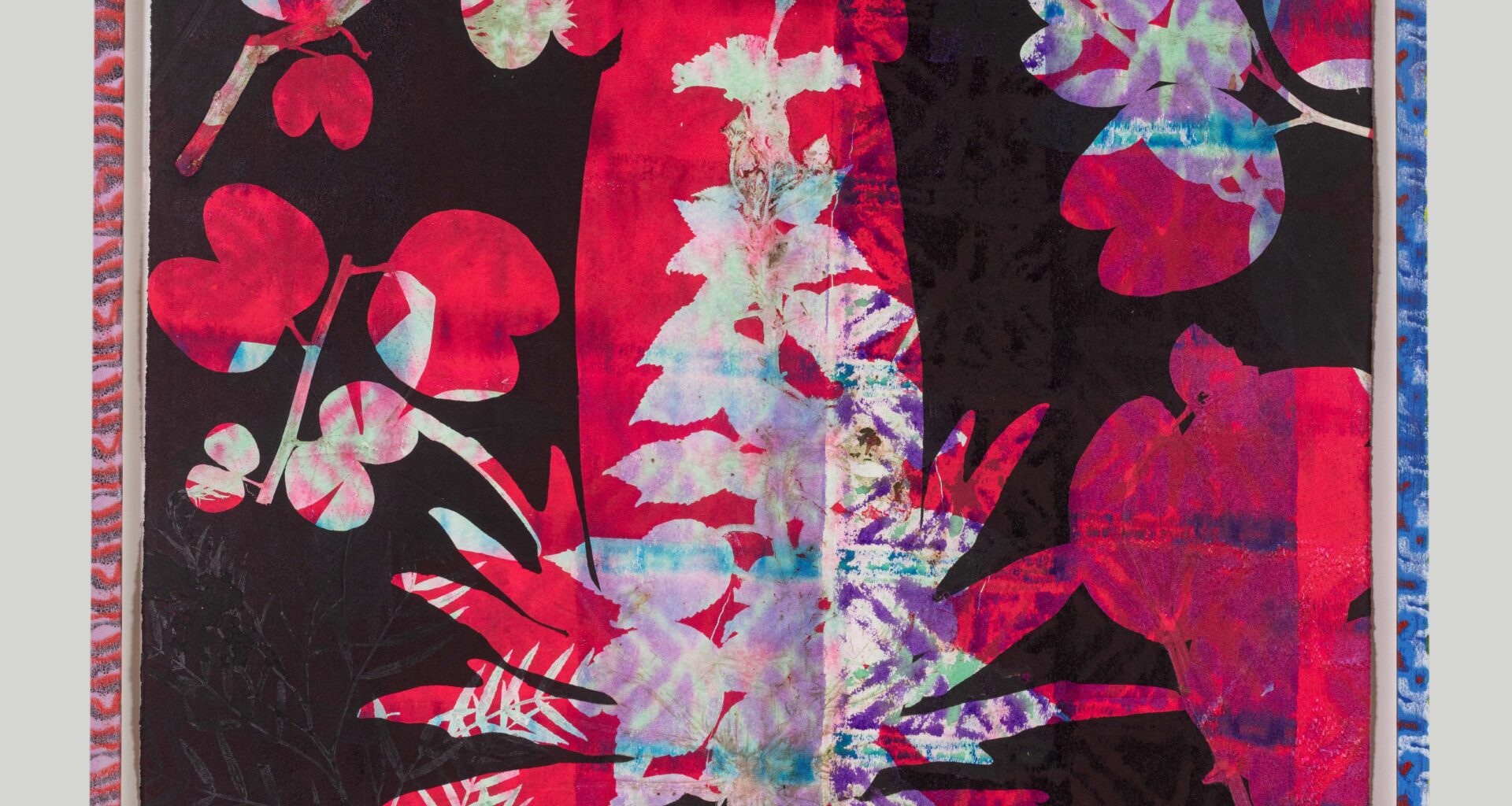
Zerbini: The breakthrough came when I realized that a plant could function as a matrix. What intrigued me was that a leaf could reveal things that a photograph never could. Through the printing process you begin to see every vein, every structure, every detail. You start to understand the plant almost at a molecular level. There’s also something deeply physical about it. When you press the plant, you don’t just see its image—you smell it, you feel its presence. The work engages multiple senses at once. That changed everything for me. I stopped feeling like someone who simply represented nature. Instead, I felt as though I was collaborating with it. When I cut a leaf and use it in a print, I don’t feel like the sole author of the work, I was more like a director facilitating a process. The plant itself becomes an active participant. That shift transformed my understanding of what art-making could be.
Rail: That’s a remarkable distinction, the idea of working with nature rather than depicting it.
Zerbini: Yes, exactly. The monotypes made me realize that nature is not simply a subject. It’s a collaborator. And collaboration means relinquishing a certain amount of control. The plant always responds in its own way. It leaves traces I couldn’t have predicted. There is always an element of surprise and that’s what keeps the process alive.
Rail: And how do you choose the plants themselves?
Zerbini: Initially, I was naturally attracted to the spectacular ones—the unusual plants that immediately catch your attention in the forest. You see them and think, “how extraordinary.” But over time, I learned that there are no ordinary plants. The small, overlooked species can be just as remarkable. Every plant possesses its own beauty, its own complexity, its own strange and unexpected forms. For me, the process has been one of continuous learning. Every day I discover something new. I learn from the shapes, the structures, the patterns. I also learned how little I knew. Some plants are poisonous. Some are dangerous to handle. Others have properties I would never have suspected. Because of that, I’ve relied heavily on people whose knowledge is deeper than mine. I’ve worked closely with botanists, scientists and specialists who have helped me understand the material I am working with. The project became a way of entering into conversations with people from very different fields.
Rail: Which seems to echo something we’ve already discussed: the importance of crossing disciplinary boundaries.
Zerbini: Absolutely. One important moment was my participation in Nous les Arbres at the Fondation Cartier. The exhibition brought together artists, scientists, philosophers, and writers, all thinking about trees and plant life from different perspectives. That experience was transformative. I met people whose work had nothing to do with art in the traditional sense, yet we shared the same fascination with the natural world. What interested me most was discovering how differently people approached the same subject. A botanist, a philosopher, an Indigenous thinker, and an artist may all be looking at the same tree, yet each sees something different. That multiplicity of perspectives is incredibly enriching.
Rail: I recently spent time with the Cartier publication, it’s a beautiful book. I was impressed how different the works are. Some images felt almost Japanese in their sensitivity to color and composition; others seemed more radical and abstract. At times they resembled botanical studies, and at others they became something closer to symbols or invented forms. They seem to open onto many different histories simultaneously. Do you still see the monotypes as an ongoing project?
Zerbini: Absolutely. The work continues to evolve. The Cartier publication documents a particular period of research, but we’ve continued working ever since. In many ways, the monotypes are now completely different from what they were at the beginning. We’ve learned much more about color, for example. If you look at the later works in the book, you can already see color beginning to enter the process. Since then, it has become increasingly important. The project has developed in directions I couldn’t have anticipated. In fact, I’ve been thinking that perhaps it deserves a second volume because so much has changed. Recently I’ve also begun exploring ways of integrating the monotypes into painting. For a long time, I wanted to paint directly onto the prints, and now we’re mounting the papers onto canvas and working over them. That has opened up an entirely new direction.
Rail: It sounds as though the monotypes have become less a discrete series than an entire field of experimentation.
Zerbini: That’s true. At the beginning, I thought of them as a specific project. But over time, they became something much larger. They started influencing the paintings, and the paintings started influencing them in return. Now the boundaries are becoming increasingly fluid.
One of the things I love most about the process is that I never know exactly what will happen. Every print is a proposition. Every print is a conversation. When I lift the paper from the press, I’m often surprised by the result. I don’t know exactly how the plant will respond, how the colors will interact, or what kinds of forms will emerge. That uncertainty is essential. I’m always in dialogue—with the work, with the plants, with João Sanchez, my collaborator in this project, and with the many people whose knowledge has informed the process and what keeps the work alive.
Rail: And perhaps that’s why the monotypes feel so closely connected to the rest of your practice. They may use different materials, but they seem driven by the same curiosity, the same attention to observation.
Zerbini: I think that’s right. In the end, all of these works come from the same place.
Rail: Before we finish, I’d like to return to something we’ve touched on several times throughout our conversation. Some people seem to treat the botanical works as a separate strand of your practice—as though the monotypes, the historical paintings, and the large-scale canvases belong to different worlds. But when I look at them, I see strong continuities: questions of classification, observation, colonial histories, scientific knowledge, and different ways of understanding nature. Do you see these as distinct bodies of work, or are they all part of the same larger project?
Zerbini: I understand why people make those distinctions. We classify things in order to understand them. Museums classify things. Historians classify things. Scientists classify things. It’s a natural impulse. We want categories because they help us navigate complexity. But for me, all of this work belongs to the same body of work. The techniques may be different. The materials may be different. The subjects may be different. But they all emerge from the same way of responding to the world. I think of them as parts of a single vocabulary. One work might be a letter, another a word, another a sentence. Together they form a larger language. When people separate the historical paintings from the monotypes, or the geometric works from the landscapes, I understand why they do it. But from my perspective, these distinctions are less important than the relationships between them.The same questions continue to appear in different forms. Observation. Transformation. Nature. History. Systems of knowledge. Ways of seeing. They simply find different visual expressions.
Rail: That’s interesting because it suggests that the medium is almost secondary, what matters is the underlying inquiry.
Zerbini: Exactly. Earlier in my career, when preparing an exhibition, I felt that everything had to revolve around a single concept. I thought a show needed one clear message capable of containing all the works within it. There was a desire for coherence, for a structure that could explain everything. But over time that way of thinking began to dissolve. Perhaps it’s because of the world we live in now. Technology has changed the way we receive information. Different realities coexist. Images circulate constantly. Everything seems connected to everything else. I no longer feel the need to force the work into a single framework. Today I see things as much more open. Different ideas, images, and techniques coexist. They intersect and overlap. And I like that. They’re all different ways of asking questions.
Rail: It sounds as though certainty has become less important than openness.
Zerbini: Yes. The truth is that I often don’t know exactly what I’m doing. People sometimes imagine artists working towards a clearly defined destination, but that isn’t my experience. Sometimes I look at a finished work and think, “Did I really make that?” Of course, I’m responsible for the decisions, but I don’t always understand how certain things happen. I don’t fully understand why one image appears and another doesn’t. The process remains mysterious. If I already knew exactly what the work was going to be, there would be no reason to make it.
Rail: Which brings us back to experimentation.
Zerbini: Exactly.
Rail: Throughout our conversation you’ve spoken about history, plants, Indigenous knowledge, abstraction, storytelling, and observation. Listening to you, it feels less as though these are separate interests than different facets of a single investigation.
Zerbini: I think that’s true. Everything is connected. The historical paintings are connected to the landscapes. The landscapes are connected to the monotypes. The monotypes are connected to scientific observation. Scientific observation is connected to storytelling. Maybe that’s what a vocabulary really is: not a collection of answers, but a collection of possibilities. That’s what interests me. The work changes, the materials change, the subjects change—but the questions remain.